
Under the GDPR, genetic data is special-category personal data, and processing it is generally prohibited unless a specific lawful basis and appropriate safeguards apply. That single sentence drives most of what your compliance team needs to build. Genetic data qualifies under Article 4(13) and Recital 34, triggers the heightened protections of Article 9, and requires the additional research safeguards described in Article 89(1) whenever it feeds scientific research. Add Article 35's DPIA requirement and the European Data Protection Board's guidance on anonymization, and you have the full legal skeleton this article unpacks.
Here's what governs genetic-data processing across the regulation:
- Article 4(13) / Recital 34: defines genetic data and confirms it falls within GDPR's material scope
- Article 9: classifies it as special-category data with a general prohibition and narrow exemptions
- Article 89(1): mandates appropriate safeguards when genetic data supports scientific research
- Article 35: requires a Data Protection Impact Assessment for most genetic-data workflows
- EDPB guidance: treats anonymization of genetic data as unresolved, pushing controllers toward a personal-data-by-default posture
Key Takeaways
GDPR treats genetic data as special-category personal data by default, requiring both an Article 6 lawful basis and an Article 9 condition, plus Article 89 safeguards for research use.
| Point | Details |
|---|---|
| Two-basis requirement | Genetic-data processing needs an Article 6 lawful basis and an Article 9 exemption simultaneously. |
| Anonymization is unresolved | The EDPB advises treating genomic data as personal data even after de-identification attempts. |
| DPIA is near-mandatory | Article 35 assessments should document residual risk explicitly, not declare processing risk-free. |
| Member State law varies | Article 9(4) lets countries add conditions, so check national implementing law before relying on research derogations. |
| Sharing is processing | Moving genetic data between organizations requires Article 26 or 28 contractual agreements, not informal transfer. |
Table of Contents
- What Counts as Genetic Data Under GDPR
- Which Legal Basis Allows You to Process Genetic Data?
- Article 89 Safeguards: What Biobanks Actually Need
- When Do You Need a DPIA, and Who Signs Off?
- Why Anonymizing Genetic Data Is Harder Than It Sounds
- How Member State Law Changes Your Compliance Approach
- How SignalPGx Operationalizes GDPR Controls in Practice
- The Compliance Gap Nobody Wants to Admit
- Sources
- FAQ
What Counts as Genetic Data Under GDPR
Recital 34 defines genetic data as personal data relating to the inherited or acquired genetic characteristics of a natural person, derived from analyzing a biological sample such as a chromosomal, DNA, or RNA analysis, or from analyzing another element that reveals equivalent information. Article 4(13) formalizes that language into the statutory definition compliance teams actually cite. Practically, this covers raw sequencing output, variant calls, and any inferred trait or disease-risk score derived from that sequence data.
The boundary cases are where labs get tripped up. An aggregated cohort dataset can still count as genetic data if individuals remain identifiable through linkage. A pharmacogenomic variant call sits at the intersection of genetic data and health data, and GDPR treats both as special categories anyway, so the overlap rarely changes your obligations. Genetic markers used for identity verification can also qualify as biometric data simultaneously.
- Label every dataset and pipeline stage that touches genetic-origin data
- Map data flows from sample intake through report delivery so no downstream export gets missed
- Treat inferred characteristics (drug metabolism status, disease susceptibility) as genetic data, not merely "health data"
Which Legal Basis Allows You to Process Genetic Data?
You need two separate legal footholds before processing genetic data, not one. Article 6 supplies the general lawful basis (consent, contract, legal obligation, legitimate interest, and so on), and Article 9 separately requires a condition that lifts the special-category prohibition. Satisfying only one leaves the processing unlawful.
- Explicit consent (Article 9(2)(a)): The bar is higher than ordinary Article 6 consent. It must be unambiguous, specific to genetic processing, and withdrawable without penalty. Broad "future research" consent rarely survives scrutiny on its own.
- Scientific research (Article 9(2)(j) with Article 89): This derogation permits processing without individual consent in defined research contexts, but only when Article 89 safeguards are documented and Member State law hasn't restricted the exemption.
- Other Article 9(2) grounds: Occupational health, public health, or vital-interest conditions apply in narrower clinical scenarios, typically outside standard research pipelines.
Article 9(4) lets individual Member States impose further conditions or limits on genetic-data processing, meaning a research derogation valid in one country may need extra safeguards, or may not apply at all, in another.
Article 89 Safeguards: What Biobanks Actually Need
Article 89(1) requires "appropriate safeguards" for research processing, but the text deliberately avoids a checklist. The Frontiers analysis of Article 89 reads the provision as requiring data minimization and organizational and technical security measures, calibrated to the actual reidentification risk of the dataset.
In practice, defensible safeguard packages tend to include:
- Data minimization at collection, not just at storage
- Pseudonymization with key separation between clinical identity and genomic record
- Independent ethics or governance review before new research uses
- Documented risk assessments updated as datasets grow or link to new sources
- Access logging and role-based restriction on raw sequence data
The PHG Foundation's report recommends sector-specific codes of conduct and certification schemes as the clearest path to consistency, since Article 89 leaves so much to interpretation across biobanks, registries, and research consortia.
Pro Tip: Build your safeguard package before you draft the consent form. Reviewers and auditors want to see that technical controls existed at the point of collection, not that they were bolted on after a data-sharing request arrived.
When Do You Need a DPIA, and Who Signs Off?
Article 35 makes a Data Protection Impact Assessment near-mandatory for genetic-data processing, since it sits squarely in the "special category, large scale, or systematic" trigger zone. The PHG Foundation frames Article 5(2) accountability as requiring more than good intentions; you need a documented trail showing risks were identified and mitigated, not just theoretically manageable.
- Run the DPIA before processing begins, covering the nature of the genetic data, purpose, necessity, and proportionality.
- Document residual risk explicitly rather than declaring the processing "safe." Reviewers expect an honest gap analysis.
- Treat every data-sharing arrangement as processing. Sending genotype data to a collaborating lab, a cloud vendor, or a pharma partner triggers Articles 26 (joint controllership) or 28 (processor agreements).
- Formalize contracts before data moves. A Bbmri notes that genetic and health data sharing routinely requires controller-processor or joint-controller agreements specifying retention, re-use limits, and audit rights.
Why Anonymizing Genetic Data Is Harder Than It Sounds
The EDPB's own guidance states plainly that anonymization of genetic data remains an unresolved question, and it advises controllers to default to treating genomic datasets as personal data even after de-identification efforts. That single position reshapes how labs should think about "anonymized" research cohorts.
Pseudonymization removes direct identifiers but keeps a re-identification path through a key. Anonymization is supposed to remove that path permanently. Genetic sequences resist true anonymization because the sequence itself, combined with public genealogy databases or relative matching, can re-identify a person years later. A review of genetic data sensitivity argues this creates intergenerational privacy risk that GDPR's general framework wasn't built to fully address.
- Assume pseudonymized genomic data still falls under full GDPR obligations
- Document known reidentification vectors (family databases, small-cohort rarity) as residual risk, not eliminated risk
- Reassess anonymization claims periodically as public reference datasets grow
How Member State Law Changes Your Compliance Approach
Article 9(4) gives each Member State room to add conditions or restrictions on genetic-data processing beyond the GDPR floor. That means a research derogation that works in one jurisdiction can require extra consent layers, ethics board approval, or outright prohibition in another, and the EDPB has confirmed this discretion is real, not theoretical.
- Check national implementing law before relying on any Article 9(2)(j) research exemption
- Document jurisdiction-specific restrictions alongside your DPIA, not as a separate afterthought
- For cross-border transfers, confirm an adequacy decision or Standard Contractual Clauses cover the destination country
- Apply extra scrutiny to transfers involving genetic data, since its special-category status raises the practical stakes of any transfer failure
How SignalPGx Operationalizes GDPR Controls in Practice
Legal text only matters once it becomes lab workflow. SignalPGx's white-label pharmacogenomic reporting platform maps directly onto several Article 89 and Article 35 obligations without requiring labs to build controls from scratch.
- Versioned audit trails: every report revision, including living reanalysis triggered by updated CPIC guidelines, is logged, supporting the documented accountability Article 5(2) demands
- Role-based access and medical-director review: limits raw genotype and medication data exposure to authorized reviewers, supporting data minimization
- HL7/FHIR integration with EHRs: keeps genetic-derived recommendations inside governed clinical systems rather than in ungoverned exports
- Deployment in 5 to 7 days: lets labs stand up compliant infrastructure fast rather than improvising interim workarounds
A practical rollout checklist: confirm your DPIA covers the reporting pipeline, assign a named governance owner (often the DPO), verify contractual terms with any processor, and review SignalPGx's security and compliance documentation against your own risk register.
Pro Tip: Ask any reporting vendor exactly how reanalysis events are logged. If a recommendation changes because a guideline updated, your audit trail needs to show why, when, and under whose review, not just the new output.
The Compliance Gap Nobody Wants to Admit
Most GDPR guides treat genetic data like a slightly stricter version of ordinary health data, and that framing undersells the actual problem. The honest reading of the EDPB's position is that nobody has solved genetic anonymization yet, and pretending otherwise in a compliance memo is worse than admitting the gap. Labs that document residual reidentification risk honestly are in a stronger legal position than labs that claim a dataset is "fully anonymized" and hope nobody checks.

The conventional advice, get consent, run a DPIA, sign a data processing agreement, isn't wrong, but it treats compliance as a paperwork exercise rather than an operational one. The Article 89 safeguards that actually hold up under scrutiny are the ones built into the reporting infrastructure itself: access logs that exist because the platform enforces them, not because someone remembered to write a policy. That is the real argument for platforms with audit trails and versioned reanalysis baked in, not bolted on.
If you prioritize one thing first, make it the DPIA. Everything else, consent language, contractual clauses, safeguard documentation, becomes easier to defend once the risk analysis is honest.
This article is general information, not a substitute for advice from a qualified doctor. Consult a qualified healthcare professional about your own circumstances before acting on anything here.
Sources
- Recital 34 - Genetic Data - General Data Protection Regulation (GDPR)
- Appropriate Safeguards and Article 89 of the GDPR: Considerations for Biobank, Databank and Genetic Research (Frontiers)
- The GDPR and genomic data (PHG Foundation)
- EDPB response on consistent application of the GDPR, focusing on health research (EDPB)
FAQ
What does "GDPR data" mean?
GDPR data refers to any information relating to an identified or identifiable natural person, including names, IP addresses, health records, and genetic data, all classified as personal data under the regulation.
What data is not covered by GDPR?
GDPR does not cover fully anonymized data with no realistic path to reidentification, data processed purely for personal or household activities, or data processed by deceased persons' estates in most Member States.
Is genetic data considered sensitive personal information?
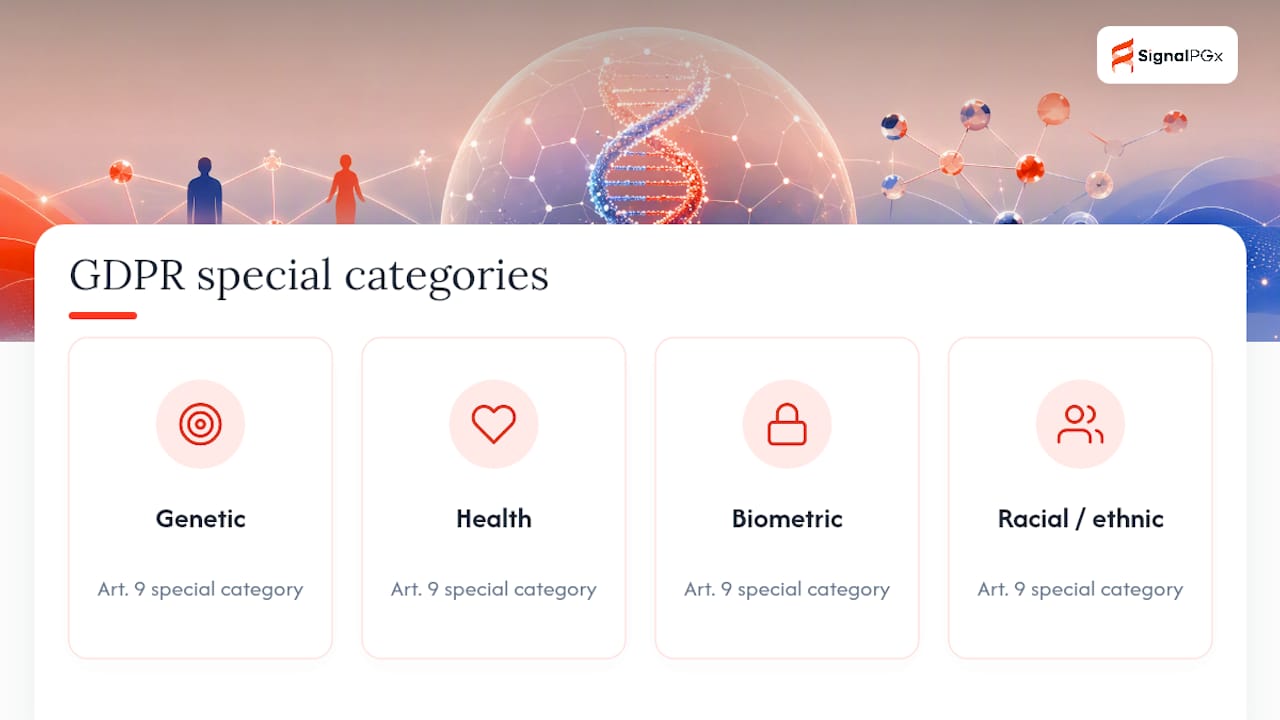
Yes. Article 9(1) classifies genetic data as a special category of personal data, alongside health, biometric, and racial or ethnic origin data, subjecting it to a general processing prohibition unless a specific exemption applies.
What are the 7 GDPR requirements?
The core principles under Article 5 are lawfulness, fairness, and transparency; purpose limitation; data minimization; accuracy; storage limitation; integrity and confidentiality; and accountability, which together govern how genetic data and all other personal data must be processed.