
A drug–gene interaction (DGI) occurs when a patient's genetic variants alter how a drug is absorbed, metabolized, distributed, or acts at its target, producing clinically meaningful changes in efficacy or toxicity that require a prescribing response. For clinicians and lab teams, the immediate implication is straightforward: genotype data, when available, should inform dose selection, drug choice, or monitoring intensity before a preventable adverse event occurs.
When a DGI is flagged, three actions apply immediately:
- Check whether a validated genotype call exists in the patient's record and confirm the phenotype assignment (e.g., poor metabolizer, ultrarapid metabolizer).
- Apply the highest-evidence guideline recommendation available, prioritizing CPIC guidelines, FDA pharmacogenomic biomarker labeling, and PharmGKB annotations.
- Decide on a clinical action: dose adjustment, alternative drug, enhanced monitoring, or no change if evidence does not support intervention.
The primary authoritative references to consult are CPIC, the FDA's Table of Pharmacogenetic Associations, PharmGKB, DGIdb, and Vanderbilt's MyDrugGenome.
Table of Contents
- What are drug gene interactions, and how do they differ from pharmacogenomics?
- How genetic variants mechanistically alter drug response
- How common are clinically relevant DGIs, and what is their measurable impact?
- Drug–drug–gene interactions: why they're more complex than simple DDIs
- Where to find validated DGI evidence fast
- How to interpret DGI evidence and convert it into a prescribing action
- Practical testing and implementation steps for clinical labs
- Limitations and common misinterpretations to know before acting
- Where DGI research is heading and what gaps remain
- How a clinical PGx reporting platform operationalizes DGI knowledge
- Key Takeaways
- The case for starting with what you can actually act on
- Signalpgx supports your lab's PGx reporting from day one
- Useful sources and annotated references
What are drug gene interactions, and how do they differ from pharmacogenomics?
The terms pharmacogenetics, pharmacogenomics, and drug–gene interaction are often used interchangeably, but they describe distinct scopes. A drug–gene interaction is the specific relationship between a single drug and a single gene variant that produces a clinically measurable change in drug response. Pharmacogenetics traditionally refers to monogenic effects on drug response, studying how variants in one gene (e.g., CYP2D6) affect one drug class. Pharmacogenomics (PGx), as defined broadly, analyzes polygenic influences on drug response phenotypes, encompassing multiple genes, pathways, and their combined effects on a medication's behavior.
A drug–drug–gene interaction (DDGI) adds a second layer: a co-administered drug modifies the functional consequence of the genetic variant, often by inhibiting or inducing the enzyme the variant encodes. This distinction matters operationally because DDGIs are frequently missed when clinical teams screen only for drug–drug interactions (DDIs) without incorporating genotype data.
Pharmacokinetic vs. pharmacodynamic DGIs
The most clinically useful classification separates DGIs by mechanism:
| Feature | Pharmacokinetic (PK) | Pharmacodynamic (PD) |
|---|---|---|
| Mechanism | Altered metabolism, transport, or bioavailability | Altered drug target, receptor, or signaling pathway |
| Representative genes | CYP2D6, CYP2C19, CYP3A4, SLCO1B1, TPMT, DPYD, UGT1A1 | HLA-B, VKORC1, OPRM1, HTR2A |
| Typical clinical action | Dose adjustment or alternative drug | Alternative drug or enhanced monitoring |
| Example | CYP2D6 poor metabolizer + codeine → opioid toxicity risk | HLA-B*57:01 + abacavir → hypersensitivity reaction |
PK interactions are the most common category in current clinical databases and the most tractable for dose-adjustment algorithms. PD interactions, particularly HLA-associated immune reactions, often require complete drug avoidance rather than dose modification.

How genetic variants mechanistically alter drug response
Genetic variants change drug response through four primary mechanisms: altered enzyme activity, modified transporter function, changed drug-target structure, and immune-mediated reactions triggered by HLA alleles.
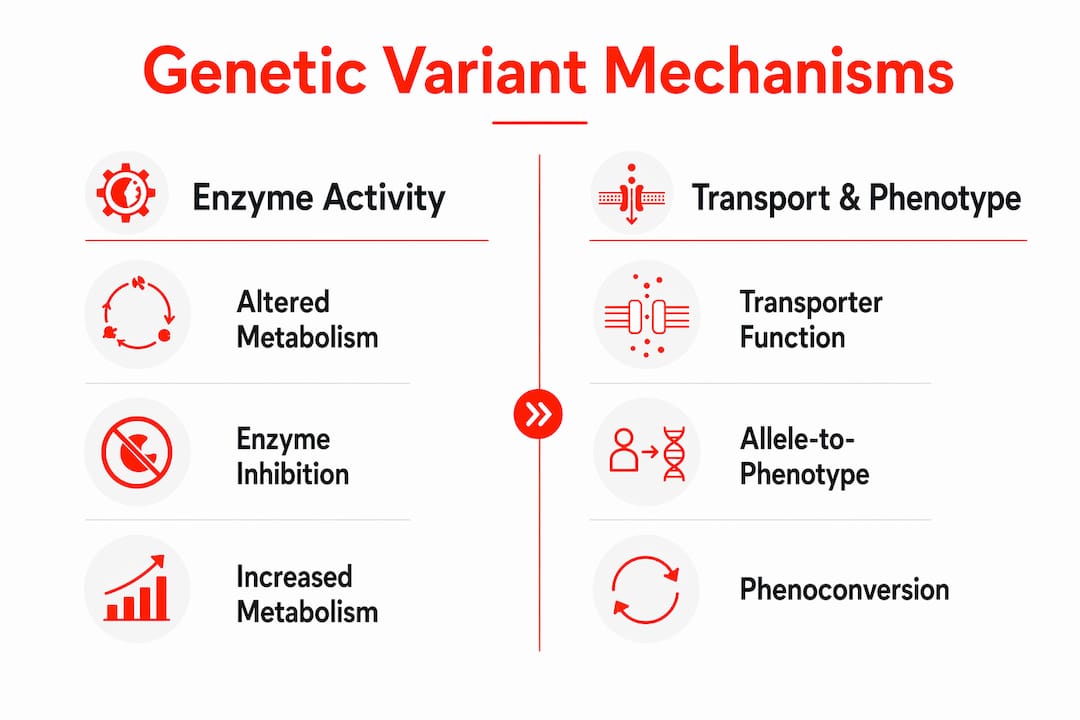
Enzyme activity is the most extensively characterized mechanism. CYP2D6 alone metabolizes roughly 25% of commonly prescribed drugs, including many antidepressants, antipsychotics, opioids, and beta-blockers. Variants that reduce or abolish CYP2D6 activity (loss-of-function alleles such as *4 and *5) produce a poor metabolizer phenotype, causing drug accumulation and toxicity. Conversely, gene duplication alleles (e.g., *1xN) create ultrarapid metabolizers who clear drugs so rapidly that standard doses produce subtherapeutic plasma levels. CYP2C19 follows a similar pattern and is particularly relevant for clopidogrel activation and proton pump inhibitor dosing.
Transporter variants affect drug entry into tissues. SLCO1B1 encodes the hepatic uptake transporter OATP1B1; the *5 variant (rs4149056) reduces statin uptake into hepatocytes, raising plasma statin concentrations and substantially increasing myopathy risk with simvastatin and other statins.
Allele-to-phenotype mapping follows a defined nomenclature. Diplotype combinations (e.g., CYP2D6 *4/*4) are translated into phenotype categories: poor metabolizer (PM), intermediate metabolizer (IM), normal metabolizer (NM), rapid metabolizer (RM), and ultrarapid metabolizer (UM). A common nomenclature pitfall is conflating "normal" with "wild-type" — some populations carry alleles that are common locally but produce reduced function by global standards.
Phenoconversion is the clinically underappreciated scenario in which a patient's functional phenotype differs from their genotype-predicted phenotype because a co-administered drug inhibits or induces the relevant enzyme. A CYP2D6 NM who is also taking fluoxetine, a potent CYP2D6 inhibitor, effectively functions as a PM for other CYP2D6 substrates. Detecting phenoconversion requires simultaneous review of the medication list alongside the genotype report.
How common are clinically relevant DGIs, and what is their measurable impact?
Over 98% of people carry at least one potentially clinically relevant pharmacogenomic variant, making routine consideration of PGx data a population-level clinical priority, not an edge case.
The clinical burden extends well beyond individual variant prevalence. A prevalence study found that incorporating DGIs and DDGIs into standard DDI screening substantially increased the total number of identified potentially clinically significant interactions compared with DDI screening alone. That figure reflects how much risk is invisible when PGx data is excluded from the medication review process.
Two drug classes illustrate the stakes most clearly. SLCO1B1 *5 carriers on high-dose simvastatin face an elevated risk of statin-induced myopathy, a preventable harm with a straightforward prescribing alternative. DPYD-deficient patients receiving fluoropyrimidines (5-fluorouracil, capecitabine) face life-threatening toxicity from standard doses; DPYD testing before initiation is now recommended by multiple guidelines. Both examples share a common feature: the harm is predictable, the test is available, and the guideline-recommended action is specific.
Hospital admission data from pharmacovigilance studies consistently show that adverse drug reactions account for a meaningful proportion of unplanned admissions, and a subset of those reactions are attributable to genetically predictable drug response differences. Integrating PGx into prescribing workflows addresses a real, measurable safety gap.
Drug–drug–gene interactions: why they're more complex than simple DDIs
DDGIs arise when two or more drugs interact with each other through a mechanism that is also genotype-dependent. They are categorized into three functional classes:
-
Inhibitory DDGIs: A co-administered drug inhibits an enzyme that metabolizes a substrate drug, and the clinical consequence is amplified or attenuated by the patient's baseline genotype. Example: a CYP2D6 NM patient taking paroxetine (a potent CYP2D6 inhibitor) alongside tramadol experiences phenoconversion to an effective PM, reducing tramadol's conversion to its active opioid metabolite and producing inadequate analgesia.
-
Induction DDGIs: A co-administered drug induces enzyme expression, accelerating substrate metabolism. Example: rifampin induction of CYP3A4 in a patient who is already a CYP3A4 rapid metabolizer can reduce immunosuppressant (tacrolimus) levels to subtherapeutic concentrations faster than in a normal metabolizer.
-
Phenoconversion interactions: Drug inhibition or induction shifts the patient's functional phenotype away from their genotype-predicted category. A 2020 review by Malki et al. systematically classified DDGIs and demonstrated that phenoconversion scenarios are among the most clinically consequential and least recognized interaction types in polypharmacy settings.
For clinical triage in polypharmacy, prioritize combinations where: (a) the substrate drug has a narrow therapeutic index, (b) the interacting drug is a known strong inhibitor or inducer, and (c) the patient's genotype places them at the extreme of the metabolizer spectrum. These three conditions together define the highest-risk DDGI scenarios and should trigger immediate prescribing review.
Where to find validated DGI evidence fast
Five resources cover the majority of clinical and research needs, each with a distinct role:
| Resource | Scope | Update cadence | Primary audience | Key limitation |
|---|---|---|---|---|
| CPIC | Gene/drug pairs with actionable guidelines | Continuous, versioned | Clinicians, pharmacists | Covers only well-evidenced pairs |
| PharmGKB | Variant annotations, pathways, evidence levels | Ongoing | Researchers, clinicians | Requires interpretation expertise |
| FDA PGx labeling | Regulatory biomarker notes in drug labels | Per label update | Clinicians, regulators | Variable actionability language |
| DGIdb | Drug–gene relationship aggregation | Periodic | Researchers | Research-oriented; not clinical guidelines |
| MyDrugGenome | Clinically oriented DGI summaries | Maintained | Clinicians | Narrower drug coverage |
CPIC is the first stop for actionable prescribing guidance. Its guidelines assign evidence levels and translate genotype-to-phenotype calls directly into prescribing recommendations, making them the most CDS-ready resource available. PharmGKB provides the underlying evidence annotations and pathway maps that CPIC guidelines draw from, and it is the right tool when you need to understand why a recommendation exists or evaluate evidence for a gene/drug pair not yet covered by CPIC. The FDA's Table of Pharmacogenetic Associations documents biomarker information embedded in approved drug labeling, organized by the strength of the prescribing action (required, recommended, or informative). DGIdb aggregates known drug–gene relationships for research querying and hypothesis generation, making it useful for exploratory analysis rather than direct clinical decision-making. MyDrugGenome, developed through Vanderbilt's PREDICT program, provides clinician-oriented summaries that connect genotype results to specific medication considerations.
Relying on a single source introduces risk. Evidence grading differs across databases, and a variant flagged as "actionable" in one resource may carry only a "moderate" evidence level in another. Cross-checking against CPIC and institutional pharmacy and therapeutics committee review remains the standard for defensible clinical decisions.
How to interpret DGI evidence and convert it into a prescribing action
The interpretation workflow has four sequential steps, each with a defined decision point.
Step 1: Verify the genotype and phenotype call. Confirm that the reported alleles are supported by the test's analytic coverage, that the diplotype-to-phenotype translation follows a recognized nomenclature (CPIC star-allele system), and that no phenoconversion scenario is present based on the current medication list.
Step 2: Consult the guideline hierarchy. Check CPIC first for a published guideline. If none exists, review PharmGKB evidence levels and FDA labeling language. PGx testing narrows the choice set rather than prescribing a single answer, so the goal is to identify which options are better supported by the patient's genotype, not to find the one "correct" drug.
Step 3: Assess clinical context. Genotype is one input. Renal and hepatic function, comorbidities, indication severity, and current co-medications all modify the final prescribing decision. A CPIC recommendation to "consider an alternative" carries different weight in a stable outpatient versus an acutely ill inpatient with limited drug options.
Step 4: Choose and document the action. Four options apply:
- Dose adjustment: supported when the guideline specifies a dose range by phenotype (e.g., CYP2C19 IM/PM and tricyclic antidepressants).
- Alternative drug: preferred when the interaction carries high harm potential and an equally effective alternative exists (e.g., avoid codeine in CYP2D6 UMs and PMs).
- Enhanced monitoring: appropriate when the evidence is moderate and the clinical risk is manageable with observation.
- No change: warranted when the evidence level is low or the interaction is unlikely to be clinically significant given the patient's full context.
Pro Tip: Prioritize alerts for high-evidence, high-harm DGIs only. Surfacing every low-evidence flag in the EHR creates alert fatigue that causes clinicians to dismiss even the critical ones. Multidisciplinary pharmacy and therapeutics review should vet which DGIs trigger automated alerts before go-live.
Practical testing and implementation steps for clinical labs
Integrating PGx into a clinical workflow requires decisions at every layer of the testing and reporting pipeline. A defensible implementation covers these steps:
- Select the test panel. Targeted panels covering high-evidence gene/drug pairs (CYP2D6, CYP2C19, CYP3A4/5, SLCO1B1, TPMT, DPYD, UGT1A1, HLA-B) are the practical starting point. Broader panels add coverage but require more extensive variant interpretation infrastructure.
- Confirm analytic validity. The testing laboratory must hold CAP accreditation and CLIA certification. Analytic validity documentation should specify which alleles are covered and the method's sensitivity for copy number variants (critical for CYP2D6 duplications).
- Define allele-to-phenotype translation rules. Establish which nomenclature system (CPIC star-allele) governs diplotype calls and document the rules for handling no-call variants and novel alleles.
- Select and version guideline sources. Specify which CPIC guideline version, FDA label revision, and PharmGKB evidence level thresholds govern each gene/drug pair in your reports. Version control is essential for audit trails.
- Configure EHR and CDS integration. FHIR and CDS Hooks are the current interoperability standards for embedding PGx recommendations into EHR workflows at the point of prescribing. Integration should surface only high-priority alerts to avoid fatigue.
- Establish medical-director review and audit trail. Every report should carry a physician-review attestation and a timestamped audit log of the evidence sources and versions used.
- Plan for living reanalysis. Automated reanalysis pipelines update prior reports when CPIC or FDA guidance changes, preventing one-time reports from becoming clinically obsolete.
Clinician-facing reports should include: the genotype call, the phenotype interpretation, a clinical actionability statement, the evidence grade, the guideline source and version, and suggested alternatives or dosing ranges where applicable.
Reimbursement and regulatory notes (U.S.): CAP/CLIA compliance is a prerequisite for clinical reporting. Reimbursement for PGx testing varies by payer and indication; Medicare coverage under MolDx applies to specific gene/drug pairs with documented clinical utility. Preauthorization requirements differ by plan, and documentation of clinical indication strengthens payer support. Labs should maintain a current reimbursement coverage map and update it as CMS and commercial payer policies evolve.
Limitations and common misinterpretations to know before acting
No PGx test covers every clinically relevant variant. Current commercial panels typically genotype a defined set of star alleles, and variants outside that set are reported as "not detected" rather than "absent." This distinction matters for populations whose clinically important alleles are underrepresented in panel design, particularly non-European ancestry groups where allele frequencies differ substantially from the populations used to develop many early PGx panels.
Ancestry-related misclassification is a real risk. A panel designed around European allele frequencies may assign a normal metabolizer call to a patient of African or Asian ancestry who carries a functionally significant variant not included in the panel. Labs should document their panel's ancestry-specific coverage and communicate that limitation explicitly in reports.
Phenoconversion, described earlier in the context of DDGIs, is the most common source of discordance between genotype-predicted and observed phenotype. A patient's medication list must be reviewed alongside the genotype report every time, not just at initial testing. A genotype result stored in the EHR from two years ago may no longer reflect the patient's functional phenotype if their medication regimen has changed.
PGx results should not be the sole basis for emergency prescribing decisions. In acute settings where time does not permit full genotype review and clinical contextualization, standard clinical protocols take precedence. PGx data is most valuable when integrated prospectively into medication management before a crisis occurs.
Where DGI research is heading and what gaps remain
The DRUGPATH meta-database aggregates approximately 59,561 drug–gene interactions and over 1 million drug–pathway interactions from PharmGKB, DrugBank, and other sources, enabling pathway-level interaction mapping that goes beyond single-gene associations. This kind of infrastructure is beginning to reveal how drugs sharing metabolic pathways can produce interaction networks that single-gene analysis misses entirely.
The Malki et al. 2020 systematic review of drug–drug–gene interactions remains a key reference for DDGI classification and prevalence, and it highlights several active research gaps:
- Standardized evidence grading across databases remains inconsistent; a unified framework would reduce the interpretive burden on clinical teams.
- Prospective outcome studies demonstrating that PGx-guided prescribing reduces hospitalizations or adverse events are still limited, particularly outside psychiatry and oncology.
- Polygenic effects on drug response are poorly captured by current single-gene panel approaches; most clinical guidelines still address one gene at a time.
- Allele coverage in diverse populations is an ongoing gap; research consortia are actively expanding variant databases for underrepresented ancestry groups.
Active research directions include machine learning models for DDGI prediction, pathway-based interaction mapping using resources like DRUGPATH, and living evidence graphs that update automatically as new variant associations are published. CDS integration with real-time reanalysis is increasingly viewed as the delivery mechanism that converts research advances into clinical benefit without requiring manual guideline review at each prescribing event.
How a clinical PGx reporting platform operationalizes DGI knowledge
Translating DGI evidence into safe, defensible prescribing requires more than a database query. It requires a reporting infrastructure that fuses evidence from multiple sources, applies versioned guideline logic, and delivers a clinician-ready output that a medical director has reviewed and can defend.
The capabilities that matter most for labs building this infrastructure include:
- Evidence fusion: drawing from CPIC, FDA labeling, PharmGKB, and institutional sources simultaneously, with transparent evidence grading in every report.
- Medication intelligence simulation: evaluating hypothetical genotype–drug scenarios before a report is issued, so labs can model interaction risk across a patient's full medication list.
- Living reanalysis: automatically updating prior reports when CPIC or FDA guidance changes, so a report issued 18 months ago reflects today's evidence.
- Medical-director review and audit trail: every report carries a physician attestation and a timestamped log of the evidence versions used, supporting both clinical defensibility and regulatory compliance.
- EHR integration via HL7/FHIR: delivering structured PGx recommendations directly into prescribing workflows using CDS Hooks, so clinicians receive guidance at the point of decision.
Operationally, labs need a platform that can deploy quickly, support white-label branding, and meet HIPAA and GDPR compliance requirements without requiring a large internal build. Time-to-deploy and the depth of the audit trail are the two factors that most often determine whether a PGx program launches on schedule or stalls in committee review.
Key Takeaways
Clinically relevant drug–gene interactions affect virtually every patient on a medication regimen, and ignoring genotype data in polypharmacy screening leaves a measurable proportion of high-risk interactions undetected.
| Point | Details |
|---|---|
| DGI prevalence is near-universal | Over 98% of people carry at least one potentially clinically relevant pharmacogenomic variant. |
| DDGIs expand interaction risk substantially | Incorporating DGIs and DDGIs into DDI screening identified 51.3% more potentially significant interactions than DDI screening alone. |
| Prioritize high-evidence, high-harm pairs | Focus CDS alerts on gene/drug pairs with CPIC level A or FDA required/recommended biomarker status to prevent alert fatigue. |
| Living reanalysis prevents report obsolescence | Automated pipelines that update prior reports when CPIC or FDA guidance changes are essential for sustained clinical safety. |
| Signalpgx operationalizes DGI knowledge | Signalpgx delivers physician-reviewed, evidence-fused PGx reports with living reanalysis and EHR integration for labs ready to deploy. |
The case for starting with what you can actually act on
The most common mistake in PGx implementation is trying to cover everything at once. Labs that attempt to build comprehensive panels, configure alerts for every catalogued DGI, and integrate across all EHR modules simultaneously tend to stall before a single report reaches a clinician. The evidence base is clear on where the highest-yield opportunities are: CYP2D6, CYP2C19, SLCO1B1, DPYD, TPMT, and HLA-B cover the gene/drug pairs with the strongest evidence, the most actionable guidelines, and the most preventable harms.
My view is that the first 90 days of a PGx program should be ruthlessly scoped. Target the five to eight gene/drug pairs where CPIC has a level A recommendation and your patient population has meaningful exposure to the relevant drugs. Configure CDS alerts only for those pairs, with medical-director sign-off on each alert rule before it goes live. Get the living reanalysis pipeline running from day one, because guidelines will change and a static report is a liability. Everything else, broader panels, polygenic scoring, pathway-level interaction mapping, can follow once the core program is generating defensible, clinician-trusted output.
The multidisciplinary piece is non-negotiable. Pharmacy, therapeutics, and diagnostic committee review of alert rules is not bureaucratic overhead; it is the mechanism that keeps clinicians trusting the system. A single false-positive alert that causes a clinician to override a real warning is harder to recover from than a delayed launch.
Signalpgx supports your lab's PGx reporting from day one
Labs that have validated their genotyping workflow still face a significant build when it comes to turning raw allele calls into clinician-ready, guideline-grounded reports. Signalpgx closes that gap with white-label PGx reporting infrastructure that typically deploys in 5–7 days, delivering physician-reviewed reports fused from 20+ evidence sources including CPIC, FDA biomarker labeling, and PharmGKB.
The platform includes a medication intelligence simulator for pre-prescription genotype modeling, living reanalysis that updates prior reports as guidelines evolve, and EHR integration via HL7/FHIR and CDS Hooks. Every report carries a medical-director audit trail and meets HIPAA and GDPR compliance requirements. For labs evaluating whether to build or license reporting infrastructure, the build vs. buy analysis is a useful starting point. To see the platform in your lab's workflow, book a demo and review current plan options at Signalpgx pricing.
Useful sources and annotated references
- CPIC Guidelines: The primary source for actionable, evidence-graded gene/drug prescribing recommendations. Use first when a clinical decision is required.
- FDA Table of Pharmacogenetic Associations: Regulatory biomarker notes from approved drug labeling, organized by prescribing action strength. Use to confirm regulatory status of a specific gene/drug pair.
- PharmGKB: Curated variant annotations, pathway maps, and evidence summaries. Use when you need the underlying evidence behind a CPIC recommendation or when evaluating a pair not yet covered by CPIC.
- DGIdb: Aggregated drug–gene relationship database for research querying and hypothesis generation. Use for exploratory research; not a substitute for clinical guidelines.
- MyDrugGenome (Vanderbilt): Clinician-oriented DGI summaries developed through Vanderbilt's PREDICT program. Use for patient-level medication review in clinical settings.
- Malki et al. 2020, PubMed: Systematic review and classification of drug–drug–gene interactions. Use as the primary reference for DDGI categories and phenoconversion scenarios.
- Prevalence study, PubMed: Quantifies the incremental interaction burden (51.3% increase) when DGIs and DDGIs are added to DDI screening. Use to justify PGx integration in clinical safety programs.
- DRUGPATH meta-database, MDPI: Pathway-level drug–gene interaction mapping aggregating ~59,561 DGIs and over 1 million drug–pathway interactions. Use for research into pathway-based interaction networks.
- StatPearls/NCBI Bookshelf: Clinical overview of pharmacogenomics for health professionals. Use as a concise reference for CDS integration rationale and implementation frameworks.
- Pharmacogenomics Fact Sheet, genome.gov: NIH summary of PGx prevalence and clinical relevance. Use for population-level prevalence data and patient communication context.
- CDC Pharmacogenomics: Public health framing of PGx testing utility and limitations. Use to contextualize testing goals and communicate realistic expectations to clinical teams.