
In pharmacogenomics, the genotype-to-phenotype translation is not a single step but a layered process: a patient's genetic variants, combined with regulatory mechanisms, medication context, and organ function, produce a drug-response phenotype that PGx reporting software must render as a clinically actionable output. For clinical laboratories, this means a raw allele call is never sufficient on its own.
Key clinical implications your lab should act on:
- Phenotype is dynamic, not static. Medication history, drug-drug interactions (DDIs), and organ function can shift a predicted metabolizer category in ways a genotype call alone cannot capture.
- Medication-intelligence simulation is required. Software must model the effect of co-medications, CYP inhibitors, and inducers on the predicted phenotype before a report reaches a clinician.
- Living reanalysis matters. As CPIC, DPWG, and FDA biomarker guidance evolve, previously issued phenotype interpretations may need revision.
- Uncertainty must be explicit. Reports should quantify confidence in phenotype assignments, especially for rare or novel variants, and flag cases requiring medical-director review.
- HL7/FHIR integration and HIPAA-compliant infrastructure are baseline requirements for defensible, workflow-embedded PGx guidance in US clinical settings.
Table of Contents
- How does genotype become phenotype at the molecular level?
- Why genotype alone often fails to predict phenotype reliably
- What software features does reliable genotype-to-phenotype translation require?
- Best practices for PGx reports that reflect genotype-to-phenotype complexity
- How should labs validate genotype-to-phenotype mappings over time?
- How does a modern PGx platform operationalize genotype-to-phenotype translation?
- Key Takeaways
- The case for moving beyond static genotype labels
- Signalpgx gives your lab a production-ready PGx reporting infrastructure
- Authoritative sources for PGx genotype-to-phenotype guidance
How does genotype become phenotype at the molecular level?
Gene expression is the mechanistic bridge: DNA sequence is transcribed into mRNA, which is then translated into protein, and it is that protein's functional activity that ultimately drives drug metabolism or sensitivity. The critical point for PGx is that the same DNA variant can produce very different protein outputs depending on which regulatory layers are active.
Several regulatory mechanisms sit between the variant and the clinical phenotype. Transcription factors control whether a gene is transcribed at all. MicroRNAs bind complementary mRNA sequences to degrade transcripts or block translation, altering protein output without any change to the underlying DNA sequence. Epigenetic marks, splice isoforms, and post-translational modifications add further layers that modulate the final protein quantity and function.
Modern technologies can now measure mRNA expression genome-wide, which means molecular phenotypes such as transcript levels and protein activity are valid quantitative data points, not merely observational labels. Precision medicine increasingly treats these measures as continuous variables rather than binary categories.
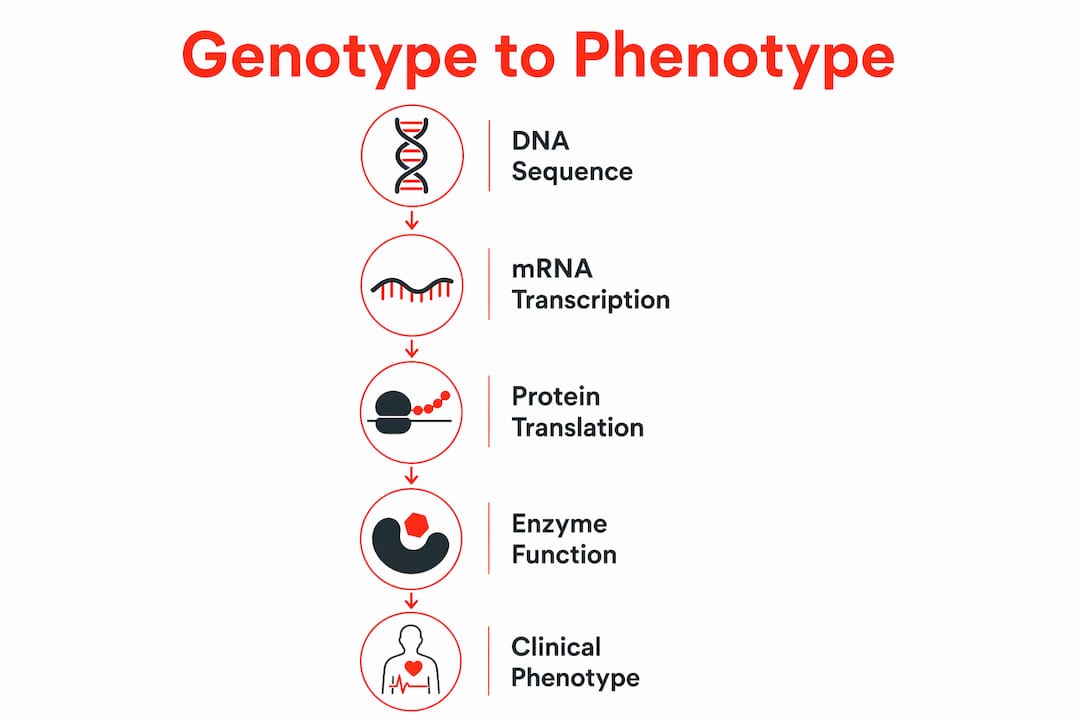
A simplified model of the pathway: a CYP2D6 variant alters the gene's transcript (reduced mRNA stability or aberrant splicing), which produces a protein with diminished enzymatic activity, which in turn yields a poor-metabolizer phenotype for drugs like codeine or tamoxifen. Add a potent CYP2D6 inhibitor such as fluoxetine to that patient's medication list, and the functional phenotype shifts further, regardless of what the genotype alone would predict.

Why genotype alone often fails to predict phenotype reliably
Phenotypic plasticity defines the degree to which a genotype determines a phenotype. When environmental factors, including medications, diet, and organ function, exert strong influence, plasticity is high and genotype-only predictions become unreliable. This is the central challenge for PGx reporting.
Several molecular phenomena compound the problem:
- Incomplete penetrance: A variant associated with a phenotype does not always produce that phenotype in every carrier.
- Variable expressivity: Carriers of the same variant can express the phenotype to very different degrees.
- Polygenic effects and epistasis: Most drug-response traits are influenced by multiple loci, and interactions between variants at different loci can produce unexpected outcomes.
- Transcriptional adaptation: Cells may compensate for a loss-of-function variant by upregulating related genes, creating a discordance between the predicted and observed phenotype that no static allele call can anticipate.
Because of canalization, epistasis, and polygenic effects, the genotype-to-phenotype map is not invertible: many genotypes can produce the same phenotype, and the same genotype can yield different phenotypes under different conditions.
Two clinical scenarios illustrate the range:
A patient carrying two loss-of-function CYP2C19 alleles (a high-penetrance, monogenic case) will reliably be a poor metabolizer of clopidogrel. The genotype-phenotype relationship here is tight, and a report can assign the phenotype with high confidence. Contrast that with a patient on five concurrent medications, one of which is a strong CYP3A4 inducer, whose CYP3A4 genotype is intermediate. The functional phenotype for any CYP3A4 substrate in that patient is dominated by the inducer effect, not the genotype. A report that ignores the medication list will be wrong.
PGx-relevant modifiers your reports must account for: medication history, DDIs (CYP inhibitors and inducers), dietary factors (e.g., grapefruit and CYP3A4), age-related changes in enzyme activity, renal and hepatic function, and rare or novel variants without established functional data. When prediction is uncertain, reports must flag that uncertainty explicitly and recommend therapeutic drug monitoring or medical-director review.
What software features does reliable genotype-to-phenotype translation require?
Reliable translation requires software that integrates genetic calls, medication intelligence, evidence fusion, and living reanalysis into a single, auditable workflow. Allele-calling alone is a starting point, not a finished product.
The operational workflow your lab should expect:
- Sample arrives and genotyping is performed.
- Automated allele calling assigns diplotype and initial functional class.
- Patient medication data is ingested and cross-referenced against a medication-intelligence graph.
- Simulation models the net effect of co-medications (DDI, induction, inhibition) on the predicted phenotype.
- Evidence fusion applies graded guidance from CPIC, DPWG, and FDA biomarker labeling to the simulated phenotype.
- A physician-reviewed, versioned report is generated with explicit uncertainty flags.
- The report is delivered to the EHR via HL7/FHIR CDS integration.
Feature requirements for clinical defensibility:
| Feature | Clinical Purpose |
|---|---|
| Allele-to-function logic | Assigns functional class from diplotype per CPIC/DPWG definitions |
| Medication-intelligence simulation | Models DDI, induction, and inhibition effects on predicted phenotype |
| Evidence-graded dosing guidance | Cites CPIC, DPWG, and FDA with version and evidence level |
| Continuous phenotype scores | Reports phenotype as a spectrum, not a binary label |
| Uncertainty quantification | Flags low-confidence calls, rare variants, and conflicting evidence |
| Medical-director review and audit trail | Provides governance and defensibility for high-risk recommendations |
| HL7/FHIR CDS integration | Delivers guidance within EHR workflow at point of prescribing |
| HIPAA-compliant infrastructure | Meets US regulatory requirements for protected health information |
A well-structured report output should include: predicted phenotype with confidence interval, metabolizer category, simulated effect of concurrent medications, recommended dose adjustment or therapeutic monitoring guidance, evidence citations with version numbers, and a flag for any rare or novel variant requiring orthogonal testing.
Best practices for PGx reports that reflect genotype-to-phenotype complexity
Reports must present phenotype as a dynamic, evidence-graded output, not a static label assigned at the time of genotyping. The following checklist reflects the operational standard your lab should hold itself to.
- Report continuous phenotype measures where possible. Assign a functional activity score rather than a binary category when the evidence supports it.
- Include explicit uncertainty and confidence. Every phenotype assignment should carry a confidence level, and rare or novel variants should be flagged as "uncertain" with a recommendation for orthogonal testing or therapeutic monitoring.
- Cite CPIC, DPWG, and FDA evidence with version. Guideline version and evidence level must appear in the report so clinicians and auditors can trace the basis for every recommendation.
- Include medication-simulation notes and the patient's medication list. Show which co-medications were modeled and how they affected the predicted phenotype.
- Require medical-director sign-off for high-risk recommendations. Clinically defensible PGx reports require a physician review layer, not just automated output.
- Maintain audit trail and versioning. Every report version, evidence update, and sign-off event should be logged for compliance and quality review.
Standardized phenotype nomenclature, using CPIC's defined terms such as "poor metabolizer," "intermediate metabolizer," "normal metabolizer," and "ultrarapid metabolizer," is not optional. Inconsistent terminology breaks EHR/CPOE integration and creates ambiguity at the point of prescribing.
How should labs validate genotype-to-phenotype mappings over time?
Static validation at launch is insufficient. Because guidelines update, novel variants emerge, and transcriptional adaptation can produce unexpected discordance, validation must be a continuous process.
Validation checklist:
- Technical verification: Confirm allele-calling concordance against reference samples and proficiency testing panels.
- Clinical validation: Conduct retrospective outcome checks to identify cases where predicted phenotype diverged from observed drug response.
- Simulation verification: Run known DDI cases through the medication-intelligence model and confirm outputs match expected phenotype shifts.
- External evidence reconciliation: Reconcile allele-function assignments and dosing recommendations against current CPIC, DPWG, and FDA guidance at each update cycle.
Update cadence should be driven by guideline releases, not a fixed calendar alone. A practical model pairs weekly or biweekly automated evidence syncs with guideline-triggered reviews and quarterly governance reports to lab leadership. Living reanalysis ensures that previously issued reports are flagged when new evidence changes a phenotype interpretation, rather than leaving outdated guidance in the EHR.
Pro Tip: Automate guideline ingestion and maintain evidence watchlists tied to versioned recommendations. This reduces the manual overhead of tracking CPIC and DPWG updates and ensures your lab's phenotype assignments stay current without requiring a full re-review cycle for every report.
How does a modern PGx platform operationalize genotype-to-phenotype translation?
Modern platforms combine medication-intelligence simulation, evidence fusion, living reanalysis, and HL7/FHIR integration to produce phenotype outputs that are clinically defensible and operationally maintainable. The capabilities a lab should look for map directly to the feature requirements described above.
Signalpgx is built around exactly this architecture. Capabilities your lab should evaluate include:
- White-label PGx reporting: Deploy a fully branded reporting service, typically within 5–7 days, without building infrastructure from scratch.
- Medication-intelligence graph: Models drug interactions, CYP induction and inhibition, and co-medication effects on predicted phenotype across the patient's full medication list.
- Living reanalysis: Recommendations update automatically as CPIC, DPWG, and FDA guidance evolves, with versioned outputs and guideline-alert notifications.
- HL7/FHIR integration: Delivers PGx guidance directly into EHR workflows via FHIR and CDS Hooks, reducing friction at the point of prescribing.
- Medical-director review and audit trail: Every report carries a physician sign-off layer and a complete versioning log for compliance and quality governance.
- HIPAA and GDPR compliance: Infrastructure meets US regulatory requirements for protected health information, with security controls documented for procurement review.
The PGx reporting pipeline from genotype call to EHR-embedded guidance is fully automated, which means your team's effort concentrates on governance and clinical review rather than manual report assembly.
Key Takeaways
Reliable genotype-to-phenotype translation in PGx reporting requires medication-intelligence simulation, living reanalysis, explicit uncertainty quantification, and versioned evidence fusion, all governed by medical-director review and HL7/FHIR-integrated delivery.
| Point | Details |
|---|---|
| Phenotype is dynamic | Medication history, DDIs, and organ function shift predicted phenotype beyond what genotype alone captures. |
| Simulation is required | Software must model CYP inhibitors, inducers, and co-medications before a report is issued. |
| Living reanalysis is essential | Transcriptional adaptation and guideline updates mean static phenotype labels become outdated; reports need versioned, trigger-based reanalysis. |
| Standards anchor defensibility | CPIC, DPWG, and FDA biomarker labeling must be cited with version; HL7/FHIR integration and medical-director governance are baseline requirements. |
| Signalpgx operationalizes this | Signalpgx combines medication-intelligence simulation, living reanalysis, and HIPAA-compliant white-label infrastructure, deployable within a short timeframe. |
The case for moving beyond static genotype labels
The field has spent years treating PGx reports as a lookup table: run the genotype, assign a metabolizer category, print the label. That model was a reasonable starting point, but it is now a clinical liability. The patients most likely to benefit from PGx guidance are also the most likely to be on complex medication regimens, which is precisely where a static genotype label is least reliable.
The shift to dynamic, phenotype-driven reporting is not a technical luxury. It is what separates a report that a clinician can act on from one that sits in the chart as a data point with no clear implication. Labs that pilot medication-intelligence simulation on a high-volume assay, such as CYP2D6 or CYP2C19, will see immediately how often the simulated phenotype diverges from the raw genotype call. That divergence is where patient safety lives.
Signalpgx gives your lab a production-ready PGx reporting infrastructure
Labs that need to move from raw genotype calls to clinically defensible, medication-aware phenotype reports have a concrete path with Signalpgx. The platform delivers white-label PGx reporting with medication-intelligence simulation, living reanalysis, and full HL7/FHIR EHR integration, typically deployed within 5–7 days and built on HIPAA-compliant infrastructure.
Three capabilities that map directly to the clinical requirements in this article:
- Medication-intelligence simulation models DDIs, CYP induction, and inhibition across the patient's full medication list, so the phenotype your report assigns reflects clinical reality.
- Living reanalysis keeps recommendations current as CPIC, DPWG, and FDA guidance evolves, with versioned outputs and audit trails your medical director can stand behind.
- HL7/FHIR integration and audit trail deliver guidance at the point of prescribing and maintain the governance record your lab needs for compliance and quality review.
View white-label PGx reporting options or book a demo to see how Signalpgx fits your lab's workflow and volume.
Authoritative sources for PGx genotype-to-phenotype guidance
The following sources underpin the clinical and molecular claims in this article. CPIC, DPWG, and FDA resources are the primary authorities for guideline citations in US clinical PGx reports. The mechanistic and foundational sources support the biological framework.
| Source | Best Used For |
|---|---|
| CPIC (cpicpgx.org) | Gene-drug guideline citations, allele-function tables, dosing recommendations |
| DPWG (pharmgkb.org/page/dpwg) | European guideline comparisons and evidence grading |
| FDA Table of Pharmacogenomic Biomarkers | US regulatory biomarker labeling and drug-label citations |
| HL7 FHIR (hl7.org/fhir) | Interoperability standards for EHR integration and CDS delivery |
| NHGRI Gene Expression Glossary | Mechanistic background on transcription, translation, and molecular phenotypes |
| PubMed — Molecular Phenotype Perspective | Foundational argument for continuous, molecular-level phenotype definitions |
| Annual Review — Transcriptional Adaptation | Compensatory expression, living reanalysis rationale, governance frameworks |
| Science Learning Hub — Phenotypic Plasticity | Phenotypic plasticity definitions and environmental modifier context |
| UC Berkeley — Genotype vs. Phenotype | Canalization, epistasis, and limits of genotype-based prediction |
This article provides general clinical and technical information for laboratory professionals. It does not constitute medical, legal, or regulatory advice. Labs should verify current CPIC, DPWG, and FDA guidance directly and consult qualified clinical and compliance professionals for their specific programs.