
Implementing CPIC guidelines requires five sequenced moves: prioritize your gene-drug pairs, design the workflow and clinical decision support (CDS) rules, train your providers and pharmacists, run a controlled go-live, and monitor performance so you can adjust as guidelines evolve. Official guideline text, evidence grades, and prescribing recommendations live at the CPIC guideline hub, and every rule you build should trace back to that source rather than a secondhand summary.
Here's the checklist in its shortest form:
- Triage and prioritize gene-drug pairs by clinical severity and prescribing volume.
- Design the clinical workflow and translate the guideline into CDS logic.
- Build education materials for prescribers, pharmacists, and lab staff.
- Pilot the build with a defined patient population and success criteria.
- Go live with staffed support and an escalation path.
- Monitor alert performance and override reasons on a fixed cadence.
- Re-review the guideline periodically and update rules as CPIC publishes changes.
The sections below break each step into tasks, owners, and realistic timelines.
Table of Contents
- Cpic Implementation Checklist: Tasks, Owners, and Timelines
- Which Gene-Drug Pairs Should You Implement First?
- How Do You Turn CPIC Recommendations Into EHR Alerts?
- Educating Providers, Pharmacists, and Lab Staff for Adoption
- Running a Safe Go-Live for Your CPIC Pilot
- Tracking the Metrics That Keep CPIC Rules Current
- Where to Find Official CPIC Guidelines and Implementation Resources
- What I've Learned Watching CPIC Rollouts Succeed and Stall
- Accelerating CPIC Implementation With SignalPGx
- Sources
- FAQ
Cpic Implementation Checklist: Tasks, Owners, and Timelines
A checklist only works if someone owns each line item. Most implementations stall not because the clinical logic is wrong, but because no one was accountable for the education packet or the dashboard nobody built. Here's how to structure ownership and pacing so nothing falls through.
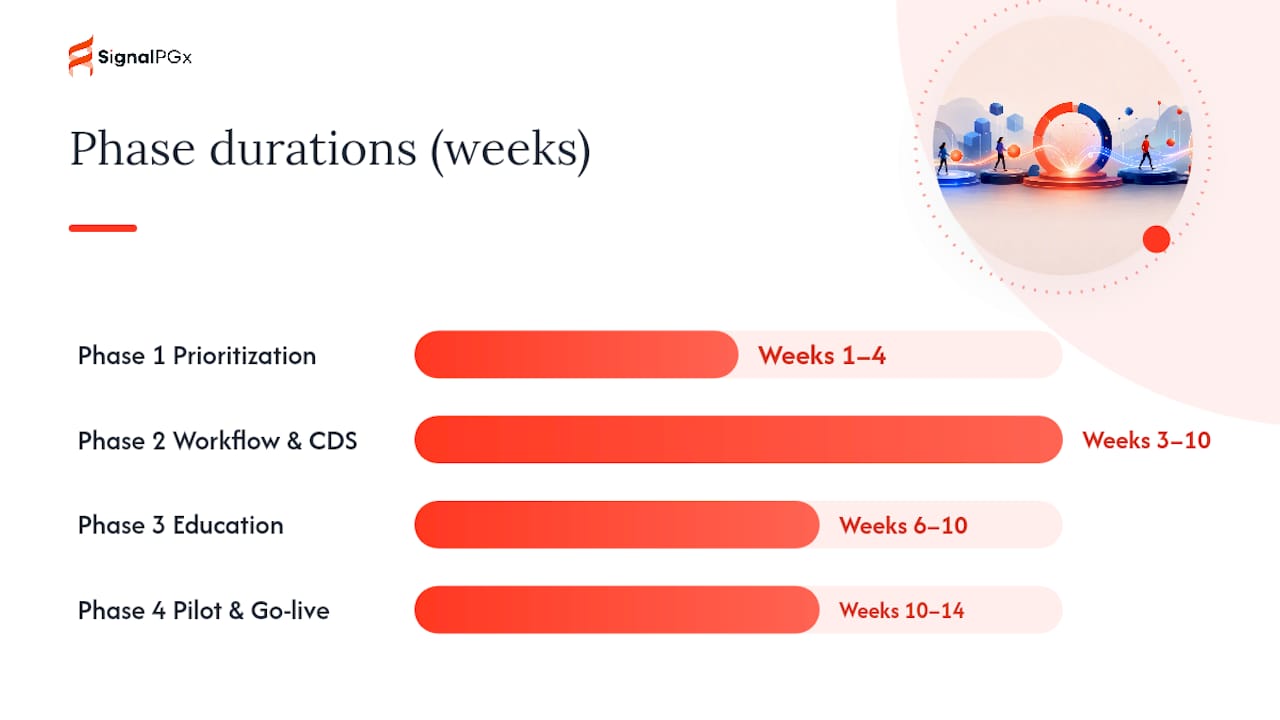
Phase 1: Prioritization and planning (weeks 1 to 4)
The clinical lead and pharmacy director co-own this phase. Deliverable: a signed-off shortlist of two to three gene-drug pairs with a one-page rationale for each, plus a project charter naming the informatics lead who will build the CDS.
Phase 2: Workflow and CDS build (weeks 3 to 10, overlapping planning)
This is where the IT/informatics lead takes the wheel, working closely with a clinical pharmacist who understands the CPIC recommendation tables. Deliverables include a CDS specification document, a set of test cases covering every genotype-to-phenotype path, and a rollback plan if the alert misfires in production.
Phase 3: Education (weeks 6 to 10, overlapping the build)
Ownership splits three ways: the pharmacy education lead handles pharmacist scripts, a physician champion handles provider-facing materials, and the lab director handles technical staff training on report interpretation. Deliverable: a training packet with role-specific one-pagers and a short competency check.
Phase 4: Pilot and go-live (weeks 10 to 14)
The clinical lead owns go-live decisions; the IT lead owns technical support during the window. Deliverable: a go-live runbook with escalation contacts and a defined pilot unit or clinic.
Phase 5: Monitoring and evaluation (ongoing from week 14)
Quality improvement or informatics owns the dashboard; the clinical lead reviews it monthly. Deliverable: a living dashboard tracking alert volume, override rates, and time-to-action.
Here's how the task breakdown looks by role:
- Clinical lead: Sets clinical priorities, signs off on pair selection, chairs the go-live review.
- Pharmacist/PGx specialist: Translates CPIC recommendation tables into clinical logic, writes override justification categories.
- Lab director: Confirms genotype data format, validates test-to-report turnaround, coordinates with the reporting platform.
- IT/informatics lead: Builds the CDS rule, configures the EHR alert, runs technical validation.
- Education lead: Builds and delivers training materials, tracks completion.
A realistic full build, from prioritization through a stable go-live, runs 12 to 16 weeks for a first gene-drug pair. Subsequent pairs move faster once the informatics team has a reusable phenotype-mapping service, often compressing to 6 to 8 weeks.
Pro Tip: Build your first CDS rule for the gene-drug pair with the clearest CPIC evidence grade and the most concrete alternative therapy, not the one with the highest testing volume. A clean first build teaches your team the mapping pattern they will reuse for every pair after it.
Which Gene-Drug Pairs Should You Implement First?
Choosing the wrong first pair burns political capital you need for pair two. The strongest prioritization frameworks weigh four factors together rather than picking on volume alone.
- Clinical severity: What happens if the wrong drug or dose is given? A pair tied to a black-box warning or documented severe adverse event outranks one with a mild side-effect profile.
- Prescribing frequency: How often does your organization actually prescribe this drug? A rare drug with severe consequences may still rank lower than a common drug with moderate consequences, simply on reach.
- Variant prevalence: How common is the actionable genotype in your patient population? Some phenotypes affect a small minority; others affect a third or more of patients depending on ancestry.
- Actionable alternatives: Does an alternative therapy or dose adjustment actually exist? A guideline with a clear "consider alternative agent" recommendation is easier to operationalize than one where the only option is closer monitoring.
A simple scoring rubric works well here: score each factor 1 to 5 and multiply by a severity weight, then rank the results. Two pairs commonly land at the top of that list for hospital and health-system pilots: CYP2C19 and clopidogrel, because of its cardiovascular stakes and clear alternative antiplatelet options, and CYP2D6 and codeine, because poor and ultrarapid metabolizer phenotypes carry well-documented safety signals in both under and over-response.
Document your scoring methodology and the shortlist in a one-page memo, then take it to your pharmacy and therapeutics committee or equivalent governance body for sign-off before any build work starts. That sign-off protects the project later when a clinician questions why a specific alert fired. CPIC's own guideline pages carry standardized evidence grades for each recommendation, which gives your committee a defensible, peer-reviewed basis for the ranking rather than an internal guess.
How Do You Turn CPIC Recommendations Into EHR Alerts?
A CPIC guideline is not, by itself, machine-readable. Someone has to walk the recommendation table and turn prose like "avoid tricyclic antidepressants" into a rule your EHR can act on. That translation happens in three layers.
Layer one: genotype to phenotype. Your lab or reporting platform assigns a phenotype (poor metabolizer, intermediate metabolizer, normal metabolizer, and so on) using CPIC's standardized terminology. Build this as its own auditable service rather than embedding the logic inside each individual drug rule. When a rule needs "is this patient a CYP2D6 poor metabolizer," it should query one phenotype record, not recompute the genotype-to-phenotype mapping itself. That separation means a terminology update from CPIC only requires a single service change, not a rewrite of every downstream rule tied to that gene.
Layer two: phenotype to recommendation. This is where you map the CPIC recommendation text to a discrete clinical action: avoid drug, reduce dose by X, use alternative agent, or monitor more closely. Keep this mapping in a table your pharmacy team can review and version, independent of the technical alert logic.
Layer three: recommendation to alert. This is the actual CDS build inside the EHR, and it's where most of the design judgment lives.
Choosing passive versus active CDS
Not every recommendation deserves an interruptive, pop-up alert. A layered approach works better in practice: reserve active, interruptive alerts for high-severity, high-confidence recommendations (avoid drug entirely, serious toxicity risk), and use passive CDS, info buttons, or chart flags for lower-severity or dose-adjustment guidance. This layering is a documented best practice for limiting alert fatigue while still surfacing safety-critical information where clinicians can find it.
When you do build an active alert, the text matters as much as the trigger. An effective alert states the phenotype in plain language, the specific risk, and the recommended action in one or two lines, without forcing the prescriber to click through to a separate reference. "Patient is a CYP2D6 poor metabolizer. Codeine may provide inadequate pain relief. Consider morphine or a non-opioid alternative" gives the prescriber everything they need without a second lookup.
Integration patterns worth knowing
Most modern EHR integrations for pharmacogenomic CDS lean on one of a few patterns:
- FHIR-based genomic resources for storing discrete, structured genotype and phenotype data rather than a scanned PDF report.
- CDS Hooks for real-time, in-workflow alerting at the point of prescribing, triggered by order-entry events.
- HL7 messaging for older systems that need lab results and interpretations passed through existing interface engines.
The data model choice matters more than most teams expect. A discrete phenotype field that your CDS engine can query directly supports far more flexible, durable rules than a system where the only record of a patient's genotype is a PDF report sitting in the document viewer. CPIC's own Informatics Working Group exists specifically to address this kind of technical barrier, and its guidance on standard terminologies is worth reviewing before you finalize your data model. For a broader view of how genotype data flows from lab to clinical guidance, see this walkthrough of the PGx pipeline.
Before go-live, build test cases for every genotype-to-phenotype path the rule could hit, including edge cases like indeterminate results or rare diplotypes. A rule that has only ever been tested against the two most common genotypes will surprise you the first time it encounters an uncommon one in production.
Pro Tip: Write your alert override reasons as a structured dropdown, not a free-text field. You cannot build a meaningful override-rate dashboard later if half your override reasons are typed as "N/A" or "MD aware."
Educating Providers, Pharmacists, and Lab Staff for Adoption
Different audiences need different depth, and treating everyone the same is the fastest way to produce training materials nobody reads. Segment your education plan by role from the start.
Prescribers need to understand what the alert means and what to do when they see it, not the underlying pharmacogenetic mechanism. A one-page summary per gene-drug pair, with the phenotype categories and the specific action for each, covers most of what they need.
Pharmacists need deeper fluency, since they field the questions prescribers can't answer and often review the override reasons. Give them a quick-reference script for common outreach scenarios: what to say when a prescriber wants to override an "avoid" recommendation, and how to document that conversation.
Lab staff need to understand how the report gets generated and what to check before it moves downstream, particularly around genotype-to-phenotype assignment and how a clinically defensible PGx report is structured for clinical use.
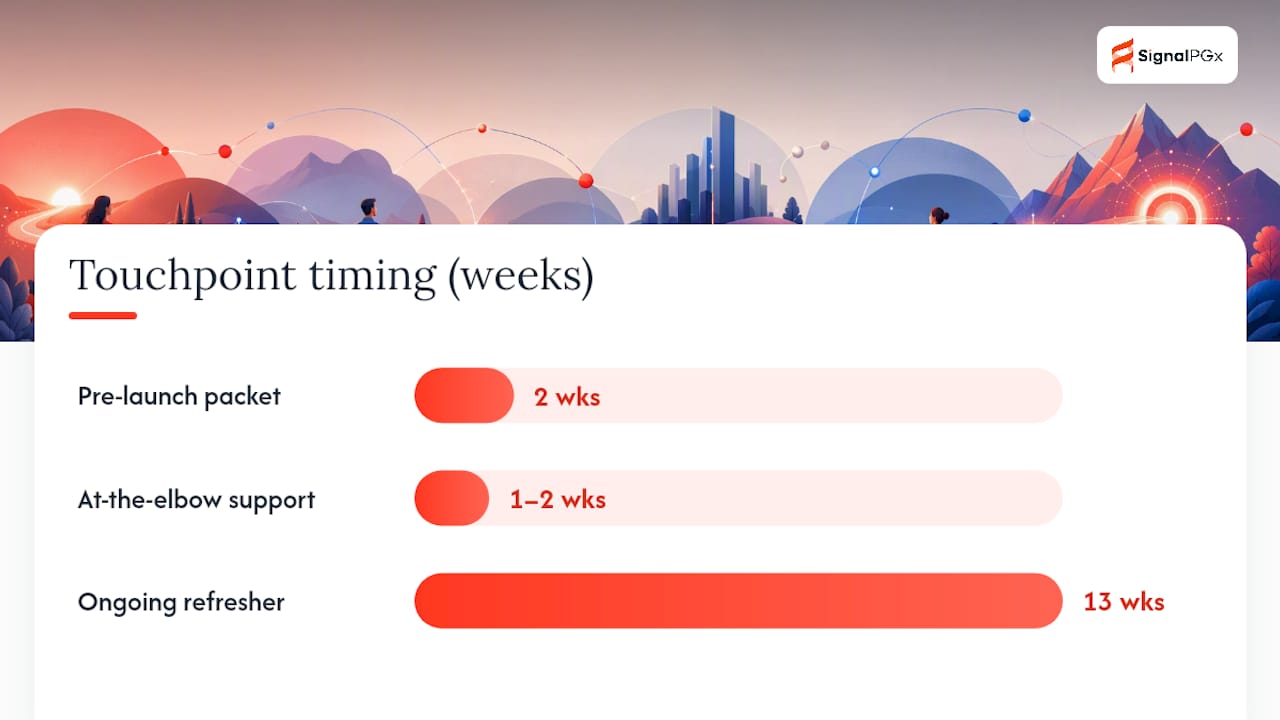
A workable education schedule runs on three touchpoints:
- Pre-launch: role-specific training packets distributed two weeks before go-live, with a short competency check.
- At-the-elbow: pharmacist champions physically present or on call during the first one to two weeks of live alerts, answering questions in real time.
- Ongoing: a quarterly refresher, plus updated materials any time CPIC revises a guideline you've implemented.
Measure understanding, don't assume it. A short quiz embedded in the pre-launch packet, a brief post-launch survey asking whether the alert text was clear, and tracking how often prescribers click through to the info button on passive alerts all give you real signal on whether the education actually landed.
Running a Safe Go-Live for Your CPIC Pilot
Go-live is where planning meets real patients, and the gap between the two always produces surprises. A tightly scoped pilot limits the blast radius while you find them.
- Define pilot scope narrowly. Pick one unit, one clinic, or one service line rather than a system-wide launch. A cardiology clinic piloting the clopidogrel rule, for example, gives you a contained population and motivated clinical champions.
- Set success criteria before you start. Decide in advance what "working" looks like: alert accuracy above a defined threshold, no missed high-severity cases, and override reasons that make clinical sense on review.
- Run the pilot for a minimum of four to six weeks. Shorter windows rarely generate enough alert volume to spot patterns in override behavior or mapping errors.
- Staff an escalation matrix. Name a pharmacist champion as first-line support, an IT contact for technical failures, and a clinical lead who can make same-day decisions if the alert is producing unsafe guidance.
- Watch for alert fatigue early. If override rates climb past what your team expected within the first two weeks, that's usually a sign the alert is firing too broadly or the text isn't giving prescribers enough to act on quickly.
- Check for mapping errors before you scale. A surprising number of early problems trace back to a genotype-to-phenotype mapping edge case that wasn't in the original test suite, not to the CDS logic itself.
Widening the pilot before these checks are clean just multiplies the same problem across more patients and more clinicians.
Tracking the Metrics That Keep CPIC Rules Current
A CDS rule that goes live and never gets reviewed again degrades quietly. Guidelines update, patient populations shift, and alert text that made sense at launch can become the thing clinicians learn to click through without reading.
Track these metrics on a fixed cadence, not just when something goes wrong:
- Alert firing rate: How often does the rule trigger, and does that match your expected patient volume for the gene-drug pair?
- Acceptance and override rates, with reasons: A high override rate isn't automatically bad, but an override rate with vague or missing reasons is a governance problem.
- Time-to-action: How quickly does the prescriber respond to the alert, and does that response match the recommended action?
- Patient-safety signals: Any adverse events or near-misses tied to a phenotype the alert should have caught.
Pull this data into a dashboard reviewed monthly by the clinical lead and quarterly by your governance committee. Monthly catches operational drift; quarterly catches whether the underlying guideline itself needs a fresh look.
That last point matters more than most teams initially plan for. CPIC guidelines aren't static documents. Guideline publishers actively maintain and expand pharmacogenomic prescribing guidance, including recent additions covering areas like clozapine monitoring and HLA genotyping. A living reanalysis process, one that automatically flags when a guideline you've implemented has been revised, keeps your CDS rules from quietly going stale between manual review cycles. Teams running this kind of automated reanalysis on their PGx reports report far less manual overhead than teams that rely on someone remembering to check the guideline page every quarter.
Implementing CPIC guidance successfully depends on prioritizing pairs by clinical severity, building auditable phenotype-based CDS, and monitoring override data to catch drift before it becomes a safety issue.
| Point | Details |
|---|---|
| Start with two pairs | Pick the two or three gene-drug pairs with the clearest evidence grade and best alternative therapy options. |
| Separate phenotype from rules | Build genotype-to-phenotype assignment as its own reusable service so updates don't require rewriting every rule. |
| Layer your alerts | Reserve interruptive alerts for high-severity recommendations; use passive CDS for everything else. |
| Pilot narrowly first | Run a four to six week pilot in one clinic or unit before a system-wide rollout. |
| Automate guideline monitoring | A living reanalysis process, like the one built into SignalPGx's reporting platform, flags guideline updates automatically instead of relying on manual quarterly checks. |
Where to Find Official CPIC Guidelines and Implementation Resources
Every rule you build should trace back to a primary source, not a summary of a summary. These are the references worth bookmarking.
- CPIC: the canonical home for CPIC's mission, guideline list, and Informatics Working Group resources.
- CPIC guidelines hub: the full, peer-reviewed guideline library with evidence grades and standardized phenotype terminology, indexed in PubMed.
- CPIC Implementation listing: a directory of organizations that have implemented CPIC guidelines, useful for finding peer contacts and real-world lessons.
- Incorporation of Pharmacogenomics into Routine Clinical Practice: an academic review of CPIC's guideline development process and the informatics thinking behind EHR-ready recommendations.
- Implementation of CPIC Recommendations: a practical five-step implementation playbook this article's checklist draws on directly.
- CERSI-PGx guideline updates: an example of ongoing guideline activity, useful for understanding why a living review process matters.
Also worth a look if you're weighing guideline sources: this comparison of CPIC, FDA, and DPWG recommendations for teams deciding which framework to lead with.
What I've Learned Watching CPIC Rollouts Succeed and Stall
The pattern that separates a smooth CPIC rollout from a stalled one has less to do with clinical complexity and more to do with governance. Teams that get a pharmacy and therapeutics committee to sign off on pair selection before any code gets written move faster later, because nobody has to relitigate the decision when a clinician pushes back on an alert. Teams that skip that step often find themselves defending the same choice twice.
Data mapping is where good plans go sideways. A genotype field that looks clean in a spreadsheet often has inconsistent formatting once it hits the EHR's actual data layer, and that mismatch tends to surface during the pilot, not the design phase. Build test cases for the messy genotype records, not just the tidy ones.
Phased rollouts beat big-bang launches almost every time, and automation is what makes phase two faster than phase one. Once your phenotype-mapping service exists, adding a second gene-drug pair is mostly configuration, not construction.
Watch for these red flags before committing to a go-live date:
- No named clinical owner for override review.
- No data pipeline delivering discrete genotype results into the EHR.
- No plan for what happens when CPIC revises the guideline you just built.
Accelerating CPIC Implementation With SignalPGx
Everything in this checklist, from phenotype mapping to living guideline updates, is exactly what SignalPGx builds for laboratories that don't want to construct that infrastructure from scratch. The platform ingests genotype and medication data and outputs physician-reviewed, evidence-graded reports that map directly to the CDS logic your team needs, with genotype-to-phenotype assignment handled as a discrete, auditable step rather than buried inside a PDF.
SignalPGx integrates with EHRs through HL7/FHIR standards, so the discrete data model this article recommends is the default output, not a custom build your IT team has to engineer. Its living reanalysis feature automatically re-evaluates recommendations as CPIC and other guideline bodies publish updates, which addresses the monitoring burden most implementers underestimate at the outset. Labs deploying the white-label infrastructure typically go live in 5 to 7 days, and the platform runs under HIPAA and GDPR compliance standards you can review on the security and compliance page.
If your team is scoping a CPIC rollout and wants to skip months of CDS engineering, take a look at white-label PGx reporting for laboratories or book a demo to see how the platform maps to your specific gene-drug priority list.
Sources
- CPIC guidelines
- Incorporation of Pharmacogenomics into Routine Clinical Practice: the CPIC Guideline Development Process
- Implementation of CPIC Recommendations – Council on Pharmacy Standards
FAQ
What is CPIC?
CPIC (Clinical Pharmacogenetics Implementation Consortium) publishes freely available, peer-reviewed clinical guidelines that translate genetic test results into specific, actionable prescribing recommendations.
What is the first step in a CPIC implementation checklist?
Prioritize gene-drug pairs using clinical severity, prescribing frequency, variant prevalence, and the availability of an actionable alternative therapy, then get governance sign-off before building any CDS logic.
Should CPIC alerts be passive or active CDS?
Reserve interruptive, active alerts for high-severity, high-confidence recommendations, and use passive CDS, like info buttons or chart flags, for lower-severity or dose-adjustment guidance to limit alert fatigue.
How long does a typical CPIC pilot take?
A first gene-drug pair typically takes 12 to 16 weeks from prioritization through a stable go-live, with subsequent pairs moving faster, often 6 to 8 weeks, once the phenotype-mapping infrastructure exists.
Can software speed up CPIC implementation?
Yes. Platforms like SignalPGx handle genotype-to-phenotype mapping, evidence-graded report generation, and living reanalysis of updated guidelines, which removes much of the manual engineering work labs otherwise build in-house.
Where can I find the official CPIC guideline text?
The full, peer-reviewed guideline library, including evidence grades and standardized phenotype terminology, is available at the CPIC guidelines hub, indexed in PubMed.