
CYP2D6 genotype directly determines whether codeine delivers analgesia, causes life-threatening toxicity, or fails entirely: avoid codeine in ultrarapid metabolizers (UMs) and poor metabolizers (PMs); use standard label dosing for normal metabolizers (NMs); monitor intermediate metabolizers (IMs) closely and consider alternatives if analgesia is inadequate. This recommendation carries strong evidence grading from the Clinical Pharmacogenetics Implementation Consortium (CPIC) and is reinforced by an FDA boxed warning following pediatric fatalities linked to ultrarapid CYP2D6 metabolism.
Immediate clinical actions:
- Ultrarapid metabolizers (UM/URM): Avoid codeine. Excess morphine formation risks fatal respiratory depression. The FDA boxed warning specifically cites post-tonsillectomy/adenoidectomy pediatric deaths in this phenotype.
- Poor metabolizers (PM): Avoid codeine. Morphine formation is negligible; patients receive no meaningful analgesia yet remain exposed to adverse effects.
- Normal metabolizers (NM): Standard label dosing is appropriate. Monitor for expected opioid side effects.
- Intermediate metabolizers (IM): Use label dosing with heightened monitoring; switch to an alternative if analgesia is insufficient.
- All phenotypes: Screen for strong CYP2D6 inhibitors before prescribing. A genotypic NM on fluoxetine or paroxetine is a functional PM.
- Breastfeeding alert: Codeine is contraindicated in nursing mothers who are UMs. Gasche et al. documented life-threatening neonatal opioid intoxication from morphine-enriched breast milk in this scenario.
Table of Contents
- How does CYP2D6 control codeine metabolism and analgesic effect?
- From genotype to phenotype: how does the activity score translate to codeine response?
- What do CPIC and the FDA recommend for each CYP2D6 phenotype?
- What should a CYP2D6 test report include, and what are its limits?
- Which drugs alter CYP2D6 or CYP3A4 activity and change codeine's risk profile?
- How does CYP2D6 phenotype prevalence vary, and who is at highest risk?
- Which analgesics should you choose when codeine is contraindicated?
- How does high-quality PGx reporting support safe codeine prescribing?
- Key Takeaways
- Why CYP2D6-guided prescribing belongs in every precision analgesia workflow
- Signalpgx makes CYP2D6-guided codeine prescribing operational for your lab
- Useful sources for further reading
How does CYP2D6 control codeine metabolism and analgesic effect?
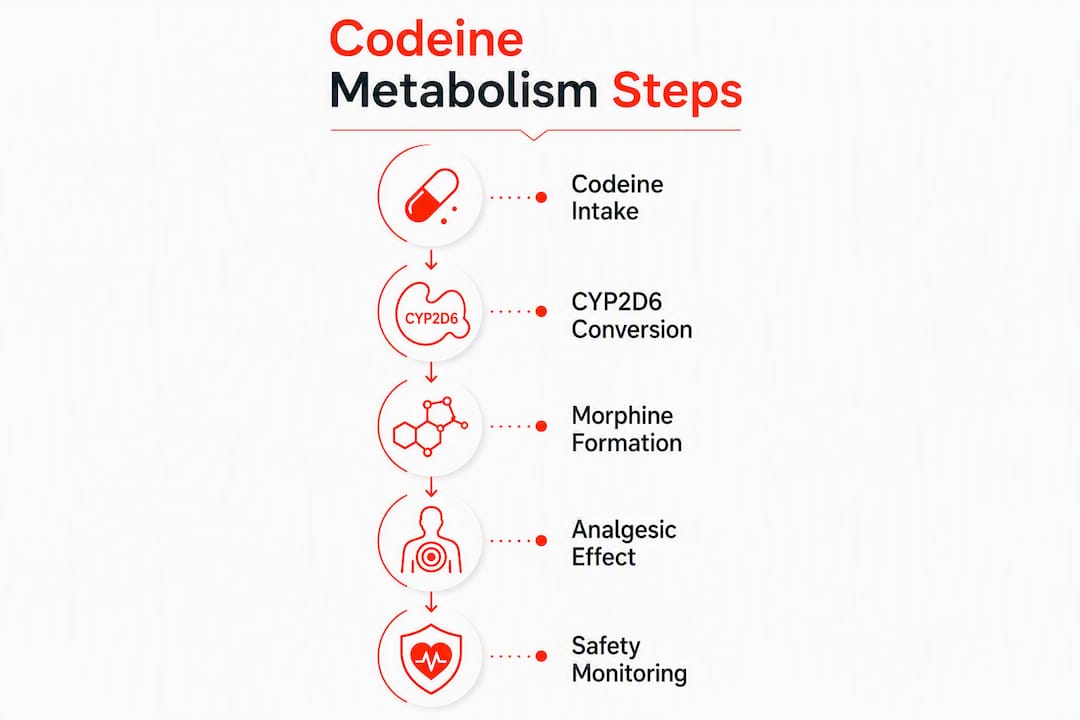
Codeine is pharmacologically inert until CYP2D6 converts it to morphine via O-demethylation. That single enzymatic step is the entire basis for codeine's analgesic activity, because codeine itself binds mu-opioid receptors with far lower affinity than morphine.
Only 5–10% of a codeine dose undergoes CYP2D6-mediated O-demethylation in normal metabolizers. The remainder is handled by two other pathways: glucuronidation via UGT2B7 (approximately 80%, producing codeine-6-glucuronide, which is largely inactive) and N-demethylation via CYP3A4 to norcodeine (a minor, pharmacologically weak metabolite). Neither of those alternative routes generates meaningful opioid activity.
The clinical implication of that small 5–10% fraction is counterintuitive but critical. Because morphine is so potent at mu-opioid receptors, even modest changes in CYP2D6 activity produce clinically significant shifts in opioid exposure. A UM with gene duplications may convert two to three times more codeine to morphine than an NM, pushing plasma morphine into a toxic range at standard doses. A PM converts essentially none, leaving the patient with no analgesia and a full burden of non-opioid side effects.
"Metabolism of codeine into active morphine is dependent on CYP2D6, and so is strongly influenced by CYP2D6 genotype. Codeine displays a reduced binding potential to mu opioid receptors compared to morphine, resulting in milder analgesic effects." — PMC review of CYP2D6 pharmacogenomics
CYP3A4 activity adds a second layer of complexity. When CYP3A4 is inhibited (e.g., by macrolides or azoles), less codeine is shunted to norcodeine, leaving more substrate available for CYP2D6-mediated morphine formation. CYP3A4 inducers such as rifampin or phenytoin have the opposite effect, reducing morphine yield. Clinicians evaluating codeine response must therefore account for both pathways simultaneously.
| Metabolic pathway | Enzyme | Primary product | Approximate fraction | Opioid activity |
|---|---|---|---|---|
| O-demethylation | CYP2D6 | Morphine | 5–10% | High |
| Glucuronidation | UGT2B7 | Codeine-6-glucuronide | ~80% | Negligible |
| N-demethylation | CYP3A4 | Norcodeine | ~10% | Low |
From genotype to phenotype: how does the activity score translate to codeine response?
The CPIC activity-score system converts a patient's diplotype into a numeric value that predicts CYP2D6 enzyme function and, by extension, expected morphine formation from codeine. Each allele is assigned a function score: 1.0 for normal-function alleles (*1, *2, *35), 0.5 for decreased-function alleles (*9, *17, *29, *41), 0.25 for the severely decreased *10 allele, and 0.0 for no-function alleles (*3, *4, *5, *6). Gene duplications multiply the contributing allele's score by the copy number.

The CPIC activity-score cutoffs define four phenotype categories with direct prescribing implications for codeine:
| Diplotype example | Activity score | Phenotype | Expected codeine response |
|---|---|---|---|
| *4/*4 | 0 | Poor metabolizer (PM) | Negligible morphine formation; no analgesia, adverse effects persist |
| *4/*10 | 0.25 | Intermediate metabolizer (IM) | Reduced morphine; subtherapeutic analgesia likely |
| *1/*41 | 1.5 | Intermediate metabolizer (IM) | Mildly reduced morphine; monitor closely |
| *1/*1 | 2.0 | Normal metabolizer (NM) | Expected morphine formation; standard dosing appropriate |
| *1x2/*1 | 3.0 | Ultrarapid metabolizer (UM) | Excess morphine; toxicity risk at standard doses |
Pro Tip: *When reviewing a lab report, look for three distinct fields: the reported diplotype (e.g., *1/*4), the computed activity score, and the assigned phenotype label. Some platforms report only the diplotype without computing an activity score, which can lead to misclassification, particularly for alleles like 10 that carry a non-standard 0.25 weight. Copy-number variation (CNV) for gene duplications must be explicitly assessed; a report that does not address CNV cannot reliably rule out ultrarapid metabolizer status.
One practical nuance: the CPIC and Dutch Pharmacogenetics Working Group (DPWG) use slightly different activity-score thresholds for phenotype boundaries, so the phenotype label on a report may differ depending on which guideline the laboratory applied. When in doubt, use the numeric activity score rather than the phenotype label to anchor your clinical decision.
What do CPIC and the FDA recommend for each CYP2D6 phenotype?
CPIC's evidence-graded recommendations are unambiguous: codeine should be avoided in both PMs and UMs, with strong evidence supporting that recommendation in both phenotypes. For NMs, standard label dosing is appropriate. IMs occupy a monitored middle ground.
Prescribing actions by phenotype:
- Ultrarapid metabolizer (activity score >2.25): Strong recommendation — avoid codeine. Excess morphine formation creates a dose-independent toxicity risk. The FDA's boxed warning on codeine labels specifically addresses UM-related respiratory depression and death in pediatric patients following tonsillectomy or adenoidectomy.
- Normal metabolizer (activity score 1.25–2.25): Strong recommendation — use label dosing. No genotype-based dose adjustment is required.
- Intermediate metabolizer (activity score 0.25–1.0): Moderate recommendation — use label dosing with close monitoring. If analgesia is inadequate, switch to a non-CYP2D6-dependent analgesic rather than escalating the codeine dose.
- Poor metabolizer (activity score 0): Strong recommendation — avoid codeine. Morphine formation is negligible; dose escalation will not improve analgesia and increases adverse-effect burden without opioid benefit.
The FDA's safety communication, reinforced by post-marketing case reports including the landmark Gasche et al. case documented in peer-reviewed literature, established that standard codeine doses can be lethal in UMs. That evidence base drove the FDA's 2013 contraindication of codeine in pediatric patients following tonsillectomy or adenoidectomy, and subsequent label revisions extending caution to breastfeeding mothers.
When codeine is contraindicated by phenotype, CPIC and clinical practice guidelines support several alternatives. Non-CYP2D6-dependent opioids such as morphine, hydromorphone, and oxymorphone provide predictable analgesia regardless of CYP2D6 status. Nonopioid options including NSAIDs, acetaminophen, and regional anesthesia techniques are appropriate for mild-to-moderate pain, particularly in pediatric or postoperative settings where opioid avoidance is preferred.
Clinicians should also note that CPIC guidelines are living documents. Recommendations for CPIC, FDA, and DPWG guidance may be updated as new evidence emerges, making it important to verify the current version before applying them to patient care.
What should a CYP2D6 test report include, and what are its limits?
A clinically actionable CYP2D6 report must deliver more than a star-allele diplotype. The minimum content a prescriber should expect includes: the detected diplotype, a computed activity score using CPIC-recommended allele function values, an assigned phenotype label with the guideline source identified, explicit documentation of CNV assessment (gene duplication or deletion), and guideline-linked prescribing recommendations for the relevant drug.
Checklist for evaluating a CYP2D6 report:
- Allele coverage: Does the assay interrogate at minimum the CPIC/AMP Tier 1 alleles (*2, *3, *4, *5, *6, *9, *10, *17, *29, *41) plus gene duplications?
- CNV detection: Is copy-number variation explicitly assessed? Platforms that do not detect duplications will miss UM calls, the highest-risk phenotype for codeine toxicity.
- Activity score: Is a numeric activity score provided, or only a phenotype label? The score is more portable across guideline versions.
- Phenotype source: Which guideline version (CPIC, DPWG) was used to assign the phenotype? Different thresholds can produce different labels for the same score.
- Confidence flags: Are low-confidence calls or ambiguous diplotypes flagged for clinical review?
- Living reanalysis: Does the platform update recommendations as CPIC or FDA guidance evolves, or is the report a static snapshot?
Phenoconversion is the most underappreciated limitation of genotype-only reports. Strong CYP2D6 inhibitors convert a genotypic NM into a functional PM by blocking the enzyme, regardless of what the DNA says. Common strong inhibitors that produce this effect include bupropion, fluoxetine, paroxetine, and quinidine. A patient's genotype report may show NM status, but if they are concurrently prescribed paroxetine, their effective phenotype for codeine metabolism is PM. Medication review is therefore mandatory before interpreting any CYP2D6 result in the context of codeine prescribing.
Pro Tip: Preemptive genotyping, performed before a prescription is written, is the most clinically efficient strategy for high-risk populations (perioperative patients, chronic pain patients, pediatric surgical candidates). Point-of-care testing is useful when a genotype is urgently needed for an acute decision, but it requires rapid turnaround and a report format the prescriber can act on immediately. Living reanalysis ensures that a preemptive result obtained today remains clinically current when the patient returns for a different medication years later.
Which drugs alter CYP2D6 or CYP3A4 activity and change codeine's risk profile?
Treat any patient on a strong CYP2D6 inhibitor as a functional poor metabolizer for codeine-related decisions, regardless of their genotype. That single decision rule prevents the most common drug-interaction error in codeine prescribing.
Strong CYP2D6 inhibitors (phenocopy PM status):
- Bupropion
- Fluoxetine
- Paroxetine
- Quinidine
- Terbinafine
CYP3A4 inhibitors (increase morphine formation by reducing norcodeine shunting):
- Clarithromycin, erythromycin (macrolides)
- Fluconazole, itraconazole, ketoconazole (azoles)
- Ritonavir and other HIV protease inhibitors
CYP3A4 inducers (reduce morphine formation):
- Rifampin
- Phenytoin
- Carbamazepine
- St. John's Wort
Decision flow for co-medication scenarios:
- If a strong CYP2D6 inhibitor is present: avoid codeine or select a non-CYP2D6-dependent opioid. Do not rely on genotype alone.
- If a CYP3A4 inhibitor is present: expect higher morphine formation than the genotype alone predicts; exercise caution and consider dose reduction or an alternative.
- If a CYP3A4 inducer is present: morphine formation may be reduced; analgesia may be subtherapeutic even in an NM.
- If both a CYP2D6 inhibitor and a CYP3A4 inhibitor are present: the interaction effects compound; codeine should be avoided.
A practical example: a patient with an NM genotype who is prescribed fluoxetine for depression presents for postoperative pain management. Their genotype report shows an activity score of 2.0 and NM status. However, fluoxetine is a strong CYP2D6 inhibitor, so their functional phenotype is PM. Prescribing codeine in this scenario delivers no meaningful analgesia and exposes the patient to the full adverse-effect profile of an opioid without the benefit. A pre-prescription simulation that accounts for co-medications would flag this interaction before the prescription is written.
Atomoxetine, a norepinephrine reuptake inhibitor used in ADHD, is itself a CYP2D6 substrate and a moderate inhibitor. Patients on atomoxetine who are also prescribed codeine may experience reduced morphine formation, and the interaction warrants review. This is one example of why CYP2D6 results carry relevance well beyond codeine, extending to antidepressants, antipsychotics, beta-blockers, and tamoxifen.
How does CYP2D6 phenotype prevalence vary, and who is at highest risk?
CYP2D6 phenotype frequencies differ substantially by ancestry, and those differences have direct implications for which patient populations benefit most from preemptive genotyping. Poor metabolizer prevalence runs approximately 5–10% in people of European descent, below 1% in many East Asian populations, and is highly variable across African populations. Ultrarapid metabolizer prevalence also varies, exceeding 10% in some population groups.
| Ancestry group | Approximate PM prevalence | Approximate UM prevalence | Key alleles driving variability |
|---|---|---|---|
| European | 5–10% | 1–5% | *3, *4, *5, *6, *41 |
| African | Variable, generally lower | Variable, can be elevated | *17, *29 (decreased function); duplications |
| East Asian | <1% | <1% | *10 (severely decreased, high frequency) |
| Hispanic/Latino | Intermediate | Intermediate | Mixed European/Indigenous allele patterns |
East Asian populations have a high frequency of *10, a severely decreased-function allele (activity score 0.25), which means a larger proportion of East Asian patients fall into the IM category rather than PM. That distinction matters clinically: IMs may still derive some analgesia from codeine but at reduced and less predictable levels.
Neonates, breastfeeding dyads, and pediatric surgical patients represent the highest-risk groups for CYP2D6-related codeine toxicity. A breastfeeding mother who is a UM produces breast milk with substantially elevated morphine concentrations. The NCBI Bookshelf Medical Genetics Summaries document a case in which a breastfed infant died from opioid intoxication because the codeine-prescribed mother carried more than two copies of the CYP2D6 gene, producing UM-level morphine output that transferred through breast milk. The FDA's boxed warning on codeine labels reflects this risk directly.
Post-tonsillectomy and adenoidectomy pediatric patients are a second high-risk group. Multiple case reports, including those cited in the CPIC guideline, document fatal respiratory depression in UM children given standard codeine doses for postoperative pain after these procedures. The FDA responded by contraindicting codeine in this specific surgical population, a restriction that now appears prominently on all codeine labeling in the United States.
Clinical alert: Codeine is contraindicated in breastfeeding mothers identified as UMs. For mothers whose CYP2D6 status is unknown, the safest approach is to avoid codeine entirely and select an alternative analgesic with a more predictable pharmacokinetic profile.
Which analgesics should you choose when codeine is contraindicated?
When CYP2D6 phenotype or drug interactions make codeine inappropriate, the prescribing decision should shift to analgesics whose efficacy does not depend on CYP2D6-mediated bioactivation. Morphine and hydromorphone are the most straightforward opioid alternatives: both are pharmacologically active as dispensed and do not require CYP2D6 conversion to exert their effect.
Recommended alternatives when codeine is contraindicated:
- Morphine: Active opioid, no CYP2D6 dependency for analgesia. Appropriate for moderate-to-severe pain in PMs and UMs. Dose according to renal function.
- Hydromorphone: Active opioid, minimal CYP2D6 involvement. Useful in patients with morphine intolerance.
- Oxymorphone: Active opioid, does not require CYP2D6 activation. Less commonly used but pharmacokinetically predictable.
- NSAIDs (ibuprofen, Motorola, naproxen): Appropriate for mild-to-moderate pain, particularly in postoperative and pediatric settings where opioid avoidance is preferred.
- Acetaminophen: Useful as a component of multimodal analgesia; no CYP2D6 involvement.
- Regional anesthesia techniques: Nerve blocks and neuraxial analgesia eliminate opioid dependency entirely for appropriate surgical cases.
| Opioid | CYP2D6 dependency | Prescribing note |
|---|---|---|
| Codeine | High (prodrug) | Avoid in PMs and UMs; contraindicated post-tonsillectomy in children |
| Tramadol | High (partial prodrug) | Avoid in PMs and UMs; similar genotype-dependent toxicity/efficacy issues |
| Hydrocodone | Partial | Reduced active metabolite in PMs; monitor for inadequate analgesia |
| Oxycodone | Partial | Primarily active as dispensed; CYP2D6 affects oxymorphone formation |
| Morphine | Low | Preferred alternative in PMs and UMs; dose for renal function |
| Hydromorphone | Low | Preferred alternative; no CYP2D6 bioactivation required |
Tramadol deserves specific attention: like codeine, it is a prodrug that requires CYP2D6 to generate its active opioid metabolite (O-desmethyltramadol). CPIC and DPWG both recommend avoiding tramadol in PMs and UMs for the same reasons that apply to codeine. Prescribers who switch from codeine to tramadol in a PM or UM patient have not solved the problem.
For PMs specifically, dose escalation of codeine is not an appropriate response to inadequate analgesia. Clinical studies show that adverse effects such as sedation, nausea, and dizziness occur at similar rates in PMs and NMs, meaning a PM who receives a higher codeine dose will experience more side effects without gaining meaningful analgesia. Switching to a non-CYP2D6-dependent analgesic is the correct clinical move.
How does high-quality PGx reporting support safe codeine prescribing?
A well-constructed PGx report does not just deliver a genotype: it translates genotype to activity score to phenotype and then maps that phenotype to guideline-linked prescribing actions, all within a single document the prescriber can act on without consulting a separate reference. That translation chain is where most clinical value is created, and where most reporting gaps occur.
Features a clinically defensible CYP2D6 report should include:
- Detected diplotype with allele-level confidence flags
- Computed activity score using CPIC-recommended allele function values
- Explicit CNV assessment with documentation of duplication or deletion findings
- Phenotype assignment with the guideline source and version identified
- Guideline-linked prescribing recommendations (CPIC, FDA, DPWG) with evidence grade
- Drug-drug interaction flags that account for phenoconversion by co-medications
- Living reanalysis capability so recommendations update as guidelines evolve
- EHR/CDS integration via HL7/FHIR so the result reaches the prescriber at the point of care
The workflow that delivers clinical impact runs from lab to report to EHR alert to prescriber. Consider a perioperative patient whose preemptive CYP2D6 genotype is processed before elective surgery. The lab generates a report showing a *1x2/*1 diplotype, activity score 3.0, and UM phenotype. That report, integrated into the EHR via a CDS Hooks alert, flags the planned postoperative codeine order before it is dispensed. The anesthesiologist substitutes hydromorphone. The patient recovers without incident. That outcome depends entirely on the report reaching the right person at the right moment in a format they can act on.
"Pharmacogenomic testing reports should distinguish genotype versus phenotype and compute an activity score; reports that support living reanalysis reduce the risk of obsolete guidance as guidelines evolve." — CPIC guideline on genotype interpretation and clinical action
Signalpgx is built around exactly this reporting architecture. Its platform computes activity scores, documents CNV handling, maps results to CPIC and FDA guidance with evidence grades, runs a medication intelligence simulation that flags phenoconversion by co-medications, and delivers reports through HL7/FHIR EHR integration. For laboratories building or scaling a PGx reporting service, those capabilities translate directly into clinically defensible reports that prescribers can trust and act on.
Key Takeaways
CYP2D6 genotype is the primary determinant of codeine's analgesic efficacy and toxicity risk, and CPIC strongly recommends avoiding codeine in both poor metabolizers (activity score 0) and ultrarapid metabolizers (activity score >2.25).
| Point | Details |
|---|---|
| Avoid codeine in PMs and UMs | CPIC strong recommendation: negligible analgesia in PMs, toxicity risk in UMs at standard doses. |
| Activity score drives the decision | Numeric activity score (0 to >2.25) is more portable across guideline versions than phenotype labels alone. |
| Phenoconversion changes everything | Strong CYP2D6 inhibitors (fluoxetine, paroxetine, bupropion, quinidine) convert genotypic NMs to functional PMs; medication review is mandatory. |
| Breastfeeding and pediatric risk | Codeine is contraindicated in UM mothers who are breastfeeding and in children post-tonsillectomy; FDA boxed warning applies. |
| Signalpgx operationalizes CPIC guidance | Signalpgx reports deliver activity score, CNV assessment, guideline-linked actions, and living reanalysis in an EHR-integrated format labs can deploy within days. |
Why CYP2D6-guided prescribing belongs in every precision analgesia workflow
The case for integrating CYP2D6 genotyping into routine prescribing is not theoretical. The evidence base, anchored by CPIC's strong-grade recommendations, the FDA's boxed warning, and documented pediatric fatalities, is sufficient to justify preemptive testing in perioperative programs, chronic pain clinics, and pediatric surgical services. These are the settings where codeine exposure is highest, where the consequences of a missed UM or PM call are most severe, and where a single genotype result can inform multiple future prescribing decisions across a patient's lifetime.
Implementation does not require a complete infrastructure overhaul. The most practical entry point is preemptive genotyping for patients scheduled for procedures where postoperative opioid prescribing is anticipated, combined with EHR alerts that surface the result at the point of prescribing. Pharmacy collaboration is essential: pharmacists reviewing medication lists for CYP2D6 inhibitors add a phenoconversion safety net that genotyping alone cannot provide.
The honest evidence gap worth acknowledging is the relative scarcity of large prospective outcome trials demonstrating cost-effectiveness of preemptive CYP2D6 testing across all clinical settings. The mechanistic and case-report evidence is compelling; the health-economic data in specific U.S. care settings is still maturing. That gap should not delay implementation in high-risk populations where the clinical case is already strong, but it does argue for tracking outcomes when programs are launched, both to build the local evidence base and to support future coverage decisions.
Signalpgx makes CYP2D6-guided codeine prescribing operational for your lab
Labs that want to deliver CPIC-aligned CYP2D6 reporting without building the interpretation infrastructure from scratch have a direct path forward with Signalpgx. The platform maps genotype to activity score to CPIC- and FDA-linked prescribing actions automatically, flags phenoconversion risk from co-medications through its medication intelligence simulation, and delivers results into the EHR via HL7/FHIR and CDS Hooks, so the right alert reaches the prescriber before the wrong drug is ordered.
Key platform capabilities relevant to CYP2D6 and codeine reporting:
- Activity-score computation with CPIC-recommended allele function values
- CNV and gene-duplication detection documentation
- Guideline mapping across CPIC, FDA, and DPWG with evidence-grade tags
- Medication intelligence simulation for phenoconversion and drug-drug interaction flagging
- Living reanalysis that updates recommendations as guidelines change
- HL7/FHIR EHR integration and CDS Hooks support
- White-label deployment, typically within 5–7 days
- Full HIPAA and GDPR compliance
Your lab can deliver physician-reviewed, evidence-graded PGx reports under your own brand, with the clinical depth prescribers need to act confidently on CYP2D6 results. Book a demo or review platform details and pricing to see how quickly your lab can go live.
Useful sources for further reading
Guidelines and primary sources are living documents. Verify the current version before applying recommendations to patient care, particularly for CPIC and FDA labeling, which are updated as new evidence emerges.
- CPIC guideline for codeine and CYP2D6: Primary evidence-graded prescribing recommendations by phenotype; the authoritative source for U.S. clinical practice.
- CPIC guideline full text (PMC): Peer-reviewed publication including the phenotype-to-recommendation table, adverse-effect data, and case-report citations (including Gasche et al.).
- Codeine Therapy and CYP2D6 Genotype — NCBI Bookshelf (Medical Genetics Summaries): Concise clinical summary including FDA boxed warning details and breastfeeding/pediatric safety data.
- Codeine — StatPearls (NCBI Bookshelf): Pharmacology, drug interactions, and CYP2D6/CYP3A4 interaction mechanisms.
- CYP2D6 Overview: Allele and Phenotype Frequencies — NCBI Bookshelf: Population-level allele frequency data and CPIC activity-score methodology.
- A Review of the Important Role of CYP2D6 in Pharmacogenomics — PMC: Broad review of CYP2D6 clinical importance across drug classes, including codeine and tramadol case studies.
- Opioid Metabolism — PMC: Review of opioid metabolic pathways and population prevalence data for CYP2D6 phenotypes.
- PharmGKB/CPIC pages (cpicpgx.org and pharmgkb.org): For real-time guideline updates, allele function tables, and supplementary prescribing tools.
This article is general clinical and scientific information, not professional medical or legal advice. Clinicians should verify current guideline versions and consult appropriate specialists for individual patient decisions.