
Normalize medication histories to stable RxNorm CUIs at a documented, reproducible granularity so automated PGx rules can match drug–gene relationships deterministically. Every record leaving your normalization layer must carry a mapped RxCUI, normalized dose and form fields, a deduped medication timeline, and full mapping provenance with version tracking.
The concrete deliverables your pipeline must produce:
- Mapped RxCUI at a declared granularity (ingredient or SCD), with the concept type recorded
- Normalized dose, form, and route fields extracted and stored separately from the drug name
- Deduped medication timeline with temporal collapse of duplicate entries across sources
- Mapping provenance capturing the method used (exact, fuzzy, NLP, manual) and the vocabulary version at time of mapping
Pro Tip: Choose the least-granular concept that still preserves the PGx-relevant distinction. Ingredient-level RxCUIs cover most broad gene–drug rules; reserve SCD-level mapping for dose/form-sensitive rules where route or strength changes the clinical recommendation.
Key Takeaways
Medication history normalization succeeds when every record resolves to a versioned RxCUI at a declared granularity, with deduplication and auditable provenance feeding a PGx CDS engine that can match drug–gene rules deterministically.
| Point | Details |
|---|---|
| Declare granularity first | Choose ingredient or SCD level before building; document the choice and apply it consistently across all sources. |
| Layer your mapping methods | Run exact lookup, then deterministic string match, then fuzzy matching, then NLP; capture provenance for every decision. |
| Deduplicate before PGx matching | Undeduped NDC-derived rows cause missed or duplicate gene–drug rule triggers in automated reporting. |
| Set QA thresholds before production | Target coverage above 90%, precision above 95%, and adjudication load below 10% before go-live. |
| SignalPGx as production infrastructure | SignalPGx provides RxNorm-based ingestion, living reanalysis, and medical-director review in a HIPAA-compliant stack deployable in 5–7 days. |
Table of Contents
- How medication history normalization fits your PGx pipeline
- Which standards and vocabularies your pipeline should adopt
- Practical mapping methods that work in production
- Handling edge cases and unmapped records without breaking PGx matching
- Validation metrics and the manual adjudication workflow
- Governance, versioning, and compliance for U.S. labs
- How normalization granularity directly affects PGx rule triggering
- Implementation checklist and recommended architecture components
- Realistic timeline and staffing for an MVP pipeline
- Operational KPIs to track for ongoing pipeline health
- How SignalPGx accelerates medication normalization in production
- Practical trade-offs observed in lab deployments
- SignalPGx shortens your path to a validated PGx pipeline
- Sources
- FAQ
How medication history normalization fits your PGx pipeline
Your normalization pipeline runs in five sequential phases: preprocessing, decomposition, mapping, deduplication, and QA/export. Preprocessing cleans raw input, strips formatting artifacts, and standardizes encoding. Decomposition tokenizes each medication string into discrete fields: drug name, strength, dose form, and route. Mapping resolves each decomposed record to an RxCUI via the RxNav REST API, applying exact lookup first, then deterministic string match, then fuzzy matching, and finally NLP-based entity extraction for low-confidence free-text entries. Deduplication collapses duplicate rows across sources into a single timeline entry per medication exposure. QA and adjudication review flagged records before the versioned export feeds your PGx clinical decision support (CDS) engine.
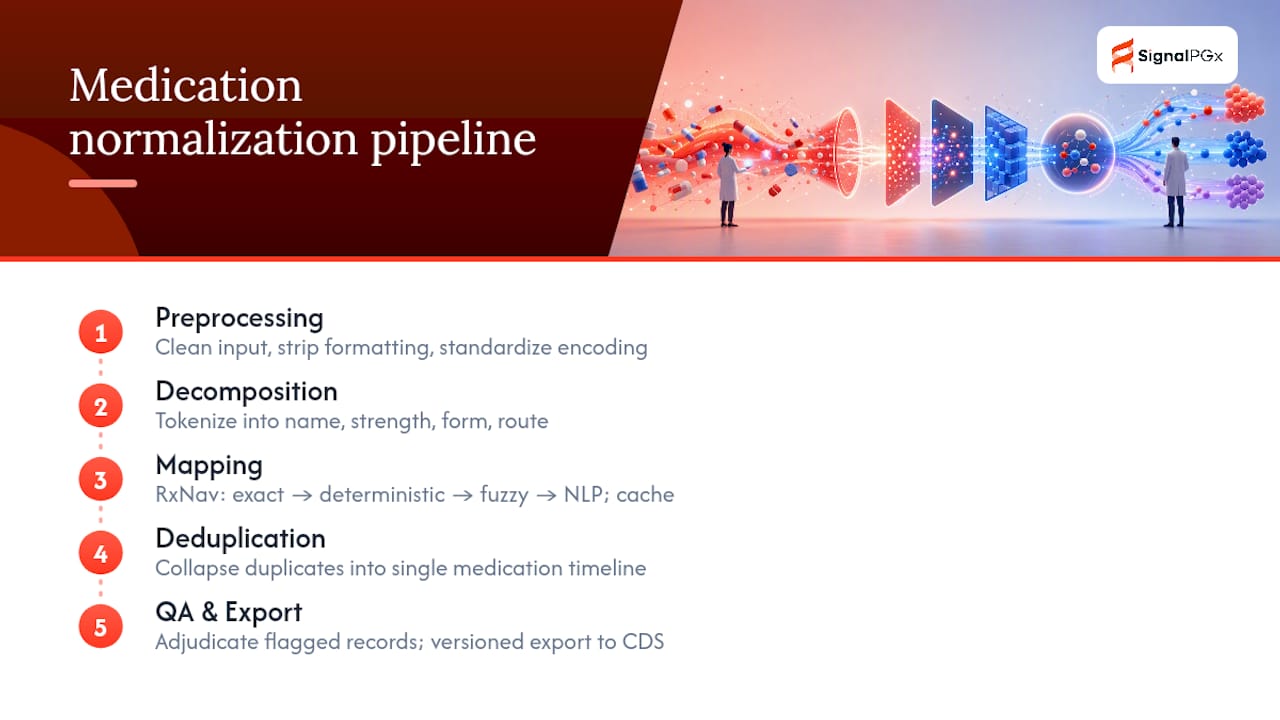
Programmatic RxNorm lookups via the RxNav API should always write results to a persistent matching cache. That cache stores raw inputs, candidate CUIs, and match scores so repeated queries return instantly and manual corrections propagate deterministically to future runs.
Pro Tip: Assign each pipeline phase to a discrete microservice or ETL job. A monolithic normalization script is hard to test, version, and rerun selectively when a vocabulary update changes only the mapping layer.
Which standards and vocabularies your pipeline should adopt
RxNorm is the U.S. canonical medication vocabulary and the authoritative identifier for normalized drug records in clinical data. Your pipeline should resolve every medication to an RxCUI and document whether that CUI represents an ingredient, a semantic clinical drug (SCD), or a branded drug concept.
Companion resources serve distinct roles in the mapping ecosystem:
- RxNav REST API (NLM): programmatic lookups, approximate matching, and relationship traversal
- DailyMed / SPL (FDA): structured product labels for dose, form, route, and NDC cross-reference
- PharmGKB: gene–drug evidence linking; your normalized RxCUIs must resolve to PharmGKB drug identifiers for PGx rule matching
- DrugBank: supplementary pharmacology and interaction data, useful for multi-ingredient disambiguation
- OMOP CDM: common data model for cross-site research queries; map RxCUIs to OMOP drug concept IDs when your lab participates in federated research networks
| Vocabulary | Role in PGx normalization | Update cadence | Why it matters |
|---|---|---|---|
| RxNorm (NLM) | Canonical drug identifier (RxCUI) | Monthly | Authoritative U.S. standard; required for CDS interoperability |
| RxNav API | Programmatic lookup and fuzzy match | Mirrors RxNorm | Enables automated, repeatable mapping at scale |
| DailyMed / SPL | Dose, form, route, NDC cross-reference | Continuous | Grounds attribute extraction in FDA-approved label data |
| PharmGKB | PGx evidence linking | Quarterly | Maps normalized drugs to gene–drug clinical annotations |
| DrugBank | Pharmacology, multi-ingredient disambiguation | Quarterly | Fills gaps where RxNorm lacks interaction detail |
| OMOP CDM | Federated research data model | Annual major releases | Enables cross-site PGx cohort queries |
Integrating RxNorm, DrugBank, DailyMed, and PharmGKB into a single knowledge model is often necessary to disambiguate drug–evidence relationships and build a portable PGx knowledge graph.
Practical mapping methods that work in production
Use a layered approach. Exact identifier lookup (NDC or DIN to RxCUI) runs first because it is deterministic and fast. Deterministic string match on cleaned drug names runs second. Fuzzy matching using Levenshtein-based similarity, tuned to a threshold validated on a pilot sample, handles spelling variants and abbreviations. NLP-based named entity recognition (NER) handles free-text clinical notes where structured fields are absent.
Decomposing medication strings into name, strength, dose form, and route before mapping, then composing an RxNorm-compliant representation from those attributes, materially improves accuracy compared to whole-string matching. Tools like MedXN implement this decomposition-and-composition pattern and can serve as a reference architecture for your NLP layer.
Capture match provenance for every record: method used, match score, candidate CUIs considered, and vocabulary version. Store this in your matching cache alongside the accepted CUI so adjudicators can audit any decision and so reanalysis can selectively reprocess records when thresholds change.
Pro Tip: Run a two-week pilot on a representative sample before setting fuzzy thresholds for production. A threshold tuned on your specific source data, rather than a published default, reduces both false positives and unnecessary adjudication load.
Handling edge cases and unmapped records without breaking PGx matching
Flag and route to manual review any record that fails deterministic mapping or carries conflicting attributes. Common edge cases your pipeline will encounter:
- Multi-ingredient combination products: decompose to individual ingredients, map each to its own RxCUI, and store the parent product name as a reference
- Supplements and OTCs: many lack RxCUIs; store best-effort ingredient mapping with a low-confidence flag and exclude from PGx rules that require coded drug exposure
- Local abbreviations and brand-name slang: maintain a curated synonym table that maps lab-specific shorthand to canonical drug names before the mapping layer runs
- Missing dose or form: store the ingredient-level RxCUI, mark dose/form fields as unspecified, and apply only ingredient-level PGx rules
- Route mismatches: a topical versus oral formulation of the same drug may have different PGx implications; flag route ambiguity for pharmacist review
Because a single RxCUI can map to multiple NDCs (NDCs are package-specific while RxCUIs are concept-level), preserve both identifiers in your provenance store. Discarding the source NDC before confirming the correct RxCUI is a common cause of misclassification.
Pro Tip: Keep your synonym and exception table in version control and treat every manual correction as a rule, not a one-off fix. That way, the same input string maps correctly in every future pipeline run without re-adjudication.
Validation metrics and the manual adjudication workflow
Measure three core metrics before promoting any normalization build to production: mapping coverage (percent of records resolved to an RxCUI), precision (percent of adjudicated mappings confirmed correct), and adjudication load (percent of records requiring manual review). Set target thresholds before your pilot ends, not after.
Free-text medication entries show misspelling and formatting error rates that can reach approximately 17%, which directly degrades automated mapping without preprocessing and fuzzy matching in place. That figure is a practical floor for estimating your adjudication queue size in early pipeline runs.
Statistic: Studies of registry and EHR free-text medication capture report non-trivial error rates, with misspelling rates reaching approximately 17%, that decrease mapping reliability without preprocessing and manual review.
For sampling, audit a random stratified sample of mapped records each release cycle, stratified by mapping method (exact, fuzzy, NLP, manual). Checklist items per record: correct RxCUI for the intended concept level, correct dose and form extraction, correct deduplication decision.
Governance, versioning, and compliance for U.S. labs
Enforce versioned mapping caches and treat mapping rule changes as code changes: commit them to version control, review them in pull requests, and tag releases. Vocabulary evolution and EHR heterogeneity make a one-time mapping impractical; your governance model must schedule reanalysis whenever RxNorm publishes a monthly update or a PGx guideline changes.
Governance checklist for your lab:
- Maintain a mapping change log with timestamps, rationale, and approver identity
- Run automated drift detection to flag RxCUIs that have been deprecated or merged in the latest RxNorm release
- Require pharmacist or clinical informaticist sign-off before any guideline-driven reanalysis goes to production
- Store PHI-containing medication records in HIPAA-compliant infrastructure; apply the same controls to your matching cache and adjudication UI
- Track FDA label changes via DailyMed for drugs with active PGx annotations and trigger reanalysis when labeling updates affect gene–drug recommendations
Pro Tip: Schedule living reanalysis runs on a calendar cadence tied to RxNorm's monthly release and CPIC's quarterly guideline updates, not on an ad hoc basis. A scheduled trigger is auditable; a manual one is not.
How normalization granularity directly affects PGx rule triggering
Normalization granularity and deduplication rules determine which medications count as active exposures when your PGx CDS engine queries gene–drug evidence. Choosing ingredient-level RxCUIs works when the underlying PGx evidence (PharmGKB annotations, CPIC guidelines) is ingredient-based. Choosing SCD-level mapping is necessary when the rule is dose- or form-sensitive, because an ingredient-level CUI cannot distinguish oral from intravenous administration or immediate-release from extended-release formulations.
Scenario: A patient's medication history contains three NDC-derived rows for the same extended-release metoprolol product, sourced from two EHR encounters and one pharmacy claim. Without deduplication and SCD-level normalization, the PGx engine sees three separate drug exposures and may apply conflicting CYP2D6 interaction rules, or worse, fail to match any rule because the NDC-level identifiers do not align with the PharmGKB drug concept. A single deduplicated SCD-level RxCUI resolves the ambiguity and triggers the correct gene–drug alert.
Mapping to a consistent RxNorm concept level is therefore not a data-hygiene preference; it is a prerequisite for deterministic drug–gene interaction detection in automated reporting.
Implementation checklist and recommended architecture components
Your minimum viable normalization architecture needs six components: an ingestion service, a normalization microservice, a matching cache, an adjudication workflow, a PGx export module, and a monitoring and reanalysis scheduler.
Stepwise deployment checklist:
- Ingest medication records from EHR, pharmacy, and lab sources via HL7/FHIR or flat-file connectors; normalize character encoding and strip formatting artifacts.
- Decompose each record into name, strength, dose form, and route fields using a rule-based or NLP parser.
- Map decomposed records to RxCUIs via the RxNav API; write results to a persistent matching cache with match scores and provenance.
- Deduplicate across sources using a temporal collapse algorithm; retain the most specific RxCUI and flag conflicts for adjudication.
- Adjudicate flagged records in a pharmacist-facing UI; corrections write back to the synonym table and cache.
- Export the versioned, normalized medication list to your PGx CDS engine in a structured format (FHIR MedicationStatement or equivalent).
- Monitor coverage, precision, and adjudication load metrics; trigger reanalysis on RxNorm or guideline update events.
Key tool patterns to implement:
- A persistent match cache (modeled on the GEMINI-RxNorm architecture) that stores raw inputs, candidate CUIs, and scores
- Automated unit tests for mapping rules, run on every cache update
- A provenance store that links each output RxCUI to its source record, mapping method, and vocabulary version
- An adjudicator interface accessible to clinical pharmacists, with a review queue sorted by confidence score
Realistic timeline and staffing for an MVP pipeline
| Phase | Duration | Key activities |
|---|---|---|
| Pilot | 6–10 weeks | Source data profiling, RxNav integration, fuzzy threshold tuning, initial adjudication |
| Validation and QA | 6–12 weeks | Coverage and precision measurement, audit sampling, governance setup |
| Production and living reanalysis | Ongoing | Monthly RxNorm sync, quarterly guideline reanalysis, adjudication throughput monitoring |
Staffing for a typical lab deployment: one data engineer (pipeline build and cache infrastructure), one clinical informaticist or NLP engineer (decomposition and mapping logic), one clinical pharmacist (adjudication and synonym curation), one QA engineer (metric instrumentation and audit sampling), and a project lead for governance coordination. FTE allocation is heaviest in the pilot phase and drops to a part-time maintenance cadence once the pipeline reaches production.
For labs looking to reduce that staffing burden, scaling PGx reporting without adding headcount is achievable when the normalization and reporting infrastructure is already production-grade.
Operational KPIs to track for ongoing pipeline health
Track five metrics continuously once your normalization pipeline is in production:
- Percent mapped to RxCUI: mapped rows divided by total input rows; target above 90% at pilot exit, above 95% at mature production
- False-positive match rate: adjudicated-incorrect records divided by total adjudicated sample; target below 5% at mature production
- Adjudication load: records flagged for manual review divided by total records; target below 10% at mature production
- Time-to-adjudicate: median hours from flagging to pharmacist resolution; track to size your adjudication team and SLA
- Downstream PGx match recall: percent of expected gene–drug rule triggers that fire correctly on a gold-standard test set; this is the metric that directly reflects normalization quality in clinical terms
Instrument each KPI in your monitoring layer and set alerting thresholds so that a vocabulary update or new data source that degrades coverage triggers an automated review before the next report generation cycle.
How SignalPGx accelerates medication normalization in production
SignalPGx provides a production-grade PGx reporting stack that ingests normalized medication data, links it to evidence from more than 20 sources including PharmGKB, CPIC, and FDA biomarker labeling, and runs living reanalysis as guidelines evolve. The platform's medication intelligence graph connects RxNorm-mapped drug records to gene–drug evidence, enabling automated rule matching without requiring your team to build and maintain that evidence layer from scratch.
Platform capability: SignalPGx supports RxNorm-based medication ingestion, HL7/FHIR EHR integration, medical-director review and audit trail workflows, and a medication intelligence simulation that evaluates predicted drug response against a patient's genotype, all within a HIPAA-compliant infrastructure.
For labs that need clinically defensible PGx reports with auditable provenance, SignalPGx's adjudication and physician-review workflows address the manual oversight requirement that no fully automated pipeline can eliminate.
Practical trade-offs observed in lab deployments
The most consequential decision in any normalization project is where to set the granularity boundary, and it is rarely obvious at the start. Ingredient-level mapping gets you to production faster and covers the majority of CPIC-graded gene–drug rules, but it will miss dose/form-sensitive interactions that require SCD-level specificity. Aggressive fuzzy matching raises your coverage numbers, but a threshold set too low floods the adjudication queue with false positives, consuming pharmacist time that is usually the scarcest resource in a lab. The right balance depends on your lab's PGx rule set: audit which rules in your evidence layer are ingredient-based versus form-sensitive, and set your granularity target accordingly. Accept ingredient-level mappings for rules where the evidence is ingredient-based; require SCD-level specificity only where the clinical recommendation genuinely changes with dose or route. That scoped approach keeps adjudication load manageable without sacrificing the precision your CDS engine needs.
SignalPGx shortens your path to a validated PGx pipeline
Building a normalization pipeline from scratch, with a matching cache, adjudication UI, provenance store, and living reanalysis scheduler, typically takes 12–22 weeks of engineering time before a single PGx report reaches a clinician. SignalPGx delivers that infrastructure as a production-ready, white-label stack that your lab can deploy in 5–7 days, with RxNorm-based medication ingestion, HL7/FHIR connectors, and medical-director review already built in.
Your team focuses on adjudication quality and clinical governance; SignalPGx handles the mapping infrastructure, evidence updates, and HIPAA-compliant security. To evaluate fit for your lab's pipeline, review the PGx reporting platform or request a pilot integration discussion with the SignalPGx team.
Sources
The following primary references are the authoritative sources for the claims and architecture patterns in this article. Consult them directly when designing your normalization pipeline or evaluating tooling.
Core references: RxNorm (NLM) — Nlm RxNav REST API — Lhncbc PharmGKB — Pharmgkb DailyMed / SPL — Dailymed GEMINI-RxNorm pipeline (PMC10409892) — automated matching cache and manual review architecture MedXN decomposition-and-composition tool (PMC4147619) — medication extraction and normalization from clinical text Cross-terminology mapping challenges (PMC4398308) — NDC-to-RxCUI 1-to-many mapping and provenance requirements EHR pharmacology research considerations (PMC11213823) — vocabulary evolution and continuous curation requirements PGx knowledge model integration (PMC7641779) — combining RxNorm, DrugBank, DailyMed, and PharmGKB
- Automated identification of unstandardized medication data: a scalable and flexible data standardization pipeline using RxNorm on GEMINI multicenter hospital data - PMC
FAQ
What is the right RxNorm granularity for PGx pipelines?
Use ingredient-level RxCUIs for gene–drug rules where evidence is ingredient-based, and SCD-level concepts when the rule is dose- or form-sensitive. Document the chosen level before building and apply it consistently.
How do you handle free-text medication entries with spelling errors?
Apply a fuzzy matching layer (Levenshtein-based) after exact and deterministic string matching, with a threshold tuned on a pilot sample from your specific data source.
Why does deduplication matter for automated PGx decision support?
Duplicate NDC-derived rows for the same drug exposure cause PGx engines to see multiple conflicting records, which can suppress or duplicate gene–drug rule triggers. Temporal collapse to a single deduplicated RxCUI per exposure is a prerequisite for deterministic CDS matching.

How often should a normalization pipeline be updated?
Sync with RxNorm's monthly release cycle and run living reanalysis whenever CPIC or FDA biomarker labeling updates affect drugs in your active PGx rule set. Vocabulary drift without scheduled updates degrades mapping coverage over time.
Can SignalPGx handle medication normalization as part of its PGx reporting stack?
SignalPGx supports RxNorm-based medication ingestion, HL7/FHIR EHR integration, and living reanalysis within a HIPAA-compliant platform, reducing the engineering effort required to build and maintain a normalization pipeline from scratch.