
For storage and transfer, use container-level envelope encryption, specifically Crypt4GH, the GA4GH-approved format that supports random-access reads without full-file decryption. For computation that must keep raw genotypes hidden from the computing party, reach for homomorphic encryption (FHE/CKKS) or multi-key HE and secure multi-party computation (SMC) when multiple institutions each hold their own data. Choose a trusted execution environment (TEE) when your team needs near-native performance and can't rewrite existing pipeline code.
None of these are free. Crypt4GH is fast and interoperable but does nothing to protect data once it's decrypted in memory for analysis. FHE protects computation itself but carries real performance overhead. TEEs are fast but shift your trust model to hardware vendors.
- Storage/transfer: Crypt4GH
- Confidential computation: FHE, multi-key HE, or SMC
- Performance-critical compatibility: TEEs
Pro Tip: Don't pick one primitive and stop there. The labs with the fewest incidents combine Crypt4GH for data at rest with a NIST NCCoE-style threat model that governs how, when, and by whom data ever gets decrypted.
Key Takeaways
Genomic data protection requires pairing Crypt4GH for storage and transfer with homomorphic encryption, multi-key HE, SMC, or TEEs for confidential computation.
| Point | Details |
|---|---|
| Match method to workflow | Use Crypt4GH for archive/sharing, FHE or SMC when raw genotypes must stay hidden during computation. |
| Follow NIST's lifecycle model | Apply NIST IR 8432's genomic-specific threat modeling instead of generic EHR security controls. |
| Fix the decrypted-copy problem | Use Crypt4GH's byte-range access so pipelines never need a fully decrypted file on disk. |
| Manage keys deliberately | Rotate keys, use an HSM or cloud KMS, and adopt multi-key models for cross-institution work. |
| Build reporting on a secure base | SignalPGx layers HL7/FHIR integration and HIPAA/GDPR-compliant reporting on top of labs' encrypted genomic pipelines. |
Table of Contents
- Why Genomic Data Needs Its Own Threat Model
- What Encryption Methods Actually Work for Genomic Data?
- Which Standards and Benchmarks Should You Trust?
- How Should You Manage Keys and Governance?
- Which Encryption Approach Fits Your Use Case?
- Sources
- FAQ
Why Genomic Data Needs Its Own Threat Model
A stolen credit card number gets replaced. A leaked genome cannot be reissued. That single fact drives everything about genomic data protection: your patient's DNA reveals information about siblings, children, and parents who never consented to sequencing, and it stays identifying for their entire lifetime.
NIST IR 8432 found that generic security controls built for typical health records routinely miss genomic-specific failure points across the data lifecycle: generation, transfer, storage, sharing, and disposal. The report calls out gaps that recur across labs:
- Sequencers exposed on hospital or lab networks with weak segmentation
- Decrypted intermediate files (BAM, VCF) left on analyst workstations during pipeline runs
- Aggregated datasets that become reidentifiable even after individual records are anonymized
NIST's own cybersecurity guidance argues these gaps justify a dedicated Cybersecurity Framework Profile for genomic data rather than borrowing generic HIPAA-era controls wholesale.
What Encryption Methods Actually Work for Genomic Data?
Five approaches dominate current practice, and they solve different problems.
Crypt4GH and encrypted file containers. Crypt4GH wraps genomic files in envelope encryption: a small header carries per-recipient keys, while the bulk data stays encrypted on disk. Because it supports byte-range random access, tools can pull a specific genomic region without decrypting the entire file first. The implementation paper documents integrations into htslib, htsjdk, and samtools, meaning existing genomics pipelines can adopt it with modest code changes rather than a rebuild.
Homomorphic encryption (FHE/CKKS). This lets you run computations directly on ciphertext. The result decrypts to the same answer you'd get on plaintext, but the computing party never sees raw genotypes. HEPRS demonstrated that CKKS-based FHE can calculate polygenic risk scores on encrypted genotypes with negligible accuracy loss, though it comes with real memory and runtime cost compared to plaintext math.
Multi-key HE and SMC. Standard HE assumes one key holder. That's fine for a single lab, but collaborative research across institutions needs something else. Multi-key homomorphic encryption lets each participating site encrypt with its own independent key, so no single party's compromise exposes the whole dataset. SMC achieves a similar goal through protocol design rather than pure cryptography, splitting computation across parties so no one sees the full input.
Trusted execution environments. TEEs like SGX run code inside a hardware-isolated enclave, decrypting data only within that protected boundary. Performance is close to native, and legacy pipeline code often runs with minimal rewriting. The catch: you're trusting the chip vendor's enclave implementation, and side-channel attacks against enclaves are an active research area.
Hybrid architectures. Most production deployments pair Crypt4GH for storage and transfer with FHE, SMC, or TEEs for the actual analysis step, plus disciplined key management tying it all together.
- Crypt4GH: fast, interoperable, mature; zero protection once decrypted for analysis
- FHE/HEPRS: strong confidentiality during compute; heavier resource footprint
- SIG-DB-style encrypted search: enables private sequence queries without exposing the database, still largely proof-of-concept
- Multi-key HE/SMC: removes single points of trust for multi-institution work; added protocol complexity
- TEEs: near-native speed; hardware trust dependency
Pro Tip: If your team is choosing based on speed alone, run the comparison on your actual file sizes. FHE overhead scales unevenly with genotype count, and a method that looks slow on a benchmark VCF can be perfectly workable on your production dataset.
Which Standards and Benchmarks Should You Trust?
Standards adoption is the difference between a research prototype and something you can put into production. GA4GH formally approved Crypt4GH as a specification, and its presence inside htslib, htsjdk, and samtools means most genomics shops can adopt it without abandoning their existing toolchain. That's a meaningfully lower lift than switching to a novel format with no library support.
- Crypt4GH spec and benchmarks: byte-range decryption for BAM/VCF workloads, documented overhead versus plaintext
- HEPRS: open, peer-reviewed FHE implementation for polygenic risk scoring
- SIG-DB: proof-of-concept combining locality-sensitive hashing with homomorphic encryption for encrypted sequence search
- NIST IR 8432 and NCCoE SP 1800 drafts: lifecycle threat models and governance profiles
| Reference | What It Gives You |
|---|---|
| GA4GH Crypt4GH spec | Standardized encrypted container format with native tool support |
| HEPRS repository | Working FHE implementation for encrypted polygenic risk scoring |
| SIG-DB | Encrypted sequence-search proof-of-concept |
| NIST IR 8432 / NCCoE | Lifecycle threat modeling and governance profile guidance |
The NIST NCCoE project pairs its threat-modeling work with NIST PRAM and STRIDE frameworks, giving security teams a repeatable way to map genomic-specific risks to control catalogs instead of improvising.
How Should You Manage Keys and Governance?
Crypt4GH's header design already builds in a smart default: it separates the encrypted data from a small header carrying per-recipient keys, so you can grant a new collaborator access by re-wrapping the header rather than re-encrypting terabytes of sequence data.
Single-key models work fine inside one institution. They become a liability the moment two or more organizations need to compute jointly. A multi-key HE or SMC design means no single compromised key unlocks everyone's data.
Practical governance steps worth running through:
- Rotate encryption keys on a defined schedule, not just after a suspected incident
- Store keys in an HSM or cloud KMS rather than embedded in pipeline scripts
- Apply least-privilege access with audit trails on every decryption event
- Track consent and data provenance alongside the genomic record itself, ideally via FHIR-based provenance tracking
- Segment sequencer networks from general lab IT to reduce lateral movement risk
- Consent boundaries need to travel with the data, not live in a separate spreadsheet
- Network microsegmentation for sequencers is cheap insurance against a costly breach
- Incident response plans should assume genomic data can't be "reset" after exposure
Pro Tip: The single most common failure isn't weak cryptography, it's the decrypted BAM file an analyst leaves sitting on a laptop mid-pipeline. Crypt4GH's byte-range access exists specifically so tools never need a fully decrypted copy on disk in the first place.
Which Encryption Approach Fits Your Use Case?
Match the method to the workflow rather than picking one primitive for everything.
- Long-term archive and cross-lab sharing: Crypt4GH plus a managed KMS. Mature, fast, well-supported.
- Routine on-site clinical analysis: Crypt4GH combined with TEEs or a tightly segmented compute environment. Near-native speed with a contained trust boundary.
- Outsourced or privacy-sensitive risk scoring: FHE or a HEPRS-style implementation. Slower, but the computing party never sees raw genotypes.
- Distributed GWAS across institutions: SMC or multi-key HE. No single party holds a master key across sites.
- Crypt4GH is production-ready today; most genomics teams can adopt it this quarter
- FHE and SMC are viable but still carry meaningful performance and engineering overhead
- Hybrid stacks (Crypt4GH at rest, HE/TEE during compute) are becoming the practical default rather than the exception
When a single method can't satisfy both privacy and utility, that's the signal to combine primitives rather than compromise on either.
Balancing Rigor With Momentum
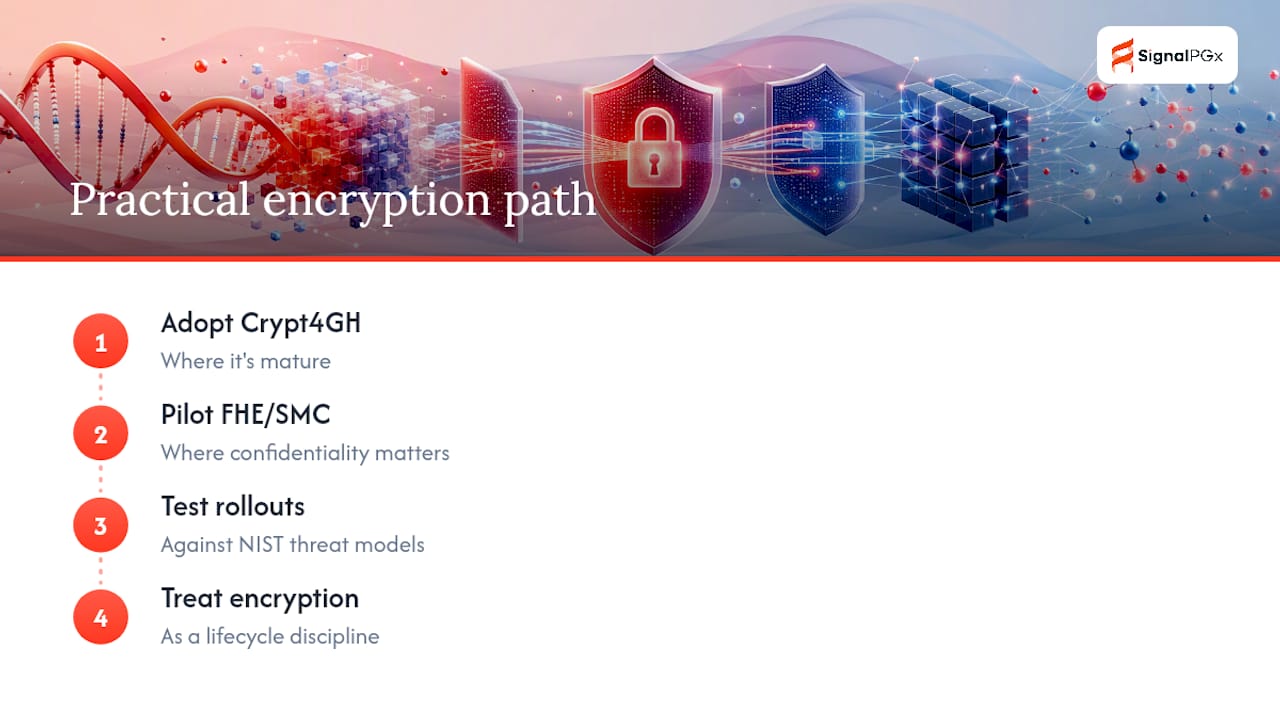
Privacy-preserving cryptography for genomics keeps advancing, but perfect security that never ships helps no one. The practical path is standards-driven: adopt Crypt4GH where it's mature, pilot FHE or SMC where confidentiality during computation genuinely matters, and test rollouts against NIST's own threat models before scaling. SignalPGx builds its reporting infrastructure on that same premise, treating encryption as a lifecycle discipline rather than a checkbox.
Where SignalPGx Fits Into a Secure Genomic Pipeline
Everything above assumes your lab has already solved encryption in transit and at rest, and that's exactly the layer SignalPGx sits on top of. The platform ingests genotype and medication data, applies medical-director-reviewed interpretation, and delivers reports through HL7/FHIR integration, all under HIPAA and GDPR compliance controls built for labs that already take genomic data governance seriously.
For a lab that has hardened its encryption layer but still hand-builds PGx reports downstream, that's the gap worth closing next. SignalPGx's white-label infrastructure lets labs deploy a branded pharmacogenomic reporting service in 5 to 7 days, without building interpretation logic or a report pipeline from scratch. If you're evaluating how encrypted genotype data flows into clinical-grade output, look at SignalPGx's white-label PGx reporting for laboratories ready to move from raw data to physician-reviewed reports.
Sources
- Cybersecurity of Genomic Data (NIST IR 8432) — Final report
- Genetic Data Encryption (Crypt4GH) – GA4GH
- Crypt4GH: a file format standard enabling native access to encrypted data
- Privacy-preserving framework for genomic computations via multi-key homomorphic encryption — NSF PAR
This article is general information, not a substitute for advice from a qualified doctor. Consult a qualified healthcare professional about your own circumstances before acting on anything here.
FAQ
What Is the Best Encryption Method for Genomic Data?
There's no single best method: use Crypt4GH for storage and transfer, and add homomorphic encryption, multi-key HE, or SMC when computation itself must stay confidential.
Is Crypt4GH Compatible With Existing Genomics Tools?
Yes. Crypt4GH is GA4GH-approved and integrates into htslib, htsjdk, and samtools, so most pipelines can adopt it without a full rebuild.
Can You Run Genomic Analysis on Encrypted Data Without Decrypting It?
Yes, through homomorphic encryption. HEPRS demonstrated computing polygenic risk scores on encrypted genotypes with negligible accuracy loss.
Why Doesn't Standard HIPAA Encryption Cover Genomic Data Risks?
NIST IR 8432 found genomic data's lifelong identifiability and kinship-revealing nature create lifecycle risks that generic health record controls don't address.
How Does SignalPGx Handle Encrypted Genomic Data in Reporting?
SignalPGx integrates with lab pipelines through HL7/FHIR standards and applies HIPAA/GDPR-compliant controls to turn encrypted genotype and medication data into physician-reviewed PGx reports.