
Translate CPIC recommendations into computable IF-THEN rules, encode results as discrete coded observations, and surface guidance at the moment a clinician places an order. That is the entire job, stated plainly. Everything else in a CPIC integration guide is detail work in service of that sequence: rule logic, coded data, and delivery at the point of prescribing.
The CPIC Informatics Working Group has said explicitly that its guidelines should be read as technical specifications for engineers, not literature reviews for clinicians. That reframing matters. A PDF summary of a CPIC guideline does nothing for clinical decision support (CDS) until someone converts its recommendation tables into logic a rules engine can execute against a patient's phenotype and the drug being ordered.
Three moves make or break the project:
- Turn each guideline's dosing table into discrete IF phenotype/drug THEN action rules.
- Store results in LOINC-coded Observations (or HL7 v2 OBX segments) and match drugs using RxNorm identifiers, never free text.
- Deliver the recommendation through FHIR and CDS Hooks, or an HL7 v2 feed into the EHR's CDS layer, and build a living reanalysis process so rules update when CPIC does.
Pro Tip: Before writing a single rule, confirm your lab can already produce a discrete phenotype value, not just a PDF report. If phenotype lives only in prose, every downstream step stalls.
Key Takeaways
Successful CPIC integration depends on discrete, standards-coded data reaching a layered CDS system at order time, backed by governance that keeps rules current as guidelines evolve.
| Point | Details |
|---|---|
| Code everything discretely | Use LOINC for results, RxNorm for medications, and PharmVar/PharmGKB for alleles and phenotypes. |
| Layer your CDS design | Start with passive displays, add active alerts only for CPIC high-risk, high-evidence interactions. |
| Plan for ambiguous genotypes | Route indeterminate phenotype calls to pharmacist review instead of defaulting to normal metabolizer status. |
| Build living reanalysis in early | Automate re-evaluation and clinician notification whenever CPIC guidance updates. |
| Consider a deployable platform | SignalPGx delivers HL7/FHIR outputs, living reanalysis, and physician review, typically live within 5 to 7 days. |
Table of Contents
- Prerequisites and Project Plan Before You Start Building
- How Do You Map Genotype Data to Coded PGx Results?
- How Do You Convert CPIC Guidance Into CDS Rules?
- What Integration Pattern Should Connect Your LIS and EHR?
- What Should Your Test Plan Look Like Before Go-Live?
- How Do You Keep CPIC Rules Current After Deployment?
- Handling Edge Cases and Ambiguous Genotypes in Rule Logic
- Integration Examples Across Common EHR Environments
- Security and Privacy Considerations Specific to PGx Data
- User Training and Change Management for Clinical Staff
- Fallback and Error Handling Mechanisms in CDS Rules
- Deploy a Standards-Based PGx Report Without Building From Scratch
- Sources
- FAQ
Prerequisites and Project Plan Before You Start Building
Get the right people and data lined up first, or the engineering work will stall on approvals nobody thought to request.
- Assemble the team. You need a lab director, a clinical pharmacist who understands CPIC dosing tables, an EHR/informatics analyst, someone from security/compliance, and a project manager to keep the calendar honest.
- Confirm your data inputs. Know whether you are starting from VCF variant calls or diplotype/haplotype outputs, what LOINC codes your lab already assigns, how patients get matched across systems, and how medications will map to RxNorm.
- Define governance up front. Decide who signs off on rules before go-live, how overrides get logged, and how you will satisfy HIPAA and GDPR obligations for genomic data specifically, not just general PHI.
- Set a realistic timeline. Basic plumbing (getting a discrete result into an EHR field) can happen in days. Clinical governance, pharmacist review, and a full rollout with training typically take weeks to months, depending on how many drug-gene pairs you are activating at once.
A practical checklist for labs launching PGx reporting covers the sequencing in more depth if your team is scoping this for the first time.
How Do You Map Genotype Data to Coded PGx Results?
CDS rules can only query discrete facts, not narrative text, so every genotype has to travel a defined path from raw variant call to coded observation before a rule can touch it.
The path runs through allele nomenclature and standard terminology. PharmVar supplies the star allele definitions; PharmGKB layers on phenotype interpretation and CPIC guideline content; LOINC codes the test and result; RxNorm identifies the medication. Skipping any one of these forces a human to interpret free text at the point of care, which defeats the purpose of building CDS at all.
Model the output using HL7 FHIR Genomics Reporting profiles: an Observation for the phenotype call, a DiagnosticReport tying results together, and a TherapeuticImplication resource carrying the medication-specific recommendation. Legacy systems that cannot ingest FHIR yet still need the same information carried in HL7 v2 OBX segments, just packaged differently.
- Convert variants (expressed in HGVS notation) into star alleles, then into phenotype, with a documented, versioned conversion rule set.
- Attach provenance to every recommendation using RelatedArtifact or PlanDefinition so a reviewer can trace a rule back to the exact CPIC guideline version it came from.
- Keep test LOINC codes and observation codes separate from the phenotype value itself. Conflating them is a common cause of mapping bugs.
| Field | Example Content |
|---|---|
| Test LOINC code | Identifies the pharmacogenomic panel or gene test performed |
| Observation code | Distinguishes phenotype call from raw genotype/variant data |
| Phenotype value | Coded metabolizer status (e.g., poor, intermediate, normal, rapid) |
| Allele identifiers | PharmVar star allele designation for each haplotype |
| Medication code | RxNorm identifier for the drug the recommendation concerns |
| Guideline citation | CPIC guideline URL and version, attached via RelatedArtifact |
A deeper walkthrough of this conversion logic lives in SignalPGx's genotype-to-phenotype guide.
How Do You Convert CPIC Guidance Into CDS Rules?
Start with one guideline, deconstruct it fully, and resist the urge to build all your drug-gene pairs at once.
- Extract the conditions. Read the CPIC dosing table as a set of IF statements: phenotype value, drug ordered (by RxNorm ingredient, not brand name), and any relevant patient context such as age or indication.
- Extract the actions. Each condition maps to a THEN clause: a MedicationRecommendation Task, specific recommendation text pulled from the guideline, and a severity level that determines whether the alert interrupts the workflow or simply informs it.
- Set rule preconditions carefully. Require a discrete phenotype value and a matched RxNorm ingredient before a rule fires at all. Build in context filters for exceptions like palliative care, where a standard dosing recommendation may not apply.
- Layer your CDS. Start passive, a PGx tab or infobutton clinicians can consult voluntarily, and reserve active, interruptive alerts for the CPIC-defined highest-risk interactions only. One pilot combining passive displays with targeted active alerts reported 92% clinician acceptance on the alerts it did fire, because the alert volume stayed low enough that clinicians trusted each one.
- Test and govern before activation. Every rule needs a documented test case tied to the CPIC recommendation it implements, plus clinical sign-off before it goes live, and a plan to track fire count and override rate once it does.
An architecture that separates the rules engine from the knowledge base makes this iteration faster. When PharmGKB or CPIC updates a recommendation, you change the knowledge base once instead of hunting through duplicated logic scattered across multiple system components.
Pro Tip: Write your first rule for a drug-gene pair with unambiguous CPIC guidance and low prescribing volume. Get the full pipeline, from coded result to fired alert, working end to end before you touch anything with higher clinical stakes.
What Integration Pattern Should Connect Your LIS and EHR?
Legacy EHR environments generally still run on HL7 v2 ORU messages for lab results, while newer, more interoperable deployments increasingly use FHIR Genomics Reporting paired with CDS Hooks for real-time order-entry checks. Most labs end up running both simultaneously, at least during a transition period, and an interface engine sits between the lab information system (LIS) and the EHR to translate and remap codes as needed.
A few operational realities determine whether this works cleanly:
- Patient matching has to be airtight. A pharmacogenomic result attached to the wrong MRN is a far worse failure mode than a missing result, because it can trigger a dosing recommendation for the wrong patient.
- Lab LOINC codes need explicit mapping to whatever flowsheet row or result field the EHR uses internally. These do not always align automatically, even between two systems that both claim LOINC compliance.
- FHIR and CDS Hooks remain genuinely promising but semantically inconsistent right now. Expect to encounter the same clinical concept expressed through different resource structures depending on the source system, and plan mapping logic accordingly rather than assuming a single FHIR profile will cover every case.
- Confirm early whether your EHR vendor's genomics module, such as Epic's or Cerner's equivalent, accepts discrete PGx fields natively. If it does not yet, you need a fallback display strategy so the recommendation still reaches the clinician in some usable form.
SignalPGx's overview of FHIR and CDS Hooks for PGx walks through these interoperability patterns in more technical depth, alongside a look at how genomics education resources frame the current evidence landscape for implementers.
What Should Your Test Plan Look Like Before Go-Live?
Nothing about pharmacogenomic CDS should reach production without synthetic data proving it first.
- Unit test each rule in isolation. Feed synthetic haplotype and genotype combinations through the rule and confirm the output recommendation matches the CPIC table exactly, including edge phenotypes.
- Integration test the full order-to-response loop. Simulate an order being placed in the EHR and verify the CDS response returns correctly, in the right format, within an acceptable response time.
- Roll out in stages. Move from development to a staging environment with real clinicians testing workflows, then a limited pilot with a small patient population, then full production. Each stage needs its own smoke tests and a short clinician training session before expansion.
- Track the KPIs that matter. Alert fire rate, acceptance versus override rate, and time-to-action tell you whether the rule is clinically useful or just noisy. Use override reasons to refine thresholds rather than treating every override as clinician error.
How Do You Keep CPIC Rules Current After Deployment?
Guidelines change. CPIC updates recommendations as new evidence emerges, and a static rule set quietly goes stale the moment that happens.
- Automate re-evaluation of stored genotype and phenotype data whenever CPIC or another evidence source updates, and notify the responsible clinician when a patient's existing recommendation materially changes.
- Version every rule change and require medical-director signoff on anything beyond a trivial edit, with a full audit trail behind it.
- Set a regular governance review cadence, separate from an emergency fast-track process for urgent safety-driven guideline updates.
- Log every override reason permanently. That log becomes your quality improvement data and your medico-legal defense if a dosing decision is ever questioned later.
Pro Tip: Treat living reanalysis as a subscription to evidence, not a one-time build. A rule engine that never revisits its own outputs is a liability dressed up as infrastructure. SignalPGx's approach to living PGx reports covers how automated re-evaluation can run without manual reprocessing of every chart.
Handling Edge Cases and Ambiguous Genotypes in Rule Logic
Real patients do not always sort cleanly into CPIC's phenotype categories, and your rule logic needs an explicit path for every case that does not.
Compound heterozygotes, novel or rare alleles not yet assigned a PharmVar designation, and copy number variations all produce genotype results that resist a clean star-allele call. When your allele conversion logic cannot confidently assign a phenotype, the rule should return an "indeterminate" or "uncertain function" state rather than silently defaulting to normal metabolizer status. A default-to-normal fallback is the single most dangerous shortcut in this entire pipeline, because it hides genuine uncertainty behind a confident-looking result.
Build a distinct CDS pathway for indeterminate phenotypes: route these to passive display with a note recommending pharmacist consultation, rather than suppressing the alert or, worse, generating a specific dosing recommendation from incomplete data. Some CPIC guidelines already define intermediate categories like "possible intermediate metabolizer" for exactly this reason, and your rule templates should preserve that granularity instead of collapsing it into the nearest defined bucket.
Multi-gene interactions compound the problem. A patient who is a CYP2D6 poor metabolizer and also carries a relevant CYP2C19 variant may need combined guidance that no single CPIC guideline addresses directly. Document these interaction gaps explicitly in your rule inventory so pharmacists know where clinical judgment has to fill in, rather than discovering the gap during an actual prescribing event.
Integration Examples Across Common EHR Environments
The mechanics of getting a PGx recommendation in front of a prescriber vary meaningfully depending on which EHR platform sits on the other end of the interface.
Modern EHR genomics modules generally expect discrete FHIR Genomics Reporting resources and can support CDS Hooks calls at order entry, which lets a pharmacogenomic rule fire in real time as a clinician types a prescription. Older or more customized EHR deployments frequently still rely on HL7 v2 ORU feeds routed through an interface engine, with the phenotype result landing in a flowsheet or a specific result field that CDS logic then queries on a scheduled basis rather than instantaneously.
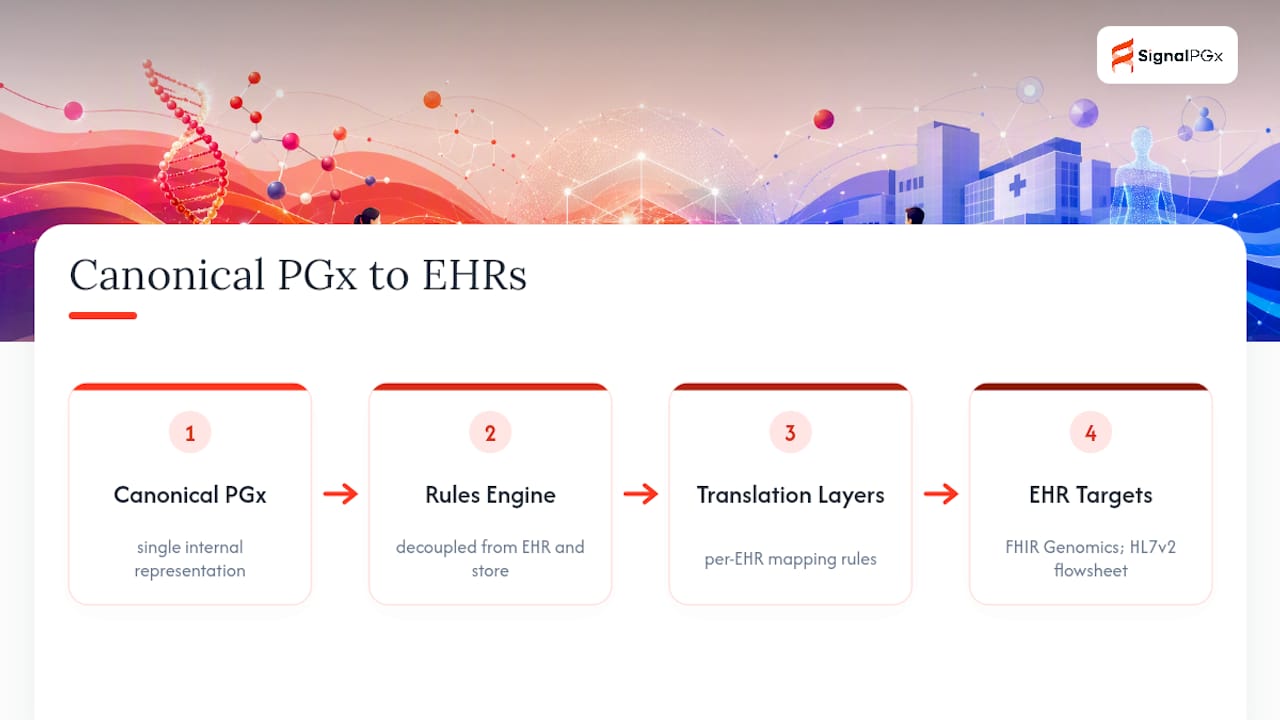
A demonstrated FHIR and CDS Hooks architecture, built around a controller, a separate rules engine, and an interface to a genomic archive access service, has shown it can execute CPIC rules successfully in connectathon testing and limited pilots. That pattern, keeping the rules engine decoupled from both the EHR and the data store, gives you room to update logic without touching either system directly.
The practical lesson across these environments is consistency of mapping, not uniformity of technology. A lab serving multiple hospital systems, each running a different EHR platform, needs one canonical internal representation of its PGx results and a set of per-EHR translation rules layered on top, rather than building bespoke logic for each destination system from scratch. That separation is what keeps a multi-site rollout from becoming a maintenance burden that scales linearly with every new EHR connection you add.
Security and Privacy Considerations Specific to PGx Data
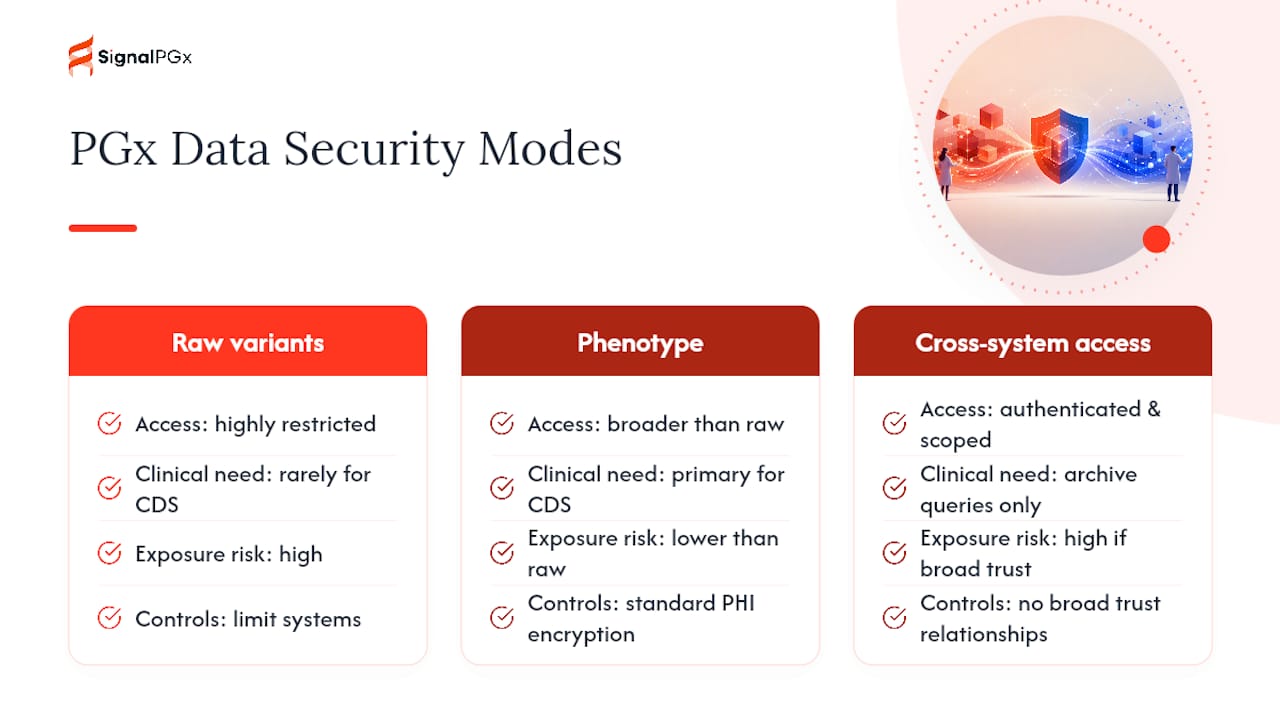
Pharmacogenomic results carry a distinct risk profile compared with routine lab values, because genotype data is immutable, potentially identifying across family members, and subject to specific regulatory attention in many jurisdictions beyond standard PHI rules.
Every interface carrying a genotype or phenotype result needs the same encryption and access control rigor you already apply to other protected health information under HIPAA, and to personal data under GDPR where applicable, but with a few PGx-specific additions worth naming directly. Access to raw variant data should be more tightly restricted than access to the interpreted phenotype result that clinicians actually need for prescribing decisions. Most CDS logic only requires the phenotype call, not the underlying VCF file, so limiting raw genomic data exposure to the smallest possible set of systems reduces your overall attack surface without limiting clinical usefulness.
Audit logging matters more here than for routine results, because a pharmacogenomic recommendation that influenced a prescribing decision may need to be reconstructed months or years later for a quality review or a legal inquiry. Every rule firing, every override, and every version change to the underlying rule logic needs a timestamped, immutable record tied to the specific guideline version in effect at the time.
Cross-system queries to a genomic archive or a genomic archive access service (GACS) need authenticated, scoped access rather than broad system-to-system trust relationships, since a compromised credential with unrestricted genomic data access is a considerably worse breach than one limited to a single patient's lab result. SignalPGx's documentation on security and compliance architecture outlines how HIPAA and GDPR requirements map onto this kind of infrastructure in practice.
User Training and Change Management for Clinical Staff
The best rule logic in the world fails if the clinicians receiving its output do not understand what a phenotype value means or how to act on a recommendation.
Training needs to happen before go-live, not after the first confused phone call to the lab. Pharmacists and prescribers need a working vocabulary for phenotype categories (poor, intermediate, normal, rapid, ultrarapid metabolizer) and a clear sense of which CPIC recommendations carry strong evidence versus which are based on more limited data. A short reference card mapping common phenotype-drug combinations to their clinical significance goes further than a one-time training session that nobody remembers by the third prescribing decision.
Change management works best when it follows the same layered approach as the CDS design itself. Introduce passive displays first and give clinicians time to build comfort with seeing pharmacogenomic data in the chart before any active, interruptive alert appears. Clinicians who encounter their first PGx alert as a hard stop, with no prior exposure to what the phenotype data even represents, tend to override reflexively rather than engage with the recommendation.
Feedback channels matter as much as the initial training. Give clinicians an easy way to flag a confusing recommendation or report that an alert fired in a clinically inappropriate context, and route that feedback directly to whoever owns rule governance. That loop is what turns override data from a compliance metric into an actual mechanism for improving rule accuracy over time.
Fallback and Error Handling Mechanisms in CDS Rules
A pharmacogenomic CDS rule that fails silently is more dangerous than one that fails loudly, because a silent failure can look identical to a genuine "no interaction found" result.
Every rule needs an explicit behavior defined for each of its failure modes: missing phenotype data, an unmapped medication code, a timeout on a query to an external knowledge source, or a malformed FHIR resource arriving from an upstream system. The default behavior for any of these should be a visible, distinguishable message indicating that PGx guidance could not be evaluated, never a blank space that a clinician might reasonably interpret as "no relevant recommendation exists."
Timeout handling deserves particular attention in real-time CDS Hooks implementations, where a slow response from a rules engine or an external terminology service can hold up the entire order-entry workflow if it is not bounded properly. Set a strict timeout, and define what the EHR does when that timeout is hit: proceed with the order and flag the missing PGx check for follow-up review, rather than blocking prescribing entirely because one component was slow to respond.
Version mismatches are a subtler failure mode worth planning for directly. If a rule was built against a specific CPIC guideline version and that guideline updates before the corresponding rule change ships, the system should flag the discrepancy rather than continuing to apply outdated logic as though nothing changed. Building this kind of version awareness into the rule engine itself, rather than relying on someone remembering to check, is what keeps a living reanalysis process from quietly drifting out of sync with the guidelines it is supposed to reflect.
Author perspective: practical trade-offs and common pitfalls
The pitfall I see most often is teams building rule logic before they have discrete phenotype data flowing reliably, then wondering why nothing fires correctly. Passive display first, active alerts only where CPIC evidence and prescribing volume justify the interruption, and governance treated as a first-class deliverable, not paperwork bolted on after launch. Technical plumbing without living reanalysis behind it is a rule set that ages badly.
— Tarek
Deploy a Standards-Based PGx Report Without Building From Scratch
Everything covered above, discrete coded results, FHIR and HL7 mapping, layered CDS, living reanalysis, governance with an audit trail, is exactly what SignalPGx's platform is built to handle out of the box, rather than requiring your team to engineer each layer independently.
SignalPGx generates HL7/FHIR-compliant outputs from genotype and medication data, runs medication intelligence simulation to flag drug response risk, and keeps recommendations current through automated living reanalysis when CPIC or other evidence sources update, without your team rebuilding rule logic each time a guideline changes. Every report passes through a physician-review workflow before delivery, giving you the medical-director signoff and audit trail that governance requires. Labs typically deploy the white-label infrastructure, branded as their own, within 5 to 7 days, backed by a security architecture built for HIPAA and GDPR compliance from the ground up.
If your team is weighing months of internal FHIR mapping work against a platform that already does it, start with a technical scoping conversation. Book a demo to walk through your specific EHR environment, or review the white-label PGx reporting product page to see exactly what ships in the base deployment.
Sources
- CPIC Informatics Working Group guidance (PMC6080683)
- Implementation of CPIC recommendations (Council on Pharmacy Standards)
FAQ
What Is the First Step in a CPIC Integration Project?
Confirm your lab can produce a discrete, coded phenotype value, not just a narrative PDF report, since every downstream rule depends on that data being queryable.
Do I Need FHIR or Can I Use HL7 v2 for CPIC Integration?
Legacy EHR environments generally still run on HL7 v2 ORU messages, while modern deployments increasingly use FHIR Genomics Reporting with CDS Hooks; many labs run both during a transition period.
How Long Does a CPIC CDS Implementation Take?
Basic technical plumbing can take days, but full clinical governance, pharmacist review, and staged rollout with training typically take weeks to months depending on how many drug-gene pairs you activate.
How Should Ambiguous Genotype Results Be Handled?
Rule logic should route indeterminate or uncertain-function phenotype calls to passive display and pharmacist consultation rather than defaulting to a normal metabolizer recommendation.
Can SignalPGx Handle CPIC Guideline Updates Automatically?
Yes, SignalPGx runs living reanalysis that automatically re-evaluates stored genotype and phenotype data when CPIC or other evidence sources update, and flags material changes for clinician review.