
CYP3A5 expresser status is the single most actionable pharmacogenomic variable in tacrolimus prescribing: CPIC guidelines recommend starting CYP3A5 expressers at 1.5–2× the standard weight-based dose, capped at 0.3 mg/kg/day, while non-expressers receive the standard dose. That adjustment applies at first prescribing, before any trough data are available, and it is grounded in consistent pharmacokinetic evidence across kidney, heart, and lung transplant populations.
What this means at the bedside, before the first trough:
- CYP3A5 expressers (extensive or intermediate metabolizers): Start at 1.5–2× the standard weight-based dose; do not exceed 0.3 mg/kg/day total starting dose.
- CYP3A5 non-expressers (poor metabolizers): Use the standard institutional weight-based starting dose.
- TDM is non-negotiable regardless of genotype: Measure the first trough at 24–48 hours post-initiation and adjust proportionally. Genotype predicts the starting point, not the endpoint.
- Potent CYP3A inhibitors change the equation: Co-administration of azole antifungals (fluconazole, voriconazole) or other strong CYP3A inhibitors can negate the expected genotype-driven exposure difference and requires immediate dose re-evaluation.
- Long-term outcome data are limited: Genotype reliably predicts tacrolimus exposure and time to target trough; randomized evidence of improved graft survival or rejection rates is not yet established.
Document the genotype-based rationale in the medical record at the time of prescribing. Note the diplotype, the phenotype interpretation, and the specific dose adjustment made. Counsel patients that their genetic result will inform tacrolimus dosing throughout their transplant course and should be shared with any future prescriber.
Table of Contents
- What do CPIC and major guidelines recommend for CYP3A5?
- How do you interpret a CYP3A5 genotype result?
- How do you calculate the starting dose and integrate TDM?
- How do drug interactions and clinical conditions modify the CYP3A5 effect?
- What should a clinical CYP3A5 report include to be actionable?
- How do you operationalize CYP3A5-guided dosing in your clinical workflow?
- What does the evidence actually show about genotype-guided tacrolimus dosing?
- Key Takeaways
- Why preemptive genotyping deserves more urgency than most programs give it
- Signalpgx brings CYP3A5-guided tacrolimus dosing to the point of prescribing
- Key references and resources
What do CPIC and major guidelines recommend for CYP3A5?
The CPIC guideline for CYP3A5 and tacrolimus classifies its dosing recommendation as strong when genotype is available, meaning the evidence base is sufficient to act without waiting for additional outcome data. The core recommendation is straightforward: increase the starting dose by 1.5–2× for expressers, cap the total starting dose at 0.3 mg/kg/day, and use therapeutic drug monitoring (TDM) to guide all subsequent adjustments.
CPIC treats both extensive metabolizers (*1/*1) and intermediate metabolizers (*1/*3, *1/*6, *1/*7) as expressers for dosing purposes. The distinction between extensive and intermediate does not change the starting-dose recommendation; both groups receive the same 1.5–2× increase. Non-expressers (*3/*3, *6/*6, *7/*7, and compound heterozygotes of nonfunctional alleles) receive the standard dose.
The guideline is explicit that testing is not mandatory but is actionable when results are available, whether preemptively or reactively. PharmGKB (pharmgkb.org) hosts the current allele-to-phenotype-to-dosing tables and is updated as new evidence emerges. Clinicians should consult the CPIC supplementary materials for the complete diplotype-to-phenotype mapping table before implementing genotype-guided dosing.
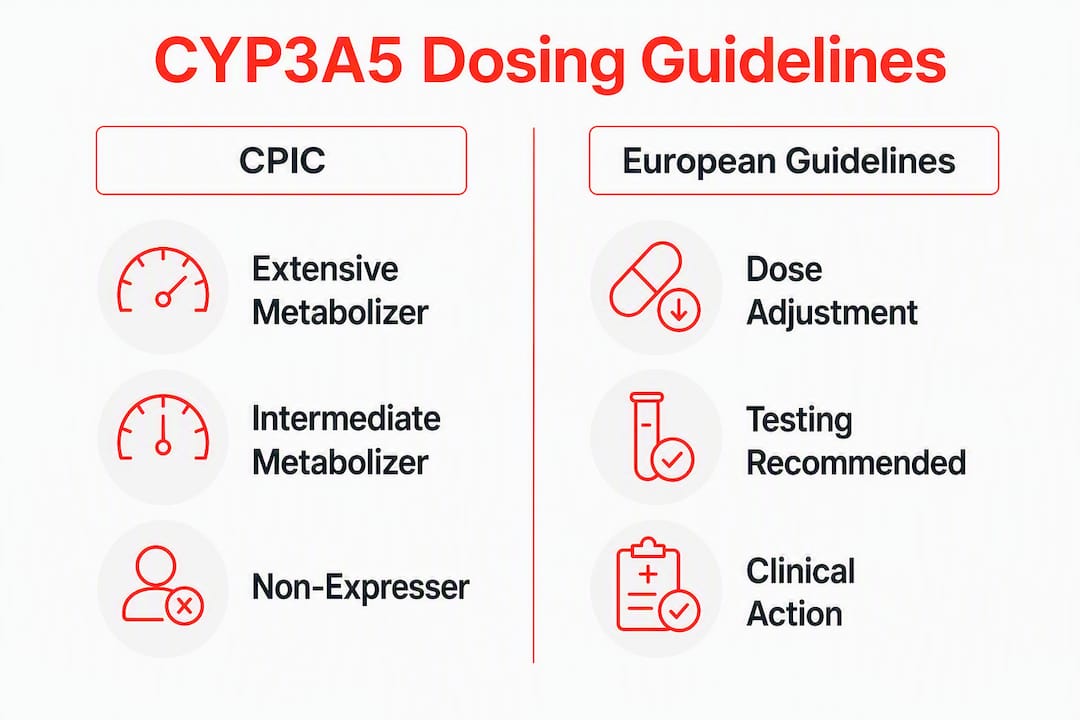
| Phenotype | Example Diplotypes | Starting Dose Recommendation | CPIC Recommendation Strength |
|---|---|---|---|
| Extensive metabolizer (expresser) | *1/*1 | 1.5–2× standard dose; max 0.3 mg/kg/day | Strong |
| Intermediate metabolizer (expresser) | *1/*3, *1/*6, *1/*7 | 1.5–2× standard dose; max 0.3 mg/kg/day | Strong |
| Poor metabolizer (non-expresser) | *3/*3, *6/*6, *7/*7, *3/*6, *3/*7 | Standard institutional weight-based dose | Strong |
Beyond CPIC, the Dutch Pharmacogenetics Working Group (DPWG) and the European Society for Organ Transplantation have issued compatible guidance, though CPIC remains the most widely cited framework in U.S. transplant programs. For a side-by-side comparison of CPIC, FDA, and DPWG guideline frameworks, the differences in recommendation language and evidence grading are worth reviewing before selecting a reporting standard for your program.
How do you interpret a CYP3A5 genotype result?
CYP3A5 is a highly polymorphic gene. The four alleles that matter most in clinical practice are 1 (functional), 3 (nonfunctional, the most common variant globally), 6 (nonfunctional, more prevalent in individuals of African ancestry), and 7 (nonfunctional). A laboratory report will typically return a diplotype, two allele calls separated by a slash, and the clinical phenotype follows directly from that diplotype.

| Diplotype | Phenotype | Expresser Status | Notes |
|---|---|---|---|
| *1/*1 | Extensive metabolizer | Expresser | Highest CYP3A5 activity |
| *1/*3 | Intermediate metabolizer | Expresser | Most common expresser diplotype in mixed populations |
| *1/*6 or *1/*7 | Intermediate metabolizer | Expresser | More common in African-ancestry populations |
| *3/*3 | Poor metabolizer | Non-expresser | Most common diplotype in European-ancestry populations |
| *3/*6, *3/*7, *6/*7 | Poor metabolizer | Non-expresser | Compound heterozygotes of nonfunctional alleles |
| *6/*6, *7/*7 | Poor metabolizer | Non-expresser | Rare; seen in African-ancestry populations |
Population frequency context matters for pre-test probability. Expresser prevalence is substantially higher in individuals of African ancestry (roughly 50–70% carry at least one *1 allele) compared to European-ancestry populations, where *3/*3 predominates and expressers are a minority. This means a transplant program serving a predominantly African-American patient population will encounter a higher proportion of patients who need dose increases, making preemptive genotyping particularly cost-effective in that setting.
When a lab's panel does not cover *6 or *7 and the patient is of African ancestry, the report should explicitly note which alleles were not assayed. Defaulting to a "poor metabolizer" call when *6 or *7 status is unknown can lead to underdosing in a patient who is actually an expresser. In that scenario, treat the result as indeterminate, escalate to a pharmacogenomics specialist or clinical pharmacist, and rely on TDM more aggressively until the phenotype is clarified.
Rare or novel variants not covered by a standard panel present a similar challenge. The default approach is to apply phenotype inference rules from CPIC's allele definition table and flag the result as uncertain. Do not assign a confident phenotype from an uncharacterized variant without specialist review.
How do you calculate the starting dose and integrate TDM?
For a 70 kg adult transplant recipient, a standard institutional tacrolimus starting dose might be 0.1 mg/kg/day, yielding 7 mg/day (typically split into two doses of 3.5 mg every 12 hours). For a confirmed CYP3A5 expresser, the CPIC-guided starting dose is 1.5–2× that amount: 10.5–14 mg/day, capped at 0.3 mg/kg/day (21 mg/day for this patient). In practice, most programs use the 1.5× multiplier as the conservative starting point and titrate upward based on troughs.
The following sequence reflects a genotype-integrated dosing workflow for the first two weeks post-transplant:
- Confirm genotype before or at transplant. Preemptive testing at transplant listing is preferred; if unavailable, reactive testing at admission is still actionable for the first dose.
- Calculate the genotype-adjusted starting dose. Apply the 1.5–2× multiplier for expressers; use the standard dose for non-expressers. Document the diplotype, phenotype, and dose rationale in the prescriber note or order comment.
- Measure the first trough at 24–48 hours post-initiation. For expressers, the target trough range is the same as for non-expressers (typically 10–15 ng/mL in the early post-transplant period for kidney recipients, per institutional protocol), but expressers are more likely to be subtherapeutic at standard doses.
- Adjust proportionally after the first trough. If the trough is 60% of target, increase the dose by approximately 40%. Avoid large single-step increases; titrate in 25–50% increments and recheck within 48–72 hours.
- Continue TDM per institutional schedule. Genotype does not replace TDM; it changes where you start, not how often you monitor.
- Reassess when clinical conditions change. Hepatic dysfunction, severe diarrhea, or addition of a CYP3A inhibitor or inducer each require fresh dose evaluation independent of genotype.
A heart transplant cohort study found that CYP3A5 expressers required a median of approximately 14 days to reach therapeutic troughs compared to roughly 7.5 days for non-expressers, and needed nearly double the daily dose to reach first target concentration. That gap is precisely what the genotype-adjusted starting dose is designed to close.
Pro Tip: Specify the genotype-based dose rationale in the medication order comment, not just the prescriber note. Pharmacists verifying the order need to see why the dose is higher than the standard institutional default, and a discrete order comment prevents unnecessary clarification calls and potential dose corrections that would undermine the genotype-guided plan.
How do drug interactions and clinical conditions modify the CYP3A5 effect?
Tacrolimus metabolism involves both CYP3A4 and CYP3A5, and the drug is also a P-glycoprotein (ABCB1) substrate. CYP3A5 genotype explains a meaningful portion of inter-individual variability in tacrolimus exposure, but it is one variable in a multifactorial equation that includes hepatic function, co-administered drugs, formulation, and gastrointestinal physiology.
The most clinically significant interaction class is strong CYP3A inhibitors. Azole antifungals, particularly fluconazole and voriconazole, are commonly prescribed post-transplant for prophylaxis and can increase tacrolimus exposure by several-fold. When a potent CYP3A inhibitor is added to a genotype-adjusted regimen, the expresser's dose advantage is effectively negated: their CYP3A5-driven metabolism is suppressed, and they may behave pharmacokinetically like a non-expresser. CPIC guidance explicitly notes that strong inhibitors require dose re-evaluation regardless of genotype, and the clinical team should anticipate a substantial dose reduction when initiating azole prophylaxis in an expresser who was started at 1.5–2× the standard dose.
Scenario: A 58-year-old kidney transplant recipient is a CYP3A5 *1/*3 intermediate metabolizer. The team starts tacrolimus at 1.5× the standard dose. On post-operative day 5, voriconazole is initiated for suspected fungal infection. Without a proactive dose reduction, tacrolimus troughs will rise sharply. The correct response is to reduce the tacrolimus dose before the first trough on voriconazole, then recheck within 24–48 hours.
Other modifiers worth tracking:
- Hepatic dysfunction: Severe hepatic impairment reduces CYP3A-mediated first-pass metabolism, increasing tacrolimus bioavailability and blunting the genotype effect. Liver transplant recipients are particularly complex because donor liver CYP3A5 genotype, not recipient genotype, drives hepatic metabolism of tacrolimus.
- Severe diarrhea or malabsorption: Reduces tacrolimus absorption unpredictably and can cause troughs to fall independent of genotype.
- Extended-release formulations: Tacrolimus extended-release (Astagraf XL, Envarsus XR) has different bioavailability characteristics than immediate-release; genotype-based dose adjustments may differ by formulation, and CPIC guidance should be reviewed for formulation-specific notes.
- ABCB1 variants: P-glycoprotein encoded by ABCB1 influences tacrolimus intestinal absorption. ABCB1 genotype is not yet incorporated into CPIC dosing recommendations for tacrolimus, but it contributes to residual variability after CYP3A5 genotype is accounted for.
- CYP3A inducers: Rifampin and certain anticonvulsants (carbamazepine, phenytoin) dramatically increase CYP3A activity and can reduce tacrolimus exposure to subtherapeutic levels. Expressers on inducers may need doses well above the 0.3 mg/kg/day cap, requiring specialist input.
What should a clinical CYP3A5 report include to be actionable?
A genotype result that arrives as a PDF with a star-allele call and no clinical interpretation is not an actionable report. For CYP3A5 and tacrolimus, the minimum elements a clinician needs to act safely are well-defined, and labs should hold their reports to this standard.
Minimum required report elements:
- Diplotype: Both allele calls explicitly stated (e.g., *1/*3), not just the phenotype label.
- Phenotype and expresser status: Clear statement of extensive, intermediate, or poor metabolizer, with the corresponding expresser/non-expresser designation.
- Alleles assayed: Explicit list of which star alleles the panel covers (*1, *3, *6, *7 at minimum) and a notation when clinically relevant alleles were not tested.
- Dosing recommendation: A specific, CPIC-aligned recommendation (e.g., "Consider initiating tacrolimus at 1.5–2× the standard weight-based dose; do not exceed 0.3 mg/kg/day") rather than a generic "consult prescriber" statement.
- Evidence date: The date of the guideline version used to generate the recommendation, so clinicians know whether the report reflects current evidence.
- Contact for clinical support: Name or role of the pharmacogenomics pharmacist, clinical geneticist, or medical director available for interpretation questions.
- Discrete EHR fields: Diplotype, phenotype, and recommendation should be structured data in the EHR, not only free text in a PDF. Free-text PDF reports rarely support automated clinical decision support alerts.
Turnaround time is a practical constraint. For preemptive testing at transplant listing, a 7–14 day turnaround is acceptable. For reactive testing at the time of transplant, same-day or next-day results are needed to influence the first dose. Labs should clearly communicate their turnaround time and whether STAT testing is available.
A preemptive CYP3A genotyping pilot in a kidney transplant program demonstrated that CDS integration and discrete EHR data fields were key to translating genotype results into actual prescribing changes. Reports that fired a CDS alert at the time of tacrolimus ordering produced better uptake than reports delivered only as PDFs. For labs evaluating whether their current reports meet this standard, the criteria for clinically defensible PGx reports provide a useful benchmark.
Checklist for evaluating whether a CYP3A5 report is actionable:
- Diplotype explicitly stated (both alleles)
- Phenotype label and expresser/non-expresser designation present
- Panel allele coverage listed (*1, *3, *6, *7 minimum)
- Uncovered alleles noted explicitly
- CPIC-aligned dosing recommendation included
- Evidence date or guideline version cited
- Discrete EHR fields populated (not PDF-only)
- Clinical support contact identified
How do you operationalize CYP3A5-guided dosing in your clinical workflow?
Translating a genotype result into a prescribing action requires more than a good report. It requires a workflow that delivers the right information to the right person at the right moment, and a maintenance plan that keeps recommendations current as guidelines evolve.
Preemptive versus reactive testing models
Preemptive testing, ordering CYP3A5 genotyping at transplant listing or pre-transplant evaluation, is the preferred model because results are available before the first tacrolimus dose. Reactive testing, ordered at or after transplant, is still clinically useful but requires rapid turnaround and a clear protocol for interim dosing when results are pending. Programs without preemptive infrastructure should at minimum have a reactive protocol that specifies who orders the test, what interim dose to use, and how the result triggers a dose review.
EHR integration and CDS design
Discrete genotype fields in the EHR are the foundation of reliable clinical decision support. A CDS alert that fires when tacrolimus is ordered, displaying the patient's diplotype, phenotype, and recommended starting dose in a single actionable line, is the target state. Alert fatigue is a real risk: the message should be concise, specific, and interruptive only when the genotype changes the recommended dose. Non-expresser alerts can be informational (non-interruptive); expresser alerts warrant a hard stop or required acknowledgment.
A sample CDS message for an expresser: *"CYP3A5 *1/3 (Intermediate Metabolizer / Expresser): Consider starting tacrolimus at 1.5–2× standard dose (max 0.3 mg/kg/day). Monitor trough at 24–48 hours. See full report [link]."
For technical implementation, integrating discrete PGx data via HL7/FHIR and CDS Hooks is the current standard for connecting lab genotype data to order-entry alerts without manual data re-entry.
Living reanalysis and guideline maintenance
CPIC and PharmGKB update their allele definitions and dosing recommendations periodically. A program that generates a static report at the time of testing and never revisits it will eventually deliver outdated guidance. Living reanalysis workflows that automatically flag previously reported results for review when a guideline changes are the most reliable way to keep recommendations current without manual audits. This is particularly relevant for CYP3A5, where the allele definition table has been refined over time and new variants continue to be characterized.
Centers for Medicare & Medicaid Services revised pharmacogenetic testing coverage in December 2020 to include tests covered by CPIC guidelines, which improved reimbursement feasibility for preemptive CYP3A5 genotyping programs. Documenting the CPIC guideline basis for testing in the order and report supports billing and audit defense.
What does the evidence actually show about genotype-guided tacrolimus dosing?
The pharmacokinetic evidence is consistent and well-replicated: CYP3A5 expresser status reliably predicts lower dose-adjusted tacrolimus troughs and longer time to reach target concentrations. Across kidney, heart, and lung transplant cohorts, expressers consistently require higher doses to achieve the same exposure as non-expressers. The heart transplant cohort data cited earlier illustrates the magnitude: roughly double the daily dose and nearly double the time to first therapeutic trough.
What the evidence does not yet show is equally important. Randomized controlled trials demonstrating that genotype-guided dosing improves long-term graft survival, reduces acute rejection episodes, or decreases tacrolimus-related nephrotoxicity are limited or absent. The CPIC guideline is transparent about this gap: the recommendation is graded strong for the pharmacokinetic effect, not for clinical outcomes. This distinction matters when communicating the value of testing to transplant committees, payers, and patients.
Key limitations of the current evidence base:
- Study populations vary in ancestry, organ type, and immunosuppression protocol, making cross-study comparisons difficult.
- Most published studies are single-center and observational, with limited power to detect differences in rejection or graft survival.
- Heterogeneity in TDM protocols, target trough ranges, and concomitant immunosuppression complicates outcome attribution.
- The interaction between CYP3A5 genotype and co-administered CYP3A modulators is underrepresented in outcome studies.
The practical implication is clear: use CYP3A5 genotype to shorten the time to first therapeutic trough and reduce early subtherapeutic exposure, which is a meaningful clinical benefit in the high-risk early post-transplant period. Maintain rigorous TDM and clinical judgment throughout. Do not present genotype-guided dosing to patients or committees as a proven strategy for improving graft survival until that evidence matures.
Areas where prospective research is most needed include multicenter outcome trials powered for graft survival endpoints, cost-effectiveness analyses across transplant types, and studies specifically designed to characterize the genotype-by-drug-interaction effect on outcomes.
Key Takeaways
CYP3A5 expresser status is the most actionable pharmacogenomic variable in tacrolimus prescribing, with CPIC recommending a 1.5–2× starting dose increase for expressers, capped at 0.3 mg/kg/day, while TDM remains mandatory for all patients regardless of genotype.
| Point | Details |
|---|---|
| Expresser starting dose | CYP3A5 expressers (*1/*1, *1/*3, *1/*6, *1/*7) start at 1.5–2× standard dose, not to exceed 0.3 mg/kg/day. |
| TDM is always required | Genotype sets the starting point; first trough at 24–48 hours guides all subsequent adjustments. |
| Drug interactions override genotype | Potent CYP3A inhibitors (e.g., fluconazole) can negate the expresser dose advantage and require immediate re-evaluation. |
| Evidence scope | Genotype reliably predicts tacrolimus exposure; randomized evidence for improved graft survival or rejection rates remains limited. |
| Signalpgx for labs | Signalpgx delivers automated, CPIC-aligned CYP3A5 reports with discrete EHR fields, living reanalysis, and CDS integration to operationalize genotype-guided dosing at the point of prescribing. |
Why preemptive genotyping deserves more urgency than most programs give it
The conventional framing of CYP3A5 testing as "optional but useful" undersells the clinical cost of not acting. The first two weeks post-transplant are when subtherapeutic tacrolimus exposure carries the highest risk of acute rejection, and that is precisely the window where genotype information has the most leverage. Waiting for reactive testing, or treating genotype as a secondary consideration after the first few troughs, means accepting a predictable delay in reaching therapeutic concentrations for a patient population that cannot afford it.
The more underappreciated problem is report quality. Many programs have genotyping capacity but deliver results in formats that do not support action: PDF reports without discrete EHR fields, phenotype labels without dosing recommendations, or results that arrive after the first dose has already been given. The bottleneck is not the science; it is the infrastructure connecting the lab result to the prescriber's order entry screen.
Programs that measure time to first therapeutic trough as a process metric, rather than waiting for long-term outcome data, will see the benefit of genotype-guided dosing within weeks of implementation. That is the right initial metric: not graft survival at five years, but trough attainment at day 7. Build the workflow around that goal, educate pharmacy and surgery teams on why the starting dose looks different for some patients, and document every genotype-based decision in the medical record. The long-term outcome data will follow from programs that get the early pharmacokinetics right.
The gap between what the science supports and what most transplant programs actually implement is not a knowledge problem. It is an infrastructure and workflow problem, and it is solvable.
Signalpgx brings CYP3A5-guided tacrolimus dosing to the point of prescribing
Translating a CYP3A5 genotype into a prescribing action requires more than a guideline reference. It requires a report that delivers the diplotype, the phenotype, and a CPIC-aligned dosing recommendation in discrete EHR fields, with a CDS trigger that fires when tacrolimus is ordered, and a maintenance system that updates recommendations when CPIC or PharmGKB revises its guidance.
Signalpgx is built for exactly this workflow. The platform generates automated, evidence-graded PGx reports that pull from 20+ curated sources, including CPIC and PharmGKB, and delivers structured data via HL7/FHIR for direct EHR integration. Living reanalysis means your CYP3A5 reports stay current as allele definitions and dosing tables evolve, without manual re-review. Medical director oversight and a full audit trail support CLIA compliance and billing documentation. Labs can deploy white-label CYP3A5 reporting under their own brand, typically within 5–7 days.
For laboratories and health systems ready to close the gap between genotype and prescribing action, explore the Signalpgx PGx reporting platform or book a demo to see how the platform handles CYP3A5 and tacrolimus reporting end to end.
This article provides general pharmacogenomic and clinical information. It is not a substitute for professional medical judgment, institutional protocol review, or consultation with a qualified clinical pharmacist or pharmacogenomics specialist. Clinicians should verify current CPIC guideline versions and institutional policies before implementing genotype-guided dosing.
Key references and resources
The sources below are organized by use case: dosing tables, implementation workflows, and allele frequency data.
For dosing tables and guideline text:
- CPIC Guideline for CYP3A5 and Tacrolimus (full text, PMC) — the primary reference for allele-to-phenotype-to-dosing tables; check PharmGKB (pharmgkb.org) for the most current version and supplementary materials.
- CPIC Guideline (Wiley/CPT) — peer-reviewed publication of the guideline with full evidence grading.
For implementation workflows and CDS design:
- Preemptive CYP3A genotyping implementation pilot (IU) — covers CDS design, EHR integration, and reimbursement considerations for a kidney transplant program.
For clinical context and patient counseling:
For aggregate evidence across transplant types:
- CYP3A5 Polymorphisms in Renal Transplant Recipients (PMC) — systematic review of pharmacokinetic and clinical outcome data in kidney transplant populations.
- Heart Transplant CYP3A5 Cohort Study (PMC) — single-center cohort data on time to therapeutic trough and dose requirements by expresser status.
For allele frequency data: