
The most effective pharmacogenomic reporting template is modular: it separates raw genotype and phenotype data from clinical interpretation, delivers both a discrete FHIR output and a clinician-facing PDF, and maps every recommendation back to a CPIC, FDA, or DPWG source. That structure is what lets your lab update guidance without re-issuing reports from scratch, which HL7's own genomics reporting guidance identifies as the key benefit of decoupling data from interpretation.
- Genotype/phenotype data structured as discrete Observations
- Medication recommendations mapped to Task or PlanDefinition resources
- A physician-reviewed PDF layer for the ordering clinician
Pro Tip: A template built this way lets a single guideline update, say a CPIC dosing change for a common antidepressant, propagate to every affected report without a full reissue. Platforms like SignalPGx build this modularity into their infrastructure by default.
Key Takeaways
The most reliable PGx reporting template separates raw genotype data from clinical interpretation, maps both to FHIR resources, and links every recommendation to a named guideline source.
| Point | Details |
|---|---|
| Use modular architecture | Separate raw Observations from phenotype calls and recommendations so guideline updates don't require full report reissues. |
| Map to FHIR resources | Structure DiagnosticReport, Observation, and Task resources so EHR CDS systems can act on the data directly. |
| Cite guideline sources | Every medication recommendation needs a level of evidence and a citation to CPIC, FDA, or DPWG. |
| Stage your rollout | Validate in a test EHR with synthetic patients, pilot with a small population, then widen deployment. |
| Consider white-label infrastructure | SignalPGx delivers physician-reviewed, FHIR-mapped templates with living reanalysis built in, typically deployable in 5 to 7 days. |
This article is general information, not a substitute for advice from a qualified doctor. Consult a qualified healthcare professional about your own circumstances before acting on anything here.
Table of Contents
- What Are the Core Data Elements a PGx Reporting Template Needs?
- How Should a Template Map to FHIR DiagnosticReport and Observations?
- What Does a Practical Implementation Checklist Look Like?
- What Should a Sample PGx Report Template Include?
- How Should Labs Deliver PGx Reports to EHRs and Patients?
- What Trade-Offs Should Labs Weigh When Starting PGx Reporting?
- Deploy a Production-Ready PGx Template Without Building From Scratch
- Sources
- FAQ
What Are the Core Data Elements a PGx Reporting Template Needs?
A defensible PGx report template rests on six categories of information, and skipping any one of them creates a gap that either a clinician or an auditor will eventually find.
- Patient and specimen identifiers. Patient ID, date of birth, accession or sample ID, and collection and issue dates need to appear on every page, not just the cover sheet, because reports get printed, forwarded, and filed separately from the EHR they came from.
- Genotype details. Star alleles, diplotypes, and variant-level observations belong here, with HGVS nomenclature included wherever the receiving system might need to reconcile against another lab's data.
- Phenotype assignment. Each gene needs a coded phenotype term, such as "poor metabolizer," alongside the logic or table version used to derive it, since phenotype-calling rules change as CPIC updates its allele function tables.
- Therapeutic implication entries. For every relevant medication, the template needs the recommended action (avoid, consider alternative, adjust dose), the level of evidence, and a citation to the guideline behind it.
- Methodology and limitations. State which alleles were tested, note the assay's sensitivity and specificity, and version the report itself. A phenotype call is only as good as the panel that produced it.
- Provenance. Name the reviewing medical director, list a contact for clinical consult, and link any related artifacts, so an auditor or a puzzled prescriber can trace exactly how a recommendation was reached.
Reports built on commercial models, like the format Biron uses for exposure, efficacy, and risk columns, show how these categories translate into a scannable layout without sacrificing the underlying data structure. The goal is a report that a pharmacist can read in ninety seconds and a bioinformatics reviewer can audit in five minutes.
How Should a Template Map to FHIR DiagnosticReport and Observations?
Structure follows data flow. A well-built PGx template decomposes into a chain: raw variant Observations, then haplotype and diplotype calls, then coded phenotype, then therapeutic implication, then a medication recommendation or Task. Each link in that chain is its own FHIR resource, and each one should reference the resource below it rather than restating its data.
- DiagnosticReport.presentedForm carries the clinician-facing PDF as an embedded document, while the report's Observation entries carry the same data in discrete, queryable form. HL7's example DiagnosticReport XML shows exactly how both coexist in a single resource bundle.
- PlanDefinition and Task resources carry structured medication recommendations when a lab wants those recommendations to trigger automated alerts inside an EHR's clinical decision support engine.
- Every medication recommendation should reference the specific Observation and evidence artifact that produced it, a traceability chain HL7's genomics guidance treats as essential for both audits and automated logic.
Pro Tip: Don't let your interpretation layer become tangled with your raw data layer. When a genotype call changes because a lab corrects a variant, you want to regenerate the phenotype and recommendation downstream, not hand edit a monolithic PDF. This separation is what makes living reanalysis operationally realistic rather than a marketing phrase.
What Does a Practical Implementation Checklist Look Like?
Rolling out a new PGx template touches bioinformatics, compliance, and clinical operations simultaneously, so sequencing matters more than most labs expect.
- Validate the pipeline. Confirm genotype to phenotype mapping against CPIC or an equivalent authority, and set sample-level QC thresholds before the template ever reaches a clinician.
- Assign governance. Designate a medical director for sign-off, maintain an audit trail for every report version, and put both the template and its underlying ruleset under version control.
- Define the reanalysis cadence. Decide which sources you monitor (CPIC, FDA labeling, DPWG), set an update schedule, and build a process for notifying affected patients and providers when a recommendation changes.
- Test before you deploy. Run the template in a staging EHR with synthetic patients, pilot it with a small live population, then widen rollout, keeping a rollback plan tied to specific versioned rules.
Tools like PGxBridge illustrate how much of the phenotype validation step can be automated, cross-checking assignments against a CPIC-derived table with more than 27,000 entries. Automation cuts manual review time significantly, but it does not replace medical-director sign-off. It reduces the burden on the reviewer, not the requirement for review.
- Estimated time-to-deploy for a validated, staged rollout typically runs shorter with a pre-built modular template than with a report format built from scratch.
- Staff training on interpreting phenotype terms and recommendation levels should happen before go-live, not after the first confused phone call from a prescriber.
What Should a Sample PGx Report Template Include?
Every field name below can be dropped directly into a LIMS or reporting engine as a starting schema.
Header and metadata fields:
- Report ID and version number
- Issued date and reviewing medical director
- Ordering clinician and specimen collection date
Genotype table columns:
- Gene, Allele 1, Allele 2, Diplotype, Phenotype, Phenotype Code
Medication recommendation table columns:
- Medication, Implication, Recommended Action, Evidence Source, Reviewer Initials
For single-gene panels, this structure stays compact. For multi-gene panels covering dozens of drug-gene pairs, the same columns repeat per medication class, which is why modular architecture matters more as panel size grows.
Sample clinician-facing phrasing should stay short and directive: "CYP2C19 poor metabolizer; consider alternative to clopidogrel per CPIC guidance." Nona Scientific's guidance on PGx reporting notes that reports function as supporting tools meant to be read alongside clinical history and professional judgment, not as standalone prescribing mandates.
How Should Labs Deliver PGx Reports to EHRs and Patients?
Discrete FHIR resources beat a PDF-only approach because a prescribing clinician working inside their EHR is far more likely to see and act on a PGx flag that triggers a CDS alert than one buried in an attached document. DiagnosticReport, Observation, and Task resources support that alerting; presentedForm still carries the readable PDF for the chart.
- Deliver a simplified patient summary through a secure portal, written at a lower reading level than the clinician report, with clear consent language for how genetic data gets stored and shared.
- Encrypt data at rest and in transit, enforce role-based access controls, and set an explicit retention policy that accounts for the jurisdictional privacy rules governing your patient population, whether that's HIPAA in the United States or GDPR for European patients.
What Trade-Offs Should Labs Weigh When Starting PGx Reporting?
Labs that try to cover every gene-drug pair on day one usually stall. Pilot with a few high-impact medication classes, cardiovascular or psychiatric drugs with strong CPIC evidence, then expand once the workflow proves out.
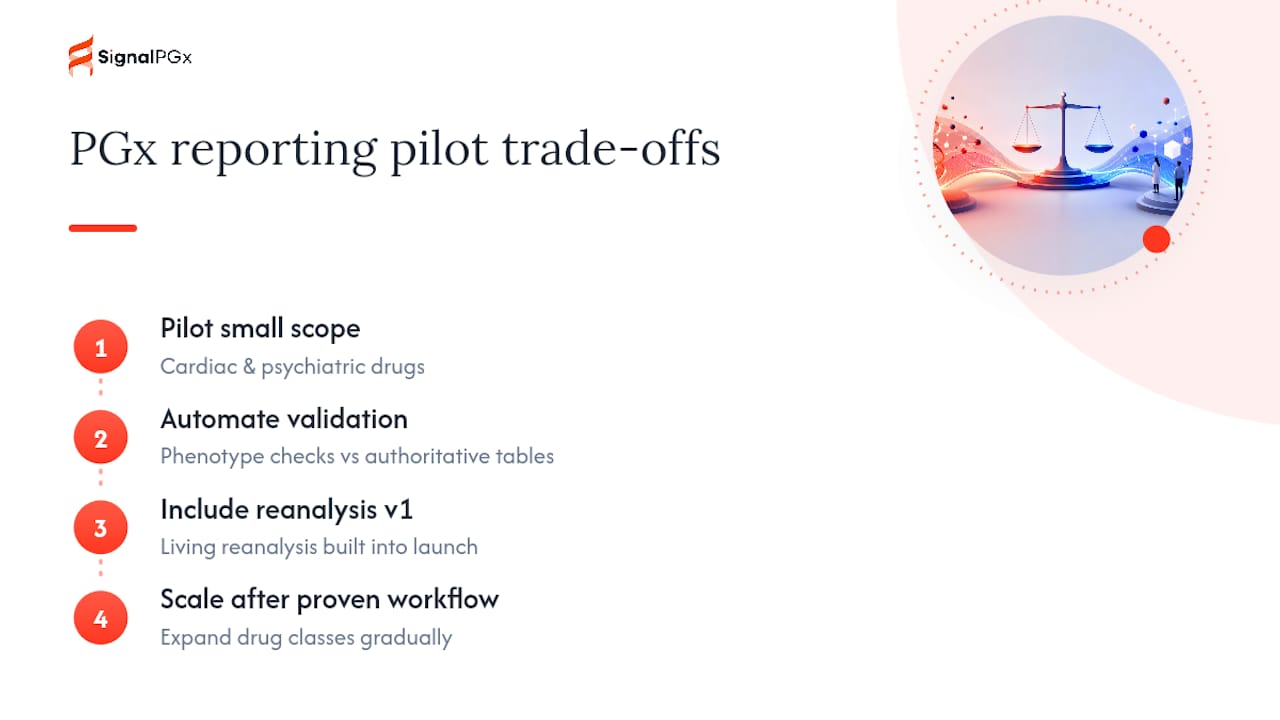
Automate phenotype validation against authoritative tables early. It's the highest-volume, most error-prone manual step, and it's also the easiest to get wrong quietly.
Build living reanalysis into version one, not version three. Retrofitting it later means re-architecting a report format that clinicians already depend on.
— Tarek
Deploy a Production-Ready PGx Template Without Building From Scratch
Building the modular, FHIR-mapped template described above from zero takes most labs months of bioinformatics and compliance work before the first report ever reaches a clinician. SignalPGx skips that build phase entirely: it delivers physician-reviewed, evidence-graded PGx reports with living reanalysis already wired in, so guideline updates from CPIC or the FDA propagate to your reports automatically instead of triggering a manual rewrite.

The platform's HL7/FHIR integration outputs discrete Observations and Tasks that plug into your existing EHR's clinical decision support, not just a PDF attachment nobody opens. White-label deployment typically runs 5 to 7 days, with HIPAA and GDPR compliance built into the infrastructure rather than bolted on afterward. If your lab is ready to see what a live template looks like against your own panel, book a demo and bring your gene list.
FAQ
What Are PGx Reporting Templates?
PGx reporting templates are structured formats for presenting pharmacogenomic test results, combining genotype and phenotype data with medication-specific clinical recommendations, typically delivered as both a clinician PDF and discrete FHIR data.
What Data Fields Belong in a PGx Report Template?
At minimum, a template needs patient and specimen identifiers, genotype and phenotype tables, therapeutic implication entries with evidence citations, methodology notes, and reviewer provenance.
Should PGx Reports Use FHIR or PDF Delivery?
Both, ideally: discrete FHIR resources like DiagnosticReport and Observation support EHR clinical decision support and alerting, while a PDF carried in presentedForm gives clinicians a readable summary.
How Often Should a PGx Report Template Be Updated?
Update cadence should track the guideline sources you monitor, typically CPIC, FDA labeling, and DPWG, with a defined process for notifying affected patients and providers when a recommendation changes.
Can Labs Deploy a Custom PGx Reporting Template Quickly?
Yes. White-label platforms like SignalPGx offer pre-built, FHIR-mapped, physician-reviewed templates that typically deploy within 5 to 7 days instead of requiring months of in-house development.