
A medical director review is the physician-level clinical escalation that happens when initial clinical review is ambiguous, adverse, or requires judgment that criteria alone cannot resolve. It sits above nurse-led utilization management screening and below the appeals process, giving your organization a defensible checkpoint before a denial goes final. When your clinical reviewers hit a case that InterQual or Milliman criteria don't cleanly answer, that case moves to a credentialed physician.
- When it's used: prior authorization escalations, concurrent utilization review, retrospective audits, and formal appeals.
- Who performs it: a board-certified medical director or a delegated physician reviewer with matching specialty experience.
- Typical outcomes: approval, partial approval, a request for additional clinical information, or a denial with a documented, guideline-referenced rationale.
State-level data from Pennsylvania shows why this matters at scale: over a two-year period, the state ran 20,129 medical reviews, with overturn rates ranging from 6% to 11% depending on the service category. Physician review changes outcomes often enough to justify the infrastructure behind it.
Key Takeaways
A defensible medical director review program depends on clear escalation criteria, credentialed physician reviewers, complete documentation, and metrics tracked against internal baselines rather than external benchmarks.
| Point | Details |
|---|---|
| Escalate on ambiguity, not volume | Route cases to physician review when criteria are silent, high cost, high risk, or clinically complex. |
| Credential rigorously | Require active licensure, board certification, and five or more years of clinical practice for reviewers. |
| Document every rationale | Cite specific guideline sections, not general criteria names, to survive audits and appeals. |
| Benchmark against yourself | Compare overturn and timeliness rates to your own historical data, not other organizations. |
| Use living evidence tools | Platforms like SignalPGx keep pharmacogenomic recommendations current and audit trails complete for review defensibility. |
Table of Contents
- What Does a Medical Director Actually Do in a Review Program?
- When Should a Case Escalate to Medical Director Review?
- How Does the Review Workflow Move From Intake to Decision?
- What Credentials and Staffing Does a Medical Director Review Program Need?
- What Documentation Does an Audit-Ready Review Require?
- How Do You Build or Improve a Medical Director Review Program?
- What Best Practices Improve Review Quality and Provider Trust?
- Which Metrics Actually Show a Review Program Is Working?
- How SignalPGx Supports Medical Director Review Workflows
- Sources
- FAQ
What Does a Medical Director Actually Do in a Review Program?
A medical director review program exists to make sure medical services align with evidence-based guidelines, internal quality standards, and cost-effectiveness, all while a licensed physician signs off on the clinical logic. That's the mission statement. Day to day, the job looks more granular.
Core responsibilities typically include:
- Making final clinical determinations on cases nurse reviewers can't resolve against published criteria.
- Conducting peer-to-peer conversations with treating physicians before finalizing an adverse decision.
- Interpreting ambiguous or conflicting guideline language for the rest of the utilization management team.
- Overseeing escalation rules so cases route to the right specialty reviewer.
- Supporting quality improvement initiatives, including DRG clinical validation and readmission review.
Consider three scenarios your team has probably already lived through. A prior authorization for a specialty infusion drug meets most InterQual criteria but not all, and the treating oncologist disputes the gap. A borderline ICU admission looks appropriate on paper but the acuity indicators are mixed. A coder flags a DRG assignment where the documented complications may or may not meet the severity threshold. None of these resolve cleanly through automated logic. Each requires a physician who can weigh incomplete information the way the treating clinician did.
This role intersects constantly with case management and appeals teams. Case managers flag concurrent cases that are trending toward denial; appeals teams route reversed or upheld cases back through documentation review. The medical director is the clinical anchor point between those two functions, and often the named decision maker of record.
When Should a Case Escalate to Medical Director Review?
Not every prior authorization needs physician eyes. Escalation criteria exist to protect the medical director's time for cases that genuinely need judgment, and to keep straightforward approvals moving fast. Medical necessity review workflows typically route clear-cut cases through initial clinical screening and reserve physician review for anything ambiguous or heading toward denial.
The use cases break down into distinct categories:
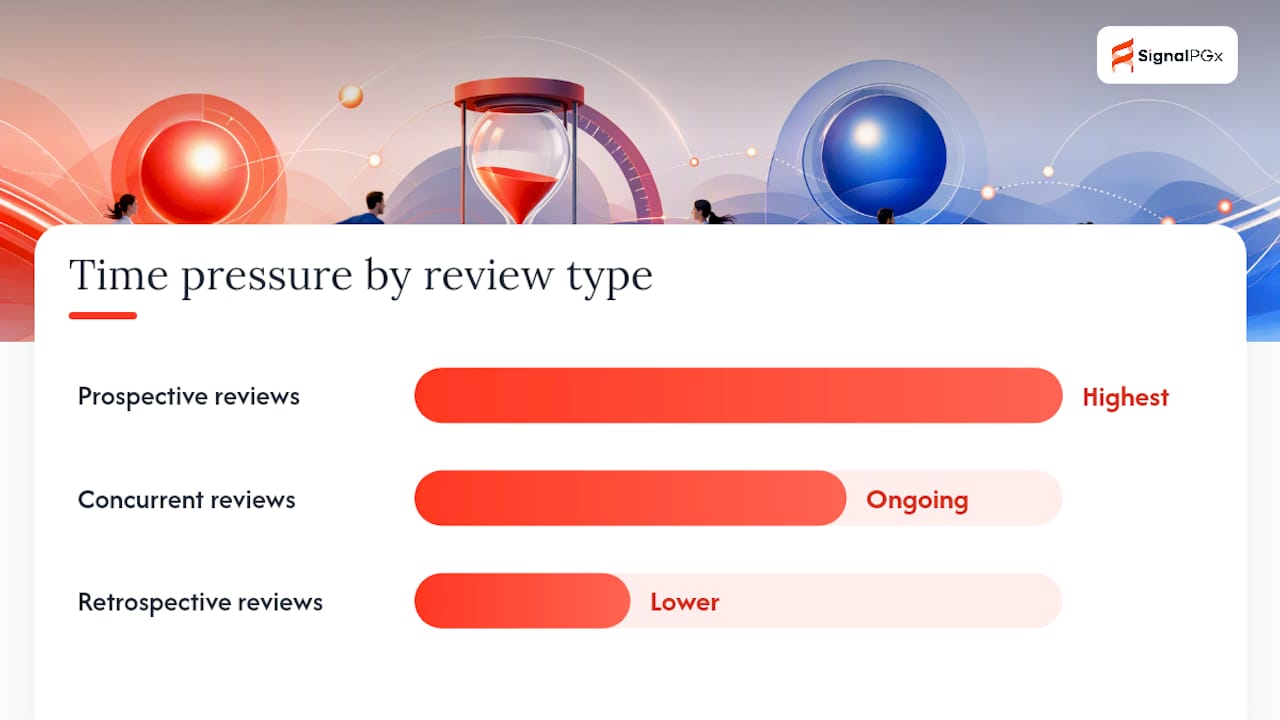
- Prospective prior authorizations, reviewed before a service is rendered, where timing pressure is highest.
- Concurrent reviews, conducted during an active inpatient stay or ongoing treatment course.
- Retrospective reviews, done after care delivery, often tied to claims audits or DRG validation.
- Appeals, where a prior denial is being reconsidered with new or clarified clinical information.
- Peer-to-peer requests, initiated by the treating provider to discuss a pending or recent adverse determination.
The practical difference matters. Prospective reviews demand speed and lean on documentation available at the time of request. Concurrent reviews require ongoing communication with the care team since the clinical picture keeps changing. Retrospective reviews carry less time pressure but higher documentation stakes, since the record has to stand on its own without a live conversation to fill gaps.
Set your escalation thresholds around a few clear triggers: criteria that are ambiguous or silent on the specific clinical scenario, high-cost interventions where an error is expensive in both directions, identifiable safety risk, and complex comorbidity that criteria weren't built to handle.
How Does the Review Workflow Move From Intake to Decision?
A defensible medical director review workflow follows a predictable sequence, even though the clock resets differently depending on review type.
- Intake. The request arrives with clinical documentation, whether from a prior authorization submission, a concurrent review note, or a retrospective claims flag.
- Initial clinical review. A nurse or clinical reviewer applies published criteria, such as InterQual or Milliman guidelines, to the documented facts.
- Escalation trigger check. If the case meets criteria cleanly, it's approved at this level. If not, it escalates automatically.
- Medical director assessment. The physician reviewer examines the full record, applies clinical judgment where criteria are silent or ambiguous, and determines next steps.
- Peer-to-peer opportunity. Before finalizing an adverse determination, medical necessity review guidance recommends offering the treating provider a chance to discuss the case directly.
- Final determination. The medical director documents the decision, whether approval, partial approval, or denial with rationale.
- Communication. The determination and appeal rights go to the provider and, depending on jurisdiction, the patient.
Timelines vary sharply by review type, and you should never assume one SLA fits all three. Prospective prior authorizations often carry the tightest turnaround requirements because care is pending. Concurrent reviews run on a rolling basis tied to length of stay. Retrospective reviews and appeals typically have longer statutory or contractual windows, sometimes measured in weeks rather than days. Contract terms and state or federal rules set the actual numbers, so confirm your specific obligations rather than assuming a standard timeline applies.
Build your escalation checklist directly into your SOP:
- Clinical criteria not fully met by the documentation on hand.
- Ambiguous or conflicting documentation between provider notes and coding.
- High-cost or high-risk service where an incorrect determination carries real consequences.
- A direct conflict between the treating clinician's recommendation and the initial reviewer's finding.
Operational platforms like AngelTrack's medical director review queue illustrate this well: cases get prioritized by clinical significance rather than sitting in a first-in-first-out line, and the system tracks what percentage of eligible cases actually reached physician review.
What Credentials and Staffing Does a Medical Director Review Program Need?
Credentialing sets the ceiling for how defensible your program is. Job specifications for physician reviewer roles consistently call for an active MD or DO license, board certification where applicable, and five or more years of full-time clinical practice. That baseline exists because reviewers without recent clinical practice tend to lose touch with how care actually gets delivered on the ground.
Beyond the minimum, look for these preferred qualifications when you're staffing a program:
- Direct utilization management experience, not just clinical practice.
- Familiarity with DRG clinical validation and readmission review methodology.
- Prior peer review or claims review work, which builds comfort with documentation-heavy decision making.
- Licensure that covers the states where your covered population lives, since telehealth and multi-state plans complicate this more than people expect.
Staffing models vary by volume. A full-time in-house medical director makes sense once case volume justifies a dedicated FTE, typically for larger payers or health systems with steady review flow. Smaller or specialty-specific programs often lean on part-time or consultant physician reviewers, paid per case or per hour. Many organizations build a specialty pool, rotating in a cardiologist for cardiac cases and an oncologist for oncology cases, with cross-coverage arrangements for lower-volume specialties where a dedicated reviewer isn't cost-effective.
What Documentation Does an Audit-Ready Review Require?
Every medical director determination needs a record that would hold up if a regulator, auditor, or appeals board pulled the file two years later. That record should include the clinical rationale behind the decision, the specific criteria applied, direct references to the guideline or policy cited, notes from any peer-to-peer conversation, documentation of any request for additional records, the final determination itself, and a clear statement of appeal rights.
A short compliance caveat matters here: appeal timelines, notice requirements, and specific procedural rules vary by state, by federal program, and by individual contract. Treat none of it as universal. What applies to a Medicare Advantage appeal doesn't necessarily apply to a commercial plan in a different state.
Conflict-of-interest practices deserve equal weight. If a reviewing physician has a financial relationship with a provider group or a vendor tied to the case, that relationship needs disclosure before the review proceeds, and many programs route those cases to an alternate reviewer entirely.
Pro Tip: Build a documentation template that forces the reviewer to cite the specific guideline section, not just "InterQual criteria," before the case can close. Vague citations are the most common weakness auditors flag.
How Do You Build or Improve a Medical Director Review Program?
Standing up a defensible program, or fixing a shaky one, follows a fairly consistent sequence regardless of organization size.
- Define scope and policy. Decide which service lines and review types (prior auth, concurrent, retrospective, appeals) fall under medical director oversight.
- Set escalation rules. Codify the triggers from your SOP: ambiguous criteria, high cost, safety risk, comorbidity complexity.
- Hire and credential staff. Verify licensure, board certification, and specialty match before a reviewer touches a live case.
- Integrate workflow technology. Connect intake, criteria checking, and case routing so escalations happen automatically rather than by manual flag.
- Create peer-to-peer SOPs. Script the call structure, required disclosures, and documentation format in advance.
- Train reviewers. Cover both clinical criteria application and the softer skill of conducting a peer-to-peer conversation without it turning adversarial.
- Pilot with audit sampling. Run a subset of cases through the new process and audit a sample before full rollout.
Your SOP checklist should nail down turnaround SLAs by review type, standardized documentation templates, peer-to-peer call scripts, a written escalation matrix, and defined audit trigger criteria.
Track these KPIs from day one:
- Timeliness (TAT): how long each review type takes from intake to determination, flagged against your SLA.
- Overturn or agree rate: how often the medical director's decision differs from the initial clinical reviewer's finding.
- Provider satisfaction: measured through surveys or complaint volume tied to the review process.
- Cost impact: the dollar effect of determinations, tracked separately from clinical outcome quality.
- Backlog rate: the percentage of cases sitting past SLA at any given time, an early warning sign of understaffing.
What Best Practices Improve Review Quality and Provider Trust?
The programs that generate fewer disputes and stronger provider relationships share a handful of habits. Document rationale with specific guideline references every time, not just a checkbox that criteria were "reviewed." Schedule peer-to-peer calls promptly rather than letting them slip past the point where they could still change the outcome. Use structured review templates so no reviewer skips a required element. Match specialty reviewers to specialty cases whenever your staffing model allows it. Run ongoing QA on reviewer concordance, comparing how different physicians handle similar cases to catch drift early.
Peer-to-peer conversations work best when they're genuinely conversational. Prepare a concise case summary before the call. Ask clarifying questions instead of leading with the reasons for a likely denial. Medical necessity review guidance consistently notes that peer-to-peer discussions can change the outcome, which means the call has to be a real exchange, not a formality on the way to a predetermined denial.
Pro Tip: End every peer-to-peer call by reading back the outcome and next steps to the treating physician. It closes gaps in understanding and gives you a clean record of what was communicated.
When criteria are silent on a scenario, don't force a fit that isn't there. Document the physician's independent judgment and the reasoning behind it. A reviewer described as a clinical arbitrator, someone applying expert judgment where standardized criteria run out, is a more accurate model than a simple approver or denier.
Which Metrics Actually Show a Review Program Is Working?
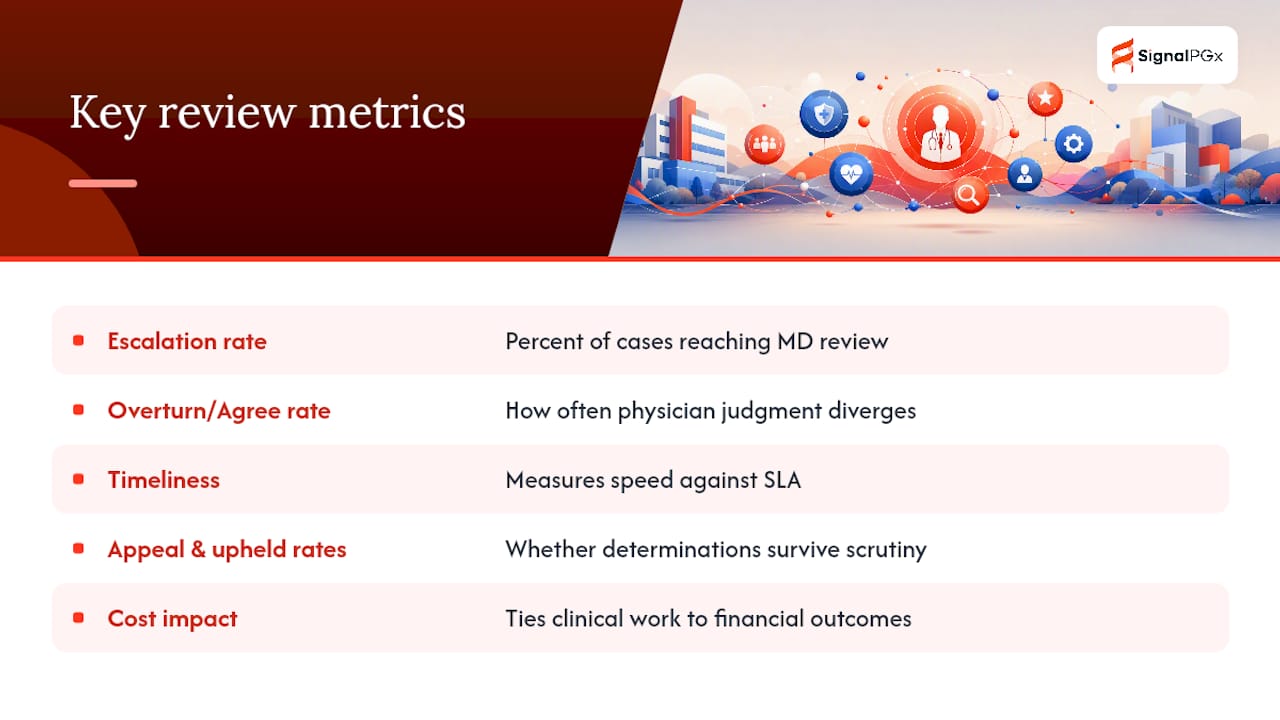
Track a small set of metrics consistently rather than chasing every number available. The escalation rate tells you what percentage of cases reach medical director review at all, which flags whether your initial screening criteria are too loose or too tight. The overturn or agree rate shows how often the physician's judgment diverges from the initial finding. Timeliness measures speed against SLA. Provider appeal and upheld rates reveal whether your determinations survive scrutiny. Cost impact per case ties the clinical work to financial outcomes leadership cares about.
Benchmark against your own historical baseline, not against other organizations. Case mix, contract terms, and population risk differ too much for cross-organizational comparison to mean much. Pennsylvania's program data shows overturn rates between 6% and 11%, but that range reflects a specific population and service mix, not a universal target.
A high overturn rate isn't automatically bad news. It can signal that initial screening is too conservative, sending too many approvable cases up the chain, or that criteria themselves are stricter than clinical reality warrants. Either reading demands a different fix.
How SignalPGx Supports Medical Director Review Workflows
Pharmacogenomic cases add a specific wrinkle to medical director review: the underlying evidence changes as guidelines evolve, and a determination made on last year's evidence base can look outdated fast. SignalPGx addresses that gap directly for laboratories and health systems running PGx reporting programs.
- Consolidated clinical evidence pulled from more than 20 sources, giving a reviewing physician one evidence-graded view instead of scattered references.
- Living reanalysis that updates recommendations automatically as CPIC, FDA, and DPWG guidance changes, so a determination doesn't quietly go stale.
- Full audit trail documenting which evidence supported which recommendation at the time of the decision.
- Case summaries built for peer-to-peer conversations, giving reviewers a concise clinical picture rather than a raw data dump.
- EHR integration via HL7/FHIR, so review context sits inside the clinical workflow instead of a separate portal.
- HIPAA and GDPR compliance, addressed through documented security and compliance controls.
That combination matters most in appeals and audits. A complete, evidence-tagged record makes a determination easier to defend months later, because the reviewer can point to exactly which guideline version and evidence source drove the recommendation at the time.
A Publisher's View on Building Defensible Review Programs
The programs that hold up under audit aren't the ones with the strictest criteria. They're the ones where reviewer judgment is documented as carefully as the criteria themselves. Living evidence, not static guidelines, is what keeps a program defensible as clinical standards shift.
Ready to Strengthen Your Medical Director Review Process?
If your medical directors are spending peer-to-peer calls hunting for scattered evidence instead of discussing the case, the workflow is working against them, not for them. SignalPGx consolidates evidence from more than 20 sources, keeps recommendations current through living reanalysis, and builds the audit trail your reviewers need automatically, so determinations stay defensible without extra manual documentation work.

For laboratories evaluating whether a white-label PGx reporting platform fits their medical director review workflow, the practical next step is straightforward: check current plans and pricing or book a demo to see how the audit trail and evidence graph work inside your existing review process.
Sources
- MEDICAL DIRECTOR REVIEWS
- Medical necessity review | Moxo
- Medical Director Review System
- What is a Medical Director Review program? - Support
This article is general information, not a substitute for advice from a qualified doctor. Consult a qualified healthcare professional about your own circumstances before acting on anything here.
FAQ
How much do you pay a medical director?
Compensation varies widely by organization size, specialty, and whether the role is full-time or consultant-based, and specific figures aren't publicly standardized across payers and health systems.
What makes a good medical director?
Strong medical directors combine active board certification and recent clinical practice with the judgment to act as a clinical arbitrator, applying reasoned decisions when published criteria don't clearly cover a case.
Is a medical director a high position?
Yes. The role typically carries physician-level authority over clinical determinations, escalation oversight, and quality improvement, placing it above nurse-led utilization review in the decision chain.
Do medical directors typically see patients?
Many medical directors maintain limited clinical practice alongside their review duties, since job specifications often require ongoing clinical experience, though the balance between direct patient care and review work differs by employer.