
The fastest defensible path to a live pharmacogenomics reporting service is a white-label vendor deployment, which typically reaches production in five to seven days once your lab has verified assay data flow. Building an in-house pipeline is possible but demands months of validation and interpretation engineering. Either route, three pillars are non-negotiable: validated genotype data with clean QC, a physician review workflow with an audit trail, and secure EHR delivery.
TL;DR:
- Deploying through a white-label vendor typically delivers a production-ready PGx report in five to seven days after assay verification, avoiding months of validation.
- Validated genotype data must include strict QC measures, with allele calls verified, contamination flagged, and complex genes like CYP2D6 carefully handled before reporting.
- Clinical reports need ongoing reanalysis based on current guidelines, with living updates flagging changed interpretations automatically for accuracy and defensibility.
- Integration requires establishing secure EHR delivery via FHIR or PDF, testing end-to-end workflows, and ensuring compatibility with existing systems before go-live.
- The key to a successful PGx launch is resolving sample identity mappings, securing medical director review capacity, and thoroughly testing EHR delivery early in the process.
Table of Contents
- What Does It Take to Launch a PGx Service?
- How Does Genotype Data Become a Clinical Report?
- How Do You Make PGx Reports Clinically Defensible?
- What Integration Work Does PGx Reporting Require?
- How Should Labs Staff and Price a PGx Program?
- What Compliance and Privacy Rules Apply to PGx Testing?
- What Does a White-Label Vendor Actually Deliver?
- Common Blockers When Rolling Out PGx Testing
- Get Your PGx Service Live Without Building an Interpretation Engine From Scratch
- Sources
- FAQ
What Does It Take to Launch a PGx Service?
Launching a pharmacogenomics reporting service is less a single project than a sequence of gated milestones, each with a clear owner. Skipping a phase to save time almost always resurfaces as a delay later, usually during integration testing or medical director sign-off.
Here is the phase order most labs follow, whether they build in-house or deploy through a vendor:
- Project kickoff and governance — name a medical director, lab director, and project lead; define scope (gene panel, indications, patient population).
- Assay verification and analytic validation — confirm your genotyping or sequencing platform's accuracy against reference materials.
- Bioinformatics pipeline setup and QC — establish call-rate thresholds, allele-calling logic, and sample tracking.
- Interpretation rules and evidence mapping — align allele-to-phenotype logic with current guideline sources.
- Report design, medical review, and sign-off — build the report template and route it through physician review.
- Integration and go-live validation — connect to your LIMS and EHR, then run end-to-end test cases.
- Training, documentation, and monitoring — train staff, document SOPs, and set up ongoing quality monitoring.
A vendor pathway compresses steps three through six into a configuration exercise rather than a build. That is the core trade a white-label vendor deployment offers: your team still owns steps one, two, and seven, but the interpretation and reporting engine arrives already built and evidence-mapped.
How Does Genotype Data Become a Clinical Report?
The technical pipeline moves through four distinct stages, and where it breaks usually tells you something about your upstream data quality, not the interpretation logic itself.
Genotype intake starts with format standardization. Most pipelines accept VCF files, genotype CSV exports, or platform-specific formats from array or targeted sequencing instruments. Mapping errors here, especially around allele nomenclature, are the single most common cause of downstream interpretation mismatches.
QC checks come next, and they need to catch problems before they reach a report:
- Call rate thresholds per marker and per sample
- Allele balance checks to flag potential contamination or mosaicism
- Sample identity verification against orderable specimens
- Special handling for structurally complex genes like CYP2D6, where copy number variation and hybrid alleles routinely trip up naive callers
Interpretation assigns phenotype from genotype using allele-function tables drawn from sources like CPIC and FDA labeling, then applies clinical rules to generate medication guidance. This is also where living reanalysis matters: guidelines change, and a report generated last year on outdated allele-function assignments can quietly become wrong without anyone noticing until an audit or a bad outcome surfaces it. A living reanalysis process re-flags affected patients automatically when a source guideline updates.
Report rendering produces both a human-readable PDF for the chart and structured FHIR resources for EHR ingestion, since clinicians and downstream systems need different formats of the same finding.
Pro Tip: Run your interpretation engine against a panel of known CPIC test cases before your first production sample. It surfaces mapping bugs faster than any live specimen will.
For a deeper technical breakdown, see how genotype data becomes clinical guidance.
How Do You Make PGx Reports Clinically Defensible?
Clinical defensibility comes down to documentation your medical director and, eventually, an auditor can trace end to end. Analytical validation establishes that your assay measures what it claims to measure: concordance against reference materials, sensitivity and specificity for the alleles you report, and reproducibility across runs and operators.
Clinical validation is a separate exercise. It typically involves a pilot period where a sample of generated reports gets reviewed case by case, with provider feedback looped back into the interpretation rules before full rollout.
Governance requirements include:
- A named medical director who reviews and signs off on report content and interpretation logic changes
- An audit trail documenting who reviewed what, and when, for every report version
- A defined evidence policy naming which sources (CPIC, FDA labeling, and others) drive recommendations
- Version control on interpretation rules, tied to the living reanalysis process
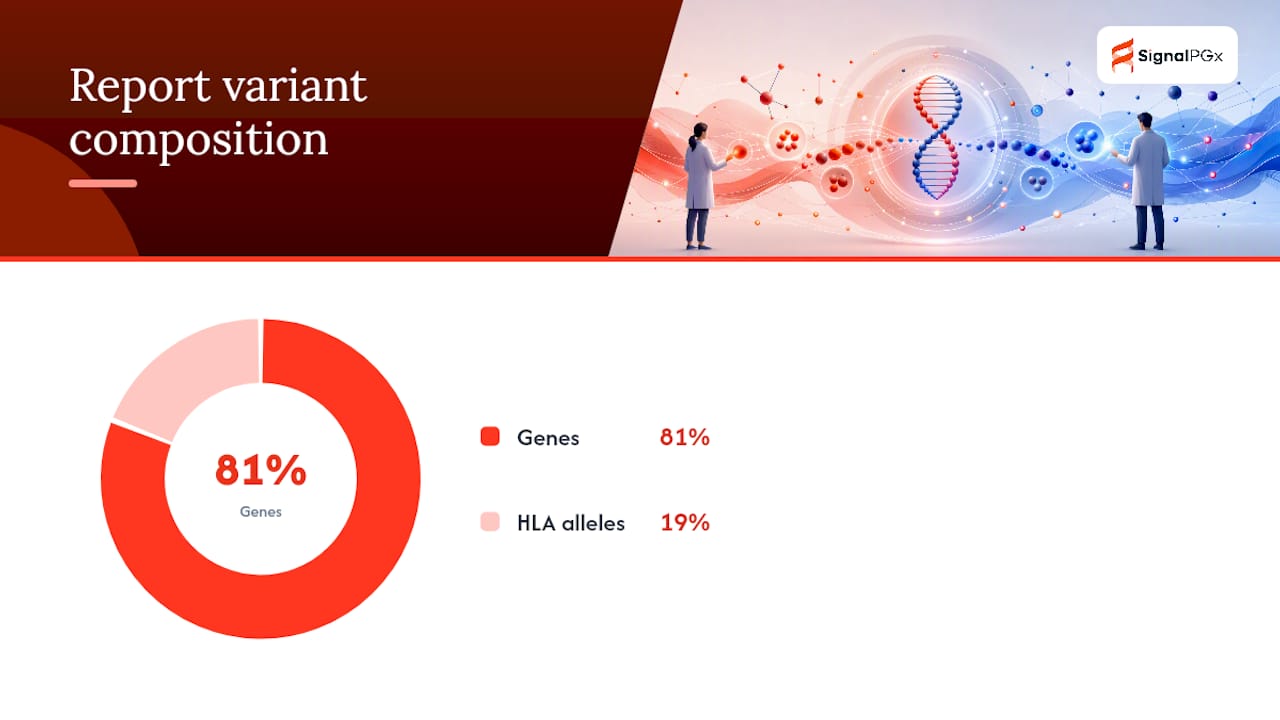
Quest Diagnostics built its advanced PGx offering around exactly this kind of evidence-backed structure, reporting genotype and predicted phenotype alongside provider-facing medication guidance informed by CPIC and FDA sources across 17 genes and four HLA alleles. That gene selection choice, not an arbitrary panel size, is what makes a report useful to a prescriber instead of just interesting to a geneticist. Evidence-graded report design is what separates a report clinicians trust from one they file and ignore.
What Integration Work Does PGx Reporting Require?
Integration is where launch timelines slip most often, mainly because labs underestimate how many systems a single report touches. Your LIMS needs to hand off patient and specimen identifiers cleanly to the interpretation engine, with a mapping scheme that survives instrument or panel changes down the line.
On the delivery side, plan for:
- SMART on FHIR apps or HL7/FHIR resource delivery for structured, EHR-native results
- PDF delivery as a fallback for systems without FHIR support
- CDS Hooks integration where you want interpretation to surface at the point of prescribing, not just in the chart
- Authentication via OAuth2, encrypted transport (TLS), and full access logging for every report view or download
SMART on FHIR and HL7/FHIR are now the default delivery methods vendors support, and labs that build this integration early see far less clinician friction once volume ramps up. Before go-live, run a staging environment through a full end-to-end test: sample intake, interpretation, report generation, and EHR delivery, using synthetic and de-identified real cases.
How Should Labs Staff and Price a PGx Program?
Staffing a PGx service is lighter than most labs expect, but the roles are specific. A realistic minimum team includes a lab director, one or two technologists handling specimen and assay workflow, bioinformatics support (often part-time or vendor-supplied), a medical director or physician reviewer, and a support contact for clinician questions.
- Set turnaround time targets by use case: preemptive panels can run several business days, while urgent perioperative or psychiatric dosing questions may need 24 to 48 hour turnaround.
- Scale staffing to volume, not headcount assumptions. A program running 50 tests a month needs a fraction of the technologist time a 500-test program requires.
- Prepare reimbursement documentation early. MolDX and Z-code registration, medical necessity documentation, and payer-specific coverage policies all take lead time to sort out.
- Plan for the most common pitfall: interpretation backlog when volume spikes faster than review capacity.
Pro Tip: Build your reimbursement documentation packet before your first billable test, not after your first denial. Revenue-defense software can help track claim status, but the underlying documentation has to exist first.
What Compliance and Privacy Rules Apply to PGx Testing?
Every PGx report in the United States falls under CLIA obligations for result reporting, record retention, and personnel qualification, regardless of whether your interpretation engine is built in-house or vendor-supplied. Retention periods and reporting formats are spelled out in your CLIA certificate requirements, and they apply to genetic test records the same way they apply to any other laboratory result.
Data protection layers on top of that:
- HIPAA governs protected health information handling for US-based labs, covering encryption at rest and in transit, access controls, and breach notification
- GDPR applies if you handle data for patients in the European Union, with stricter consent and data-minimization requirements
- Consent processes should confirm patients understand what a PGx result means and who can access it
- Security and compliance controls should be documented and reviewable before your first production sample runs
Authoritative regulatory text lives with the Centers for Medicare & Medicaid Services for CLIA and with the Department of Health and Human Services for HIPAA. Neither substitutes for your own compliance counsel review.
What Does a White-Label Vendor Actually Deliver?
A white-label vendor takes the interpretation, evidence curation, and physician review burden off your team's build list, letting you focus on sample handling and analytical QC instead of building an interpretation engine from scratch. SignalPGx, for example, describes a deployment pathway that includes evidence-fused interpretation, physician-reviewed report templates, living reanalysis, and EHR-ready integrations, deployed under your lab's own brand.
What still sits with your lab: sample accessioning, analytical validation of your genotyping platform, and day-to-day specimen operations. When vetting any vendor, ask about:
- Evidence source list and update cadence (does guidance actually get re-reviewed when CPIC or FDA labeling changes?)
- Security certifications and HIPAA/GDPR posture
- Integration options (FHIR, PDF, CDS Hooks) and typical timeline to first live report
- Reimbursement support, including documentation templates for Z-code and MolDX submissions
A shorter time-to-live shifts real overhead onto the vendor, but your lab still owns the sample workflow and analytic performance the report depends on.
Common Blockers When Rolling Out PGx Testing
The three blockers that stall most launches: unresolved sample identity mapping between LIMS and interpretation engine, medical director bandwidth for report review, and underestimated EHR integration testing time. Mitigate each early rather than discovering them at go-live.
Start with a narrow pilot: one gene panel, one clinical use case, a handful of ordering providers. Expand the gene set and provider base only after a full review cycle runs clean. Pause and remediate immediately if concordance testing shows unexpected discordance, or if medical director review surfaces interpretation errors. That is a validation signal, not a scheduling inconvenience.
— Tarek
Get Your PGx Service Live Without Building an Interpretation Engine From Scratch
Building an interpretation engine, evidence library, and physician review workflow from zero is where most in-house PGx launches lose months. SignalPGx exists to skip that build entirely: white-label reports, physician-reviewed workflows, living reanalysis that updates guidance automatically as CPIC and FDA labeling change, and EHR-ready delivery via SMART on FHIR and HL7/FHIR, all deployable under your own lab's brand.

A discovery call typically covers your current LIMS setup, target gene panel, integration requirements, and a walkthrough of the security review your compliance team will need. Most labs move from that conversation to a configured, physician-reviewed reporting environment within days, not months. Review the white-label PGx reporting platform details, check pricing and plan options, or book a demo to scope your specific integration path.
Sources
Guideline-based interpretation logic draws on CPIC and FDA biomarker labeling. Vendor deployment claims reference SignalPGx's launch documentation and Foundation Medicine's FoundationOne®PGx panel design.
This article is general information, not a substitute for advice from a qualified doctor. Consult a qualified healthcare professional about your own circumstances before acting on anything here.
- SignalPGx Launches White-Label Pharmacogenomics Reporting Platform for CLIA Laboratories
FAQ
What Does PGx Stand For?
PGx is shorthand for pharmacogenomics, the study of how a patient's genetic variants affect their response to medications. Note that "PGx" also appears in unrelated technical contexts, like database drivers and graph server software, so context matters when searching.
How Much Does a PGx Test Cost?
Costs vary widely by panel size, lab pricing model, and payer contracts, and no single flat rate applies across the industry. Labs deploying through a white-label vendor can review structured pricing tiers rather than building cost models from scratch.
Is PGx Testing Worth It?
For patients on medications with known gene-drug interactions, such as certain psychiatric, cardiovascular, or oncology drugs, PGx guidance can meaningfully change dosing or drug selection decisions. Panels built around guideline-backed genes, the approach both Quest Diagnostics and Foundation Medicine take with their offerings, tend to produce the most clinically actionable results.
Does Insurance Pay for PGx Testing?
Coverage depends on the payer, the specific gene-drug pair, and documentation of medical necessity, with MolDX and Z-codes playing a central role in Medicare-related claims. Labs should prepare reimbursement documentation before launch rather than after their first denial.
How Long Does It Take to Launch a PGx Reporting Service?
A white-label vendor pathway can reach production in five to seven days once sample data flow is verified, while an in-house build typically takes several months of validation and engineering work.