
Report UGT1A1 *28/*28, *6/*6, or *28/*6 as poor-metabolizer genotypes, and pair that call with a guideline-linked dosing recommendation (typically an initial dose reduction), the assay's analytic limits, and the specific guideline cited. Aim to deliver this before cycle 1 planning, since a late result forces clinicians to dose blind or delay treatment. The report's job is to give the oncology team a decision, not just data.
TL;DR:
- UGT1A1 testing should include specific genotype calls, predicted phenotypes, guideline-based dosing recommendations, and assay detection limits to enable immediate clinical action.
- Genotypes such as *28/*28, *6/*6, and *28/*6 significantly increase toxicity risk and require dose reductions of approximately 25 to 70 percent, depending on the guideline.
- Labs must clearly state assay limitations, especially regarding the detection of *6 variants, which are prevalent in East Asian populations but often missed by TA-repeat assays.
- Turnaround time for results should be five days or less to inform initial chemotherapy dosing, with structured codes and guideline versioning embedded for automated decision support.
- Integration of living reanalysis and guideline updates into reporting workflows ensures dosing recommendations remain current and reliable, reducing adverse events and improving safety.
Table of Contents
- What Should an Irinotecan UGT1A1 Reporting Checklist Include?
- Which UGT1A1 Genotypes Signal Higher Toxicity Risk?
- How Do Dosing Guidelines for UGT1A1 Poor Metabolizers Differ?
- What Do UGT1A1 Assays Miss, and When Should Labs Reflex to Sequencing?
- Report Template and Example Phrasing for Common Genotypes
- Interpretation Pitfalls: Gilbert Syndrome, Comorbidities, and Uncertain Genotypes
- Making UGT1A1 Reporting Fast Enough to Matter Clinically
- How SignalPGx Supports Consistent, Living UGT1A1 Reports
- What Labs Actually Learn Implementing UGT1A1 Reporting
- SignalPGx: Get Your Lab's UGT1A1 Reporting Live in Days, Not Months
- Sources
- FAQ
What Should an Irinotecan UGT1A1 Reporting Checklist Include?
A UGT1A1 report earns its place in the chart when a clinician can act on it without calling the lab. That means every result needs the same skeleton, regardless of which platform generated it.
Essential fields for every report:
- Genotype call (e.g., *1/*28, *28/*28, *6/*6)
- Predicted phenotype (normal, intermediate, or poor metabolizer)
- Recommended dosing action, tied to a named guideline
- Guideline citation with version and date
- Assay method and its detection limits
- SNOMED-CT or other structured codes for EHR ingestion
- Turnaround time, stated explicitly
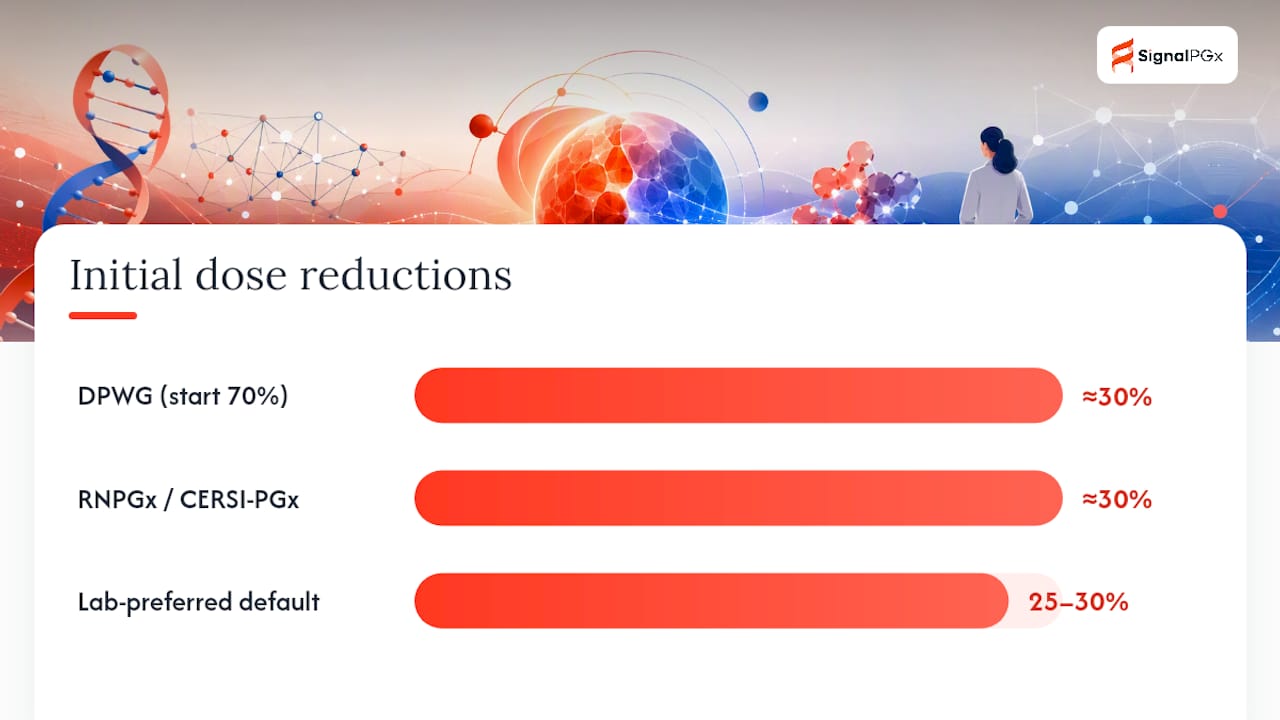
The dosing line is where labs run into trouble, mostly because DPWG and RNPGx/CERSI-PGx frame the same clinical concern in different numbers. DPWG anchors its recommendation to a starting dose of roughly 70% of standard for poor metabolizers. RNPGx and the UK CERSI-PGx guideline instead recommend roughly a 30% cycle-1 reduction with titration afterward. Both land in a similar practical range, but a report that cites one without naming it invites confusion when a second opinion cites the other.
A reconciled, lab-preferred line works better than forcing clinicians to pick a guideline mid-consult:
| Guideline | Recommended action for PM genotype | Citation to include in report |
|---|---|---|
| DPWG | Start at approximately 70% of standard dose | DPWG UGT1A1/irinotecan guideline, version and date |
| RNPGx/CERSI-PGx | Reduce cycle-1 dose by approximately 30%, titrate by tolerance | CERSI-PGx UGT1A1 irinotecan guideline, version and date |
| FDA label | Consider at least one dose-level reduction | Irinotecan product label, current revision |
| Lab-preferred default | Reduce initial dose by 25 to 30%; adjust per oncologist judgment | Internal policy citing DPWG and CERSI-PGx |
Advisory notes belong right after the dosing action, not buried in a footnote.
Pro Tip: Put the guideline name and version directly in the interpretive comment, not just in a reference list at the bottom of the report. Clinicians read the interpretive line first and often do not scroll to the citations.
Which UGT1A1 Genotypes Signal Higher Toxicity Risk?
Genotype-to-phenotype mapping is where most reporting errors start, usually because labs treat *28 as the only allele that matters.
The *1 allele is the wild-type reference and carries seven TA repeats in the promoter (TA6 is the common shorthand for wild-type in some nomenclature systems, but *1 functions as normal). Patients homozygous for *1 (*1/*1) are normal metabolizers with no genotype-driven dose adjustment. Heterozygotes carrying one *28 allele (*1/*28) are classified as intermediate metabolizers; they clear SN-38, irinotecan's active metabolite, less efficiently than normal metabolizers but tolerate standard starting doses in most cases, with closer monitoring during cycle 1.
The genotype combinations that demand the poor-metabolizer label and an explicit dosing flag are:
- *28/28 (homozygous TA7 repeat expansion), the classic high-risk genotype behind FDA labeling
- *6/6 (homozygous), a variant especially relevant in patients of East Asian ancestry
- *28/6 (compound heterozygous), which functionally phenocopies homozygous poor-metabolizer status and should be reported as PM-equivalent, per the NCBI summary on UGT1A1 and irinotecan
Poor metabolizers carry meaningfully elevated risk of severe neutropenia and diarrhea compared with normal metabolizers, a signal consistent enough that it underpins both FDA labeling and DPWG's essential-testing recommendation, according to the practitioner-focused review of UGT1A1 testing for irinotecan.
Population allele frequency shapes how often a lab should expect to see these calls. The *28 allele frequency varies widely among populations, being less common in some Asian populations and more frequent in African populations, according to the NCBI Bookshelf summary, which matters directly for pretest counseling and for forecasting reflex-testing volume. A lab serving a population where *28 frequency runs high should expect more heterozygotes and, proportionally, more homozygous poor metabolizers than a lab serving a population where the allele is rarer. This is also exactly why *6, which is prevalent in East Asian populations but nearly absent in European populations, cannot be an afterthought on a panel serving a diverse patient base.
How Do Dosing Guidelines for UGT1A1 Poor Metabolizers Differ?
No single dosing number commands universal agreement, and pretending otherwise in a report does clinicians a disservice. The honest move is to present each guideline's own language and let the ordering physician apply clinical judgment on top of it.
The three guideline positions, side by side:
- DPWG recommends starting UGT1A1 poor metabolizers at approximately 70% of the standard irinotecan dose, built on pharmacokinetic and maximum-tolerated-dose data, and classifies pretreatment genotyping as essential before starting irinotecan, per the DPWG guideline.
- The FDA label advises considering at least one dose-level reduction for patients homozygous for *28, but stops short of specifying an exact percentage, per the Camptosar (irinotecan) label.
That gap between DPWG's 70% starting dose and RNPGx's 25 to 30% reduction is smaller than it looks; both describe roughly the same practical target, just measured from different reference points. The FDA's vaguer language reflects a regulatory posture that leaves dosing specifics to clinical judgment rather than codifying a fixed percentage, which is precisely why a report that only quotes "consider dose reduction" without adding DPWG or CERSI-PGx specifics leaves the oncologist with nothing concrete to act on.
Labs have two defensible options for presenting this in a report: quote each guideline's own wording side by side, or state a reconciled lab-preferred default (commonly 25 to 30% reduction) while still naming the source guidelines and explicitly inviting clinician override based on comorbidities or treatment urgency.
The clinical stakes behind these numbers are not theoretical. A prospective safety and cost analysis found that genotype-guided dosing in poor metabolizers reduced febrile neutropenia rates and demonstrated that dose reductions can maintain therapeutic drug exposure, supporting genotype-based adjustment as both safer and cost-effective for this population, per the prospective cost analysis of genotype-guided irinotecan dosing.
That finding matters for the report itself: it gives labs a citable basis for stating that genotype-guided dose reduction is not merely cautious, but evidence-supported for reducing severe hematologic toxicity.
What Do UGT1A1 Assays Miss, and When Should Labs Reflex to Sequencing?
Most UGT1A1 panels are built around TA-repeat length assays, which detect the *28 allele (and related TA-repeat variants like *36 and *37) efficiently but were never designed to catch single-nucleotide variants located elsewhere in the gene. That distinction is the single most common source of false reassurance in irinotecan pharmacogenomic reporting.
Common testing approaches and what each one covers:
- TA-repeat fragment analysis detects promoter-region repeat length variants (*28, *36, *37) but does not detect *6 or other coding-region SNVs.
- Targeted genotyping panels can include *6 and other known variants if specifically designed to do so, but coverage varies significantly by vendor and region.
- Sequencing (targeted or broader) catches both TA-repeat variants and coding SNVs, including rare or novel variants, at higher cost and typically longer turnaround.
The *6 allele deserves specific attention because it's clinically significant and geographically concentrated. It's prevalent in East Asian populations and largely absent in European populations, meaning a TA-repeat-only panel deployed without regard to patient ancestry can systematically miss poor-metabolizer status in exactly the population where *6 matters most, a gap flagged directly in the NCBI Bookshelf review of irinotecan and UGT1A1 and echoed in laboratory test documentation from major reference labs, including ARUP's UGT1A1 gene analysis fact sheet.
The report language here should be specific, not hedged into meaninglessness. A limitations line reading "this assay does not detect all UGT1A1 variants" tells a clinician nothing actionable. Better: "This assay detects TA-repeat variants (*28, *36, *37) but does not include *6. If the patient has known or suspected East Asian ancestry and clinical suspicion for toxicity remains despite a normal result, consider reflex sequencing." Reflex criteria worth building into lab protocol include unexplained severe toxicity in a patient reported as normal metabolizer, ancestry consistent with elevated *6 prevalence, and any case where the ordering clinician specifically requests broader variant coverage.
Pro Tip: Don't bury the limitations line at the bottom of a long report. Put it directly beneath the interpretive comment, where it will actually get read before a dosing decision is made.
Report Template and Example Phrasing for Common Genotypes
A usable report template has eight fields, in this order: test performed, analytic method, genotype call, predicted phenotype, brief interpretation, recommended action with guideline citation, limitations, and SNOMED-CT structured codes, followed by a clinician contact line for questions.
Sample interpretive language, adapted to genotype, keeps reports consistent across technologists and shift changes:
| Genotype | Predicted phenotype | Sample interpretive line |
|---|---|---|
| *1/*1 | Normal metabolizer | No genotype-based dose adjustment indicated. Standard irinotecan dosing per protocol. |
| *1/*28 | Intermediate metabolizer | Standard starting dose is generally appropriate; monitor closely during cycle 1 per institutional protocol. |
| *28/*28 | Poor metabolizer | Consider dose reduction per DPWG (approximately 70% of standard) or CERSI-PGx (approximately 25 to 30% reduction). See limitations. |
| *6/*6 | Poor metabolizer | Functionally equivalent to *28/*28; consider dose reduction as above. Confirm assay included *6 detection. |
| *28/*6 | Poor metabolizer (compound heterozygous) | Report as PM-equivalent; consider dose reduction consistent with homozygous poor-metabolizer recommendations. |
Each report should carry a short line pointing to the guideline source document rather than leaving the clinician to search for it independently, whether that's a link to the DPWG PDF, the CERSI-PGx guideline, or an internal lab policy document that cites both. SNOMED-CT codes belong in a structured data field alongside the narrative text, not as a replacement for it, so that EHR systems can trigger clinical decision support alerts while the clinician still gets readable interpretive language. Labs building out PGx toxicity reporting for irinotecan can adapt this field structure directly into their laboratory information system output.
Interpretation Pitfalls: Gilbert Syndrome, Comorbidities, and Uncertain Genotypes
A UGT1A1 result ordered to investigate suspected Gilbert syndrome and a UGT1A1 result ordered for irinotecan pharmacogenomic risk assessment are answering two different clinical questions, even when the same genotype comes back. A report generated for diagnostic purposes (explaining unconjugated hyperbilirubinemia) should not be silently repurposed for chemotherapy dosing decisions without an interpretive comment that explicitly reframes the result in a pharmacogenomic context.
Situations where genotype alone isn't the whole story:
- Hepatic dysfunction alters SN-38 clearance independent of genotype, and a report should note that a normal-metabolizer call doesn't override clinical concern in a patient with abnormal liver function tests.
- Concomitant medications that inhibit UGT1A1, such as atazanavir, can functionally phenocopy a poor-metabolizer state even in a genotypically normal patient.
- Recent unexplained bilirubin elevation, regardless of genotype result, should prompt a recommendation for clinical review before finalizing a dosing interpretation.
- Compound heterozygotes with variants of uncertain significance need language that says so plainly: "Clinical significance of this combination is not fully established; consider PM-equivalent caution and clinical correlation" rather than a false-confidence phenotype call.
Making UGT1A1 Reporting Fast Enough to Matter Clinically
A UGT1A1 result that arrives after cycle 1 has already started is a result that didn't do its job. Turnaround matters as much as accuracy here, because oncologists plan chemotherapy on tight scheduling windows.
Operational targets worth building into lab protocol:
- Target turnaround of five calendar days or less, consistent with DPWG and CERSI-PGx best-practice expectations, measured from specimen receipt to final report release.
- Deliver results with SNOMED-CT structured codes alongside narrative text so HL7/FHIR-integrated EHR systems can trigger clinical decision support alerts automatically.
- Route high-risk genotype calls (PM-equivalent results) through an expedited notification path, not just standard result release, so the ordering oncologist sees the flag before finalizing a chemotherapy order.
- Require medical director review before release, with a documented record of which guideline version informed the dosing language in that specific report.
- Schedule periodic reanalysis so reports issued under an older guideline version get flagged for update as DPWG, CERSI-PGx, or FDA labeling changes.
Pro Tip: Build the guideline version and date into a structured metadata field, not just narrative text. When DPWG or CERSI-PGx revises its recommendation, you want to query every report issued under the old version, not search free text manually.
How SignalPGx Supports Consistent, Living UGT1A1 Reports
SignalPGx builds the operational backbone this article describes directly into laboratory workflow. Evidence fusion pulls current DPWG, FDA, and CERSI-PGx guidance into each report automatically, while living reanalysis flags reports for update the moment a cited guideline changes. Physician-reviewed templates standardize the genotype-to-phenotype language across every technologist and shift, and HL7/FHIR integration pushes SNOMED-coded results straight into the ordering clinician's EHR.
What Labs Actually Learn Implementing UGT1A1 Reporting
The friction usually isn't the genotyping itself. It's reconciling turnaround pressure against medical director review, and getting clinicians comfortable with divergent guideline numbers instead of one clean answer.
If you build one thing first, build the limitations line. A clear statement of what the assay didn't test for prevents more misdosing than any dosing algorithm.
— Tarek
SignalPGx: Get Your Lab's UGT1A1 Reporting Live in Days, Not Months
Building this reporting infrastructure in house means months of template design, guideline tracking, and EHR integration work before a single report goes out the door. SignalPGx compresses that timeline by deploying white-label, physician-reviewed PGx reporting infrastructure in 5 to 7 days, already built around the genotype-to-phenotype logic, guideline citations, and structured SNOMED coding this article outlines.

Living reanalysis means your UGT1A1 reports update automatically as DPWG, CERSI-PGx, or FDA guidance evolves, so your lab never issues an interpretation built on outdated dosing percentages. HL7/FHIR integration pushes structured results directly into the ordering clinician's EHR, and every report carries HIPAA and GDPR-aligned compliance controls built in from the start. If your lab is evaluating how AI-driven pharmacogenomic interpretation can shorten your path to clinically defensible UGT1A1 reporting, request a demo and see the report template running on your own genotype data.
This article is general information, not a substitute for advice from a qualified doctor. Consult a qualified healthcare professional about your own circumstances before acting on anything here.
Sources
- Camptosar (irinotecan) FDA label
- UGT1A1 genotype-guided dosing of irinotecan: A prospective safety and cost analysis in poor metaboliser patients
- Irinotecan therapy and UGT1A1 genotype - NCBI Bookshelf
FAQ
Is there a connection between Gilbert syndrome and irinotecan toxicity?
Yes. Gilbert syndrome is caused by the same UGT1A1 *28 variant that drives poor irinotecan metabolism, so patients with diagnosed Gilbert syndrome share the reduced SN-38 clearance that raises toxicity risk, even though the two results serve different clinical purposes.
What do the results of a UGT1A1 test indicate?
A UGT1A1 result identifies which alleles a patient carries at the *28 and, on comprehensive panels, *6 loci, and translates that genotype into a predicted metabolizer phenotype (normal, intermediate, or poor) that guides irinotecan starting dose decisions.
What drugs are metabolized by UGT1A1?
UGT1A1 glucuronidates several substrates, but its best-established pharmacogenomic role involves irinotecan's active metabolite, SN-38; the enzyme also handles bilirubin, which is why *28 variants also cause Gilbert syndrome.
How much does UGT1A1 testing cost?
Cost varies by lab, panel scope, and region, and isn't standardized publicly; labs offering broader sequencing panels that include *6 and rare variants typically price higher than basic TA-repeat-only assays.
Should compound heterozygous genotypes like *28/*6 be treated as poor metabolizers?
Yes. Evidence supports reporting *28/*6 as functionally equivalent to homozygous poor-metabolizer status, since both alleles reduce UGT1A1 activity and the combination phenocopies *28/*28 in clinical risk.