
Test every carbamazepine-naive patient with ancestry from populations where HLA-B*15:02 is prevalent before writing the first prescription. If the result is positive, avoid carbamazepine. That single decision point, supported by the FDA label annotation, the Amstutz et al. recommendations published in Epilepsia, and ClinGen/ClinPGx annotations, has the potential to prevent one of the most catastrophic drug reactions in clinical practice: carbamazepine-induced Stevens–Johnson syndrome (SJS) or toxic epidermal necrolysis (TEN).
The formal allele designation is HLA-B15:02 (also written HLA-B1502 in older nomenclature). Both refer to the same allele; the colon-delimited format is current WHO nomenclature and should appear in all new laboratory reports.
Immediate clinical actions at the point of prescribing:
- HLA-B*15:02 positive: Do not initiate carbamazepine or oxcarbazepine. Select a structurally unrelated alternative and document the contraindication in the chart.
- HLA-B*15:02 negative: Carbamazepine may be used per standard clinical guidelines. Maintain vigilance for hypersensitivity signs during the first 4–28 days of therapy.
- Ancestry unknown or mixed: Treat as high-risk. Test before prescribing, or choose an alternative while awaiting results.
- Patient already on carbamazepine: Risk of SJS/TEN is highest in the first 8 weeks. Retrospective testing has limited actionability but may inform future prescribing decisions.
Table of Contents
- What the evidence shows about HLA-B15:02 and carbamazepine-induced SJS/TEN
- Who should be tested for HLA-B15:02 and when
- Laboratory methods for HLA-B15:02 genotyping and how to interpret results
- HLA-B15:02 prevalence across populations and how it changes pretest probability
- How to act on HLA-B15:02 test results: prescribing decisions and alternatives
- Test limitations, common misinterpretations, and scenarios that can cause harm
- Operational lab checklist: ordering, specimen requirements, TAT, and reporting
- Authoritative guidance: FDA label, CPIC/Amstutz, and ClinGen/ClinPGx
- Operationalizing results in PGx reporting and CDS
- Key Takeaways
- What labs actually learn when they roll out routine HLA-B15:02 screening
- How Signalpgx helps labs operationalize HLA-B15:02 reporting
- Annotated primary sources for protocol development
What the evidence shows about HLA-B*15:02 and carbamazepine-induced SJS/TEN
The association between HLA-B*15:02 and carbamazepine-induced SJS/TEN is among the strongest pharmacogenomic drug-reaction signals documented in the literature. A systematic review and meta-analysis in JAMA Dermatology reported a pooled odds ratio of approximately 80 for SJS/TEN overall, with even larger effect sizes in Han Chinese, Thai, and Malaysian subgroups. An odds ratio of that magnitude is not a statistical curiosity; it represents a clinically decisive signal.
The prospective evidence is equally compelling. A multicenter screening study in Taiwan found that no SJS/TEN cases occurred among HLA-B*15:02-negative patients who received carbamazepine after screening, versus approximately 10 cases expected based on historical incidence. That result, published in the New England Journal of Medicine, provided the prospective prevention data that regulators and guideline authors needed to move from association to action.
Several points of nuance matter for clinical interpretation:
- The allele's predictive power is specific to SJS/TEN, not to milder maculopapular exanthema (MPE) or drug reaction with eosinophilia and systemic symptoms (DRESS). Those phenotypes are more strongly associated with HLA-A*31:01.
- A negative HLA-B*15:02 result does not eliminate all hypersensitivity risk; it substantially lowers the probability of SJS/TEN specifically.
- The association is supported by case-control studies, genome-wide association studies (GWAS), and the prospective Taiwan cohort, giving it a multi-study evidence base that few pharmacogenomic signals can match.
- Positive predictive value (PPV) for SJS/TEN remains low in absolute terms because the reaction itself is rare, even among carriers. Clinical sensitivity and specificity for SJS/TEN in high-prevalence populations are high, but PPV is population- and prevalence-dependent.
Who should be tested for HLA-B*15:02 and when
The Amstutz et al. recommendations in Epilepsia and the FDA label both converge on a clear testing indication: test carbamazepine-naive patients from populations where HLA-B*15:02 is common before initiating therapy. In practice, the safest institutional policy is to test all patients regardless of reported ancestry, because ancestry ascertainment by self-report or clinical observation is unreliable in admixed populations.
Guideline-driven testing indications:
- Patients with ancestry from Southeast Asia (Thailand, Malaysia, Vietnam, Philippines), East Asia (Han Chinese, Taiwanese), or South Asia where allele frequency exceeds 1%.
- All carbamazepine-naive patients, as the broadest and most defensible institutional policy.
- Patients being considered for oxcarbazepine, given overlapping cross-reactivity risk.
- Patients where ancestry is unknown, mixed, or self-reported without documentation.
Timing is non-negotiable. Pre-prescription testing is the only clinically meaningful window. Ordering the test after a rash appears converts a preventive tool into a retrospective annotation. Most SJS/TEN cases occur within the first 8 weeks of carbamazepine exposure, with the highest-risk window in the first 28 days.
HLA-A*31:01 co-testing: The Amstutz recommendations explicitly advise testing for HLA-A31:01 alongside HLA-B15:02. HLA-A31:01 predicts a broader spectrum of hypersensitivity reactions, including DRESS and MPE, across multiple ethnic groups including Northern European populations where HLA-B15:02 is rare. A combined panel provides more complete risk stratification than either allele alone.

For patients already receiving carbamazepine, retrospective testing is of limited preventive value during the first 8 weeks. After that window, the incremental SJS/TEN risk drops substantially, though testing may still inform decisions about future aromatic anticonvulsant use.
Laboratory methods for HLA-B*15:02 genotyping and how to interpret results
Common genotyping methods
| Method | Allele Resolution | Typical TAT | Key Consideration |
|---|---|---|---|
| Sequence-specific primer PCR (SSP) | Group-level (2-digit) | 1–2 days | Fast; may miss rare alleles at same group |
| Sequence-specific oligonucleotide probes (SSOP) | Intermediate (2–4 digit) | 1–3 days | Higher throughput; probe coverage determines allele scope |
| Sanger sequencing | High (4–8 digit) | 3–5 days | Reference standard; labor-intensive |
| Next-generation sequencing / MPS | Allele-level (high resolution) | 3–7 days | Most complete coverage; preferred for ambiguity resolution |
SSP-PCR and SSOP are the most common methods in US reference laboratories for targeted HLA-B*15:02 detection because they offer adequate resolution for clinical decision-making at acceptable turnaround times. MPS-based typing is increasingly used when broader HLA panel coverage is ordered simultaneously.
Analytic vs. clinical validity: Analytic sensitivity and specificity for detecting HLA-B15:02 are high across validated platforms. Clinical sensitivity for predicting SJS/TEN is also high in affected Asian populations, but clinical specificity is moderate because most HLA-B15:02 carriers who receive carbamazepine do not develop SJS/TEN. This distinction matters when counseling clinicians: a positive result is a strong contraindication, not a certainty of reaction.
Allele nomenclature pitfall: Older assays and some lab reports use "HLA-B1502" (no colon), while current WHO nomenclature uses "HLA-B15:02." Both refer to the same allele. Reports should use the current format and note the equivalence to prevent clinician confusion.
Example report language for a positive result:
Example report language for a negative result:
Pro Tip: Assay coverage documentation should accompany every report. Specify which alleles the method detects and at what resolution. A report that states only "HLA-B15:02 negative" without method context leaves clinicians unable to assess whether rare alleles at the B15 group were evaluated.
HLA-B*15:02 prevalence across populations and how it changes pretest probability
Population prevalence of HLA-B*15:02 varies widely, and that variance directly determines how much a positive result changes clinical management. The NCBI Medical Genetics Summaries report the following prevalence estimates:
- >15% in parts of Hong Kong, Thailand, Malaysia, and some regions of the Philippines
- ~10% in Taiwan
- 2–4% in some South Asian populations
- <1% in Japan and Korea
- Largely absent in most non-Asian populations, including Northern European groups
These figures have direct implications for pretest probability and PPV. In a Thai population with a 15% allele frequency, a positive result carries substantial prior probability and warrants unambiguous contraindication language. In a Northern European patient with no Asian ancestry, a positive result is unexpected but still clinically actionable; the low prior probability means the absolute number of prevented cases per screened patient is smaller, but the individual clinical consequence of a missed positive remains catastrophic.
Pro Tip: Never infer HLA-B15:02 carrier status from physical appearance or surname. Admixed ancestry, adoption, and incomplete family history all create scenarios where a patient who appears to be of European descent carries the allele. When ancestry is uncertain, test. The cost of a false negative in this context is irreversible.*

How to act on HLA-B*15:02 test results: prescribing decisions and alternatives
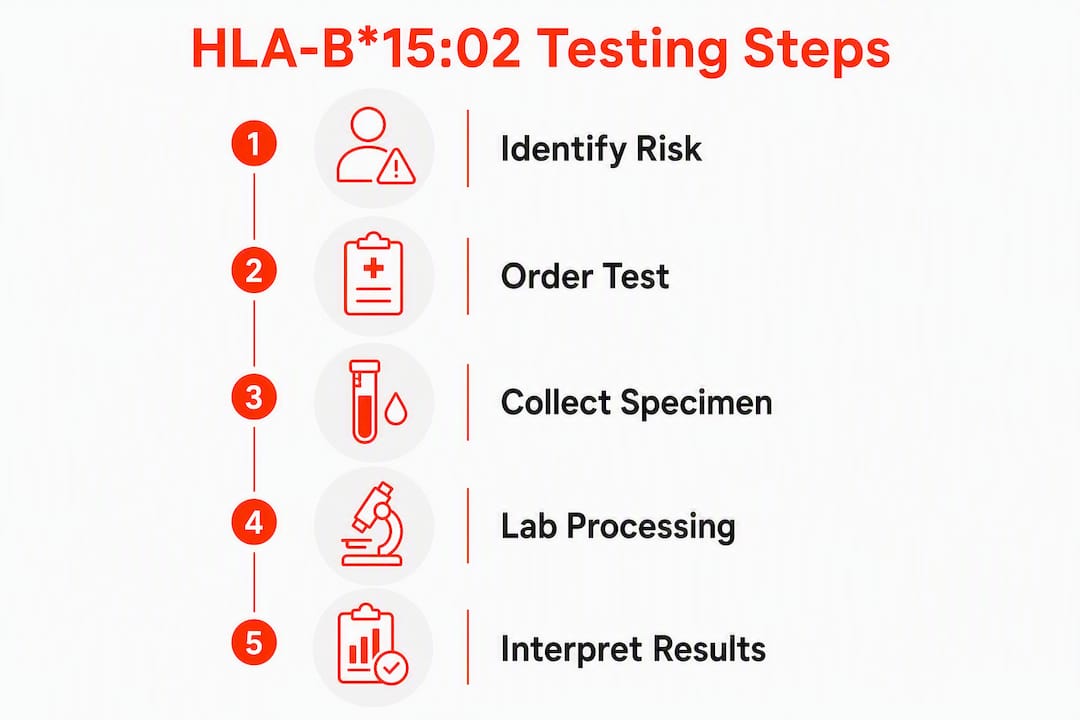
Sequential action flow at the point of prescribing
- Confirm carbamazepine is the intended agent and that the indication is appropriate.
- Identify patient ancestry and order HLA-B15:02 (and HLA-A31:01) genotyping before writing the prescription.
- If HLA-B*15:02 positive: Document contraindication. Do not prescribe carbamazepine or oxcarbazepine.
- If HLA-B*15:02 negative: Proceed with carbamazepine per standard dosing. Counsel patient on early hypersensitivity signs and schedule a follow-up within the first 4 weeks.
- If result pending and clinical urgency is high: Choose a structurally unrelated alternative while awaiting results.
Alternative medications and cross-reactivity considerations
Selecting an alternative for an HLA-B*15:02-positive patient requires attention to structural class. Aromatic anticonvulsants share cross-reactivity risk:
- Phenytoin: Cross-reactivity with HLA-B15:02 is documented; avoid in HLA-B15:02-positive patients. The FDA label for phenytoin carries a similar ancestry-based screening recommendation.
- Oxcarbazepine: Structurally related to carbamazepine; cross-reactivity risk is recognized in guideline recommendations. Avoid unless no alternative exists.
- Lamotrigine: Lower cross-reactivity evidence, but caution is still warranted in HLA-B*15:02-positive patients; not a first-line substitute without specialist input.
- Eslicarbazepine: Shares the dibenzazepine core; treat with the same caution as oxcarbazepine.
- Phenobarbital: Some cross-reactivity data exist; use with caution and specialist guidance.
- Valproate, levetiracetam, gabapentin: Structurally unrelated to aromatic anticonvulsants; generally preferred alternatives when the indication permits.
The principle is straightforward: the further the structural distance from the dibenzazepine scaffold, the lower the cross-reactivity concern. Specialist neurology or clinical pharmacology input is advisable when the indication for carbamazepine is narrow (e.g., trigeminal neuralgia) and alternatives are less well-studied for that specific use.
Test limitations, common misinterpretations, and scenarios that can cause harm
HLA-B*15:02 testing is one of the most clinically validated pharmacogenomic tests available, but several limitations can produce false reassurance or misapplication if not communicated clearly.
Core limitations:
- Low absolute PPV for SJS/TEN. Even in high-prevalence populations, most HLA-B*15:02 carriers who receive carbamazepine do not develop SJS/TEN. A positive result is a contraindication, not a diagnosis of inevitable reaction.
- Does not predict DRESS or MPE. A negative HLA-B15:02 result provides no reassurance against these phenotypes. HLA-A31:01 is the relevant marker for broader hypersensitivity risk.
- Incomplete allele coverage in some assays. Group-level SSP-PCR methods may not resolve rare alleles within the B*15 group. Clinicians should know what the assay covers.
- Ancestry ascertainment errors. Self-reported ancestry is imprecise. Admixed patients may carry the allele without fitting the expected demographic profile.
- Negative result does not eliminate clinical vigilance. The NCBI Medical Genetics Summaries are explicit: a negative genotype lowers but does not eliminate risk. Monitor all patients during the first 4–28 days regardless of result.
Common reporting pitfalls:
- Ambiguous wording such as "variant detected; clinical significance uncertain" when the allele is HLA-B*15:02 and the drug is carbamazepine. The clinical significance is well-established; the report must say so.
- Failure to mention oxcarbazepine cross-reactivity in the positive-result interpretation.
- Absence of alternative medication guidance or a referral recommendation in the report body.
- Using the outdated "HLA-B1502" nomenclature without noting equivalence to HLA-B15:02.
Operational lab checklist: ordering, specimen requirements, TAT, and reporting
Specimen and turnaround summary
| Parameter | Specification |
|---|---|
| Specimen type | Whole blood (EDTA), buccal swab (some platforms) |
| Minimum volume | 3–5 mL whole blood; platform-dependent |
| Stability | 7 days refrigerated for EDTA blood |
| Typical TAT (reference lab) | 3–7 business days; STAT options vary by lab |
For US laboratories, ARUP Laboratories offers a validated HLA-B*15:02 test with documented method specifications, analytic performance data, and specimen requirements. Referencing a validated reference lab's test sheet in your protocol documentation supports CLIA defensibility.
Operational checklist for lab implementation:
- Define a STAT pathway for urgent carbamazepine decisions (e.g., new-onset seizure requiring rapid anticonvulsant initiation).
- Establish discrete genotype result fields in your LIS so that CDS rules in the EHR can trigger on structured data, not free-text interpretation.
- Version your report templates and link each version to the guideline edition it reflects (CPIC, FDA label date, ClinGen annotation version).
- Include a test limitations statement in every report, specifying method and allele coverage.
- Train order-entry staff on the correct test code and specimen requirements to prevent pre-analytic errors.
- Route positive results through a pharmacist or clinical pharmacogenomics specialist before they reach the prescribing clinician, where institutional workflow permits.
Pro Tip: Build your report template around discrete fields: allele call, phenotypic interpretation, recommended clinical action, alternative medication note, test limitations, and guideline references. A report that requires a clinician to read three paragraphs before finding the action statement will not change prescribing behavior as reliably as one that leads with the recommendation.
For labs evaluating the cost and logistics of pharmacogenomic testing before building an in-house workflow, reference lab partnerships can reduce implementation time while your internal validation is completed.
Authoritative guidance: FDA label, CPIC/Amstutz, and ClinGen/ClinPGx
Three primary authorities drive US practice for carbamazepine HLA-B*15:02 screening, and their recommendations are convergent on the core action:
- FDA label annotation (ClinPGx): The FDA label for carbamazepine includes a Black Box Warning recommending HLA-B*15:02 screening in patients of Asian ancestry before initiating therapy. Patients who test positive should not receive carbamazepine unless the benefit clearly outweighs the risk. This is the regulatory floor for US practice.
- Amstutz et al. / CPIC-aligned recommendations (Epilepsia): The Amstutz recommendations go further than the FDA label in two ways: they recommend considering universal testing regardless of ancestry as the safest option, and they explicitly recommend co-testing for HLA-A*31:01 to capture broader hypersensitivity risk. Strength of recommendation is highest for patients from high-prevalence populations.
- ClinGen/ClinPGx annotation: ClinPGx provides a curated, machine-readable annotation of the FDA label that labs can use to align report language with regulatory guidance. The annotation supports structured CDS integration and is updated as label language evolves.
The practical difference between the FDA label and the Amstutz recommendations is the scope of testing: the FDA targets ancestry-defined populations, while the clinical consensus increasingly favors universal pre-prescription testing. For labs building institutional protocols, the Amstutz/CPIC framing provides a more defensible and inclusive policy. Aligning your PGx reporting guidelines with all three sources, rather than any single one, produces the most complete and defensible report language.
Operationalizing results in PGx reporting and CDS
A genotype result sitting in a PDF is not a clinical decision support tool. The workflow that converts an HLA-B*15:02 result into a prescribing action requires structured data, versioned evidence, and EHR integration.
Minimal viable workflow:
- Genotype import into LIS with discrete allele call (e.g., HLA-B*15:02 detected/not detected)
- Evidence grading against current CPIC, FDA, and ClinGen annotations
- Report generation with structured interpretation and recommended action
- CDS trigger in the EHR at the point of carbamazepine order entry, surfacing the genotype result and contraindication alert
Evidence maintenance checklist:
- Subscribe to CPIC update notifications and review new publications quarterly.
- Version-control all report templates with the date of the guideline edition they reflect.
- Implement living reanalysis so that previously reported results are flagged for review when guidelines change.
- Maintain an audit trail linking each report to the evidence version used at time of generation.
Pro Tip: CDS rules that fire on free-text interpretation fields are fragile. A discrete genotype field (e.g., HLA-B15:02 = "Positive") that maps to a structured CDS rule is far more reliable than a rule that parses report narrative. Build your LIS output with this in mind from day one. The FHIR and CDS Hooks integration model is the current standard for this architecture.*
PGx reporting platforms that support discrete genotype data, versioned evidence, and HL7/FHIR output reduce the engineering burden on lab informatics teams and make the CDS layer maintainable as guidelines evolve.
Key Takeaways
Pre-prescription HLA-B*15:02 testing is the single most evidence-supported intervention available to prevent carbamazepine-induced SJS/TEN, with prospective data showing the expected case count can be reduced to zero in screened cohorts.
| Point | Details |
|---|---|
| Test before prescribing | Order HLA-B15:02 (and HLA-A31:01) before initiating carbamazepine in any at-risk patient. |
| Positive result = contraindication | Avoid carbamazepine and oxcarbazepine; select a structurally unrelated alternative. |
| Negative result is not full clearance | Monitor all patients during the first 4–28 days; DRESS and MPE risk remains. |
| Population prevalence drives pretest probability | Allele frequency exceeds 15% in parts of Thailand and Malaysia; treat unknown ancestry as high-risk. |
| Signalpgx supports defensible reporting | Signalpgx provides discrete genotype fields, living evidence updates, and EHR/FHIR integration for labs operationalizing HLA-B*15:02 reporting. |
What labs actually learn when they roll out routine HLA-B*15:02 screening
The decision to implement routine pre-prescription HLA-B*15:02 screening looks straightforward on paper. The evidence is strong, the guidelines are clear, and the FDA label provides regulatory cover. The operational reality is more layered, and the details that trip up labs are rarely the ones they anticipated.
The first friction point is almost always the order-entry workflow. Clinicians ordering carbamazepine for the first time often do not know the test exists, let alone which code to use or how to collect the specimen. A standing order set that bundles HLA-B*15:02 genotyping with carbamazepine initiation orders removes that barrier more effectively than any education campaign. The second friction point is report language. Early report templates tend to bury the clinical action in the third paragraph after a methodology description. Clinicians read the first line and stop. Moving the recommended action to the first sentence of the interpretation field changes prescribing behavior in a way that a well-written paragraph buried below the fold does not.
The third lesson is about the monitoring window. Even after a negative result is returned and carbamazepine is started, the first 28 days require active surveillance. Labs that implement HLA-B*15:02 testing without pairing it with a clinical education piece on residual risk are solving half the problem. The genotype result reduces SJS/TEN risk substantially; it does not transfer responsibility for clinical monitoring from the prescriber to the laboratory.
Labs that have moved to a combined HLA-B15:02 and HLA-A31:01 panel report that the incremental cost is modest and the clinical value of capturing DRESS risk across a broader patient population justifies the addition. The panel approach also simplifies the ordering decision: one test, two alleles, comprehensive hypersensitivity risk stratification for carbamazepine.
How Signalpgx helps labs operationalize HLA-B*15:02 reporting
Labs that have validated their HLA-B*15:02 assay still face a reporting infrastructure problem: how do you convert a discrete genotype call into a clinician-ready, evidence-graded report that stays current as CPIC, FDA, and ClinGen guidance evolves? That is the operational gap Signalpgx is built to close.
The Signalpgx white-label PGx reporting platform gives your lab structured genotype data fields, versioned evidence grading across 20+ sources, living reanalysis that flags previously issued reports when guidelines change, and HL7/FHIR output that feeds CDS rules directly at the point of carbamazepine order entry. Medical-director review and audit trail documentation are built into the workflow, not bolted on afterward. Most labs are live within 5–7 days of onboarding.
Platform capabilities aligned with HLA-B*15:02 reporting needs:
- Discrete allele call fields with structured phenotypic interpretation
- Living evidence updates linked to CPIC, FDA label annotations, and ClinGen
- EHR integration via HL7/FHIR and CDS Hooks for real-time prescribing alerts
- White-label report templates with configurable action language
- HIPAA-compliant audit trail for every report version
If your lab is ready to move from validated genotype to defensible, clinician-ready PGx reports, schedule a demo with the Signalpgx team to see how the platform handles HLA-B*15:02 and your broader pharmacogenomics panel.
Annotated primary sources for protocol development
These are the primary references your lab should cite in protocols, report footnotes, and institutional review submissions:
- FDA label annotation for carbamazepine and HLA-B (ClinPGx): The regulatory source for the Black Box Warning. Use this as the primary citation for US prescribing guidance and report footnotes.
- Amstutz et al., Epilepsia (CPIC-aligned recommendations): The foundational clinical guideline for who to test, when to test, and how to act on results. Includes HLA-A*31:01 co-testing recommendations.
- NEJM Taiwan prospective screening study: The only prospective prevention dataset showing that screening reduces SJS/TEN incidence to zero in the screened cohort. Essential for institutional justification of a screening program.
- JAMA Dermatology meta-analysis: Provides pooled odds ratios (~80 overall) and subgroup effect sizes. Use for evidence-grading sections of your protocol.
- NCBI Medical Genetics Summaries: Carbamazepine and HLA Genotype: Comprehensive clinical genetics summary covering prevalence data, interpretation guidance, and monitoring recommendations. Useful for report template development.
- NCBI Medical Genetics Summaries: Phenytoin and HLA-B*15:02: Documents cross-reactivity between phenytoin and HLA-B*15:02; cite when advising on alternative medication selection.
- ARUP Laboratories HLA-B*15:02 test sheet: Provides validated method specifications, specimen requirements, analytic performance data, and CPT coding for a US reference lab implementation. Access directly through the ARUP test directory for the most current version.