
For US clinical and CLIA labs, Signalpgx is the recommended pharmacogenomics reporting platform: CPIC/FDA-aligned, HL7/FHIR-integrated, HIPAA/GDPR-compliant, and deployable under your lab's brand in as few as 5–7 days.
Three signals that put Signalpgx at the top of any lab's evaluation list:
- CPIC/FDA guideline mapping with evidence graded across 20+ sources, including PharmVar and published literature, so every report carries traceable clinical justification
- HL7 v2 and FHIR R4 integration with CDS Hooks support, surfacing prescribing alerts directly inside Epic, Cerner, and other EHR workflows without requiring a separate clinician login
- Full HIPAA and GDPR compliance with medical-director review, versioned audit trails, and white-label infrastructure your lab controls
Ready to evaluate? View pricing and plans or book a white-label demo to start a structured pilot.
Table of Contents
- What does Signalpgx deliver for your lab?
- How to choose the right PGx reporting software
- What technical integration actually looks like in practice
- What your lab must verify before go-live
- Deployment timeline and pricing: what to budget for
- Key Takeaways
- Why integrated PGx reporting is worth prioritizing now
- Signalpgx is ready to deploy in your lab
- Useful sources for your vendor evaluation
What does Signalpgx deliver for your lab?
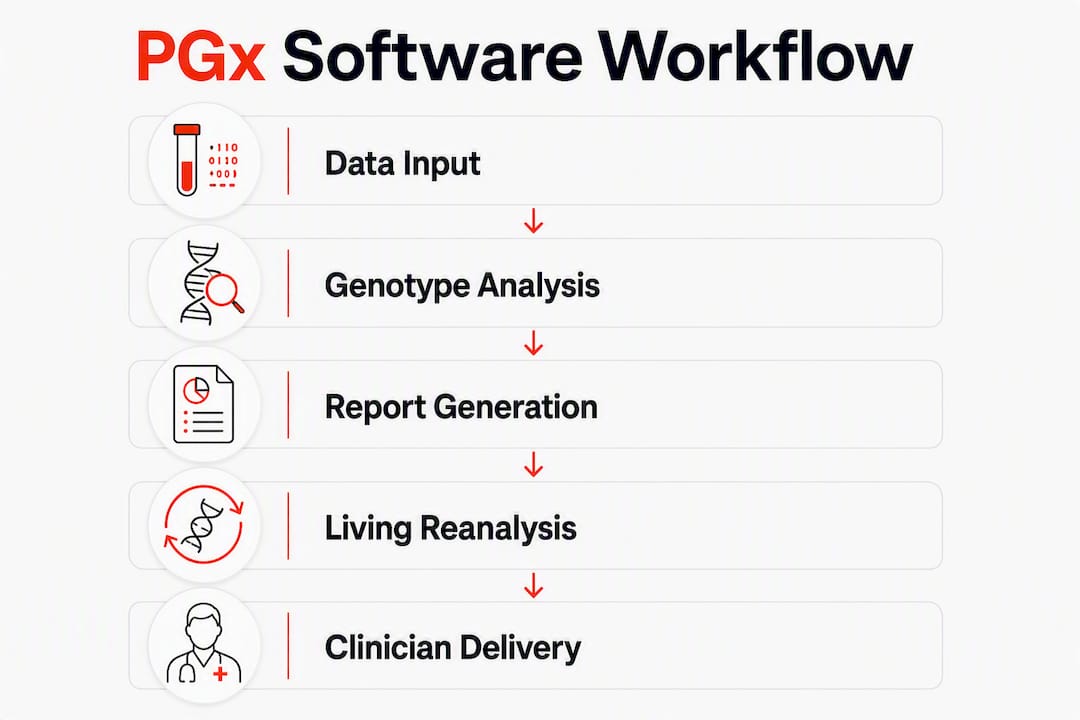
Signalpgx converts raw genotype data into physician-reviewed, evidence-backed PGx reports your clinicians can act on. The platform handles the full pipeline: automated star-allele calling, diplotype-to-phenotype assignment, and CPIC/FDA guideline mapping, all without manual curation on your team's part. Effective platforms in US clinical settings prioritize support for 25+ CPIC Level A drug-gene pairs to ensure clinical utility, and Signalpgx is built around that standard.

Reports are generated in two formats: a physician-ready PDF with evidence citations and prescribing recommendations, and a patient-friendly summary written for lay comprehension. White-labeling goes beyond placing your logo in the corner. Your lab's branding, report templates, and delivery workflows are fully configurable, so the service your patients and clinicians receive carries your identity, not a vendor's.
Living reanalysis is one of the platform's most operationally significant features. As CPIC and FDA guidance updates, Signalpgx reprocesses existing results and flags changed recommendations automatically, eliminating the manual re-interpretation burden that grows with every guideline revision cycle.
| Capability | What it does for your lab |
|---|---|
| Star-allele calling and diplotype/phenotype assignment | Automates genotype interpretation per CPIC/PharmVar standards |
| CPIC/FDA/DPWG guideline mapping | Maps each result to graded evidence with traceable source links |
| HL7 v2 / FHIR R4 + CDS Hooks | Delivers prescribing alerts inside EHR at medication order entry |
| Medical-director review and audit trail | Supports CLIA/CAP defensibility and payer audit requirements |
| White-label report infrastructure | Deploys branded reports under your lab's identity |
| Living reanalysis | Updates recommendations automatically as guidelines change |
| Batch processing and API access | Scales from low-volume pilots to high-throughput NGS/array pipelines |
How to choose the right PGx reporting software
The pharmacogenomics software market includes tools ranging from bioinformatics utilities like PharmCAT to full clinical reporting platforms. Choosing well means evaluating across five domains.
Clinical utility
- Does the platform cover at least 25 CPIC Level A drug-gene pairs, and can the vendor show you the exact gene-drug catalog?
- Are evidence sources named and versioned (CPIC, FDA biomarker labeling, DPWG, PharmVar)? Ask how often the knowledgebase updates and who is responsible for curation. Knowledgebases integrating FDA, CPIC, DPWG, PharmVar, and PubMed provide rapid, evidence-backed annotations that reduce your team's maintenance burden.
- Can the platform generate both physician-facing and patient-facing reports from the same genotype input?
Technical integration
- Does the platform support FHIR R4 Observation storage and CDS Hooks for real-time prescribing alerts, or does it rely on a separate portal that clinicians must log into separately?
- What LIS/LIMS connectors are available, and what is the typical integration timeline for your specific system?
- Does the API support batch submission for NGS and array inputs at your expected throughput volume?
Validation and quality control
- Can the vendor provide analytical verification documentation and clinical concordance data for star-allele calling accuracy?
- Is there a versioned audit trail for every report, with traceable evidence links and medical-director sign-off recorded at the result level?
- Will the vendor support your lab's end-to-end validation protocol, including a sample set run and clinician acceptance testing?
Security and compliance
- Does the vendor provide written HIPAA Business Associate Agreement (BAA) documentation and GDPR compliance statements?
- Is the platform treated as a medical device internally, with ISO 13485 or equivalent quality management practices? Vendors that document medical-device practices ensure traceability, security, and support for regulated lab deployments.
Total cost of ownership
- What is the pricing model: subscription, per-report, or enterprise license? Are integration, customization, and training fees itemized separately?
- Does the platform map genotype output to CPT codes (81225–81355 for single-gene Tier 1; 81418 for panels) to support billing workflows? Platforms that automate CPT code mapping streamline claims and improve approval rates for PGx reimbursement.
Red flags to watch for: no audit trail, no medical-director review workflow, inability to map results to CPT billing codes, and guideline updates that require manual re-curation by your team.
What technical integration actually looks like in practice
The difference between a PGx platform that gets used and one that sits idle often comes down to where clinicians encounter its output. EHR-embedded alerts surface CPIC recommendations during medication ordering and drive higher clinician uptake than portal-based approaches that require a separate login. That gap in adoption is not marginal.
EHR and LIS/LIMS integration
FHIR R4 is the current standard for storing PGx phenotype observations in the EHR. Once a phenotype is stored as a FHIR Observation, CDS Hooks can query it in real time at medication order entry and return a CPIC-aligned recommendation without pulling the clinician out of their workflow. HL7 v2 messaging remains common for LIS/LIMS connectivity, particularly for result transmission and order management. Your vendor should support both, not one or the other.
Star-allele calling and phenotype accuracy
The genotype-to-guidance pipeline starts with variant calls from your NGS or array platform, maps them to star alleles per PharmVar definitions, assigns diplotypes, and translates diplotypes to metabolizer phenotypes (poor, intermediate, normal, rapid, ultrarapid). Each step introduces potential error, so ask vendors for concordance data against reference samples, particularly for genes with complex structural variants like CYP2D6.
| Integration point | Standard | What to verify |
|---|---|---|
| EHR phenotype storage | FHIR R4 Observation | Confirmed mapping to your EHR's FHIR endpoint |
| Prescribing alert delivery | CDS Hooks | Alert fires at medication order entry, not post-order |
| LIS/LIMS result transmission | HL7 v2 ORU | Bidirectional order/result flow tested in your environment |
| Report delivery | PDF / API | White-label template confirmed; patient portal optional |
| Billing workflow | CPT code mapping | Tier 1 single-gene and panel codes auto-generated |
Automation and throughput
Batch API access matters the moment your lab moves beyond a pilot. Confirm that the platform accepts VCF or FASTQ inputs programmatically, processes them without manual intervention, and returns structured results your LIS can ingest. Signalpgx supports batch processing and API access designed for high-throughput NGS and array pipelines, which means your lab can scale without rebuilding the reporting workflow.
What your lab must verify before go-live
Validation for a PGx reporting platform is not a checkbox exercise. It is the clinical and operational foundation that makes your results defensible to payers, accreditors, and, most importantly, the clinicians relying on them.
- Analytical verification: Run a characterized reference sample set through the platform's star-allele calling engine. Confirm concordance against known diplotypes for your highest-priority genes (typically CYP2D6, CYP2C19, CYP2C9, SLCO1B1, DPYD).
- Clinical concordance review: Have your medical director or a clinical pharmacogenomics specialist review a representative set of generated reports for accuracy of phenotype assignment and appropriateness of CPIC-aligned recommendations.
- End-to-end workflow test: Submit a sample through your LIS, trigger report generation, confirm the FHIR Observation is stored in your EHR, and verify that a CDS Hook fires correctly at a test medication order.
- Audit trail inspection: Confirm that every report carries a versioned record of the evidence sources used, the guideline version applied, and the medical-director sign-off. Platforms should maintain audit logs for each PGx result and CDS event to support clinical defensibility and payer audits.
- Compliance documentation review: Request the vendor's HIPAA BAA, GDPR compliance statement, and any ISO 13485 or equivalent quality management documentation before go-live.
Pro Tip: Run your pilot with a minimum of 20–30 characterized samples across your target gene panel, and include at least one clinician CDS acceptance test where a pharmacist or physician evaluates whether the alert fires correctly and the recommendation is actionable. Document the results formally as part of your validation record.
Clinician-facing platforms that expose FDA labeling excerpts and CPIC guidance with source links support independent clinician review and strengthen your lab's defensibility posture. Require this from any vendor you evaluate.
Deployment timeline and pricing: what to budget for
Most labs move through three phases: pilot, validation, and go-live. A realistic timeline for a well-supported deployment looks like this:
Pilot (weeks 1–3): Configure the platform with your gene panel and report templates, connect to a test LIS/LIMS environment, and run characterized reference samples. Signalpgx's white-label infrastructure is designed to reach a production-ready state in 5–7 days for the reporting layer, with LIS/EHR integration timelines depending on your environment's complexity.
Validation (weeks 3–8): Execute your analytical verification and clinical concordance protocol, conduct end-user acceptance testing with lab technicians and clinicians, and collect medical-director sign-off on the validation record.
Go-live (week 8 onward): Transition to live patient samples, monitor CDS alert acceptance rates, and establish a cadence for reviewing guideline updates handled by living reanalysis.
For pricing, expect vendors to structure costs across several components: a base subscription or license fee, per-report fees at scale, integration and customization charges, training, and ongoing maintenance. Reviewing the Signalpgx pricing page gives your procurement team a concrete starting point for TCO modeling.
During procurement, request a detailed Statement of Work (SOW) that itemizes integration scope, a Service Level Agreement (SLA) with defined support response times, and confirmation of clinical review availability. Labs that build their own reporting stack consistently underestimate the ongoing curation and maintenance costs that a managed platform absorbs on their behalf.
Key Takeaways
For clinical labs evaluating pharmacogenomics reporting solutions, CPIC/FDA alignment, HL7/FHIR integration, and a verifiable audit trail are the three non-negotiable criteria that determine whether a platform is production-ready.
| Point | Details |
|---|---|
| Prioritize CPIC/FDA guideline coverage | Require support for 25+ CPIC Level A drug-gene pairs with versioned, traceable evidence sources. |
| Demand HL7/FHIR and CDS Hooks | EHR-embedded alerts at medication order entry drive clinician adoption far more effectively than portal access. |
| Insist on audit trail and medical-director workflow | Every report needs versioned evidence links and sign-off to support CLIA/CAP defensibility and payer audits. |
| Validate CPT code mapping early | Automated mapping to Tier 1 single-gene codes and panel codes reduces claim denials and supports program sustainability. |
| Signalpgx as your starting evaluation | Signalpgx delivers CPIC/FDA alignment, HL7/FHIR integration, living reanalysis, and white-label deployment in 5–7 days. |
Why integrated PGx reporting is worth prioritizing now
The clinical evidence base for pharmacogenomics has matured considerably. CPIC publishes actionable Level A guidelines for genes like CYP2C19 and DPYD that directly affect prescribing decisions for commonly used medications, and FDA biomarker labeling now covers hundreds of drug-gene interactions. The guidance exists. What most labs are still working through is the operational question: how do you get that guidance in front of the prescribing clinician at the moment it matters?
The answer is not a PDF attached to a patient chart. It is a CDS Hook that fires when a clinician orders clopidogrel for a patient with a known CYP2C19 poor metabolizer phenotype. That distinction in delivery is what separates PGx programs with measurable prescribing impact from those that generate reports no one reads. Labs that surface guidance inside the EHR workflow see meaningfully higher clinician engagement than those relying on external portals, and that engagement is what justifies the program's existence to hospital leadership.
Living reanalysis matters for the same reason. Guidelines change. A report generated two years ago under an older CPIC version may carry a different recommendation today. Platforms that automate reanalysis and flag changed recommendations protect your lab from the liability of outdated guidance sitting in a patient record without correction.
The labs that move now, while PGx reimbursement pathways are still being established and clinical adoption is accelerating, will build the institutional expertise and validated workflows that position them as preferred partners for precision medicine programs. Waiting for the market to fully mature means building that infrastructure under competitive pressure rather than ahead of it.
Signalpgx is ready to deploy in your lab
Signalpgx gives your lab a production-ready pharmacogenomics reporting infrastructure without the 12–18 month build timeline of an in-house stack. Your team gets CPIC/FDA-aligned reports, HL7/FHIR EHR integration with CDS Hooks, medical-director review workflows, and a versioned audit trail, all under your lab's brand. White-label deployment typically reaches production in 5–7 days for the reporting layer, with full HIPAA and GDPR compliance documentation available for your procurement and compliance teams.
View pricing and plans to model your total cost of ownership, or explore the white-label reporting platform to see how Signalpgx maps to your lab's specific requirements. If you are ready to run a structured pilot, contact the team to schedule a demo and define your validation scope.
Useful sources for your vendor evaluation
Use these authoritative references to validate vendor claims during demos and procurement:
- FDA Pharmacogenomics Resources — The FDA's table of pharmacogenomic biomarkers in drug labeling is the primary reference for verifying FDA-aligned drug-gene coverage claims.
- HL7 FHIR R4 Specification — Use the FHIR R4 Observation resource documentation to verify how a vendor stores and retrieves PGx phenotypes in your EHR.
- CDS Hooks Specification — Confirms the technical standard for EHR-embedded clinical decision support; use it to validate vendor claims about alert delivery at medication order entry.
- Signalpgx PGx Guidelines Comparison — Practical breakdown of CPIC, FDA, and DPWG guideline differences to help your team understand which evidence sources a platform should cover.
- Signalpgx Lab Launch Guide — Step-by-step operational guidance for labs building a PGx reporting service, covering pilot design, validation, and go-live milestones.
- Signalpgx Blog — Ongoing clinical and operational resources for lab teams managing PGx programs, including updates on guideline changes and integration best practices.