
The best lab audit trail for a US-regulated clinical laboratory is automatic, contemporaneous, attributable, immutable, and retained for the full lifecycle of the underlying record. If your current system requires manual logging for dynamic electronic records, lacks non-editable entries, or cannot produce a readable export on demand, you have a compliance gap that warrants immediate attention. Your next step: run an acceptance checklist against FDA 21 CFR Part 11 requirements and request audit-trail export evidence from your vendor. The ALCOA+ framework (attributable, legible, contemporaneous, original, accurate, complete, consistent, enduring, available) is the auditor's lens. Signalpgx maps its platform directly to those criteria.
- Core attributes: automatic generation, contemporaneous timestamping, user attribution, event-type capture, reason-for-change, and retention tied to record lifecycle
- Immediate action: request a validated audit-trail export from your LIMS or reporting platform and verify it satisfies 21 CFR Part 11 evidence requirements
- Signalpgx delivers immutable audit entries, HL7/FHIR integration, and medical-director review documentation out of the box
Table of Contents
- What do US regulators actually require from lab audit trails?
- What technical features define a compliant audit trail?
- How should your lab manage audit-trail review operationally?
- How do you validate audit-trail functionality before go-live?
- What does a realistic implementation timeline look like?
- How does Signalpgx support audit-trail compliance for labs?
- Key Takeaways
- What compliance officers consistently underestimate about audit trails
- Signalpgx gives your lab a compliance-ready audit foundation
- Useful sources
What do US regulators actually require from lab audit trails?
FDA 21 CFR Part 11 sets the floor for electronic records and signatures in regulated laboratories. It requires unique user IDs, authority checks, operational system checks, and audit trails that cannot be overwritten. Inspectors expect to see those controls functioning, not just documented in a policy.
The ALCOA+ framework translates Part 11 into testable attributes. Each letter maps to a concrete expectation:
- Attributable: every entry identifies the individual who created or modified the record
- Legible: entries are readable at the time of creation and throughout the retention period
- Contemporaneous: the timestamp reflects when the event actually occurred, not when it was logged later
- Original: the first-captured record is preserved; copies are clearly identified
- Accurate: entries reflect what actually happened without alteration
- Complete, consistent, enduring, available: the trail covers all regulated events, uses a controlled clock, persists without degradation, and can be retrieved on demand
Mandatory attributes for GxP labs go further. Each audit entry must capture who performed the action, what changed (including prior values), when it occurred to the nearest second, and why the change was made. Retention must align with the record's own lifecycle, not a shorter IT archiving schedule.
Regulators treat manual logging as insufficient when dynamic electronic records exist. Paper printouts or retrospective logs are a common trigger for FDA 483 citations. Inspectors also expect to see second-person review evidence and the ability to export a readable audit trail quickly during an inspection walk-through.

What technical features define a compliant audit trail?
Regulatory language describes outcomes; your vendor evaluation needs to test mechanisms. The following controls separate a compliant system from one that merely claims compliance.
- Immutability: audit entries must be non-editable after creation, and prior values must be preserved alongside new ones. No overwrite of previous entries is permitted under any user role.
- Controlled clock source: timestamps must derive from a secured, synchronized source. Allowing users or administrators to manipulate the system clock to alter entry times is a direct Part 11 violation.
- Complete event capture: create, modify, and delete events must all be logged, along with reason-for-change metadata and the original values that preceded each change. Timestamps and user IDs alone are insufficient if entries lack reconstructable context.
- Separation of system and data trails: system audit trails capture configuration and account management events; data audit trails capture analytical record lifecycles. Keeping them separate simplifies review, archiving, and restoration.
- Non-disableable operation: the audit trail must be switched on from installation and must not be configurable to be turned off by any user or administrator. This is one of the most frequent causes of 483 citations.
- Searchability and exportability: the system must support filtered searches and produce readable PDF or print exports for inspection requests.
- Secure encrypted backups: backups must be as secure and complete as the primary records, with integrity checks and validated restore procedures.
- Access controls and reviewer evidence: role-based permissions must restrict audit-trail editing, and in-system reviewer sign-off must be recorded electronically rather than on paper.
- Integration: HL7/FHIR APIs and LIMS/EHR connectivity maintain traceability across systems without manual re-entry.
Pro Tip: Confirm that your system records reviewer actions, such as "reviewed" and "accepted" flags, inside the application itself. A paper log of reviewer sign-offs does not satisfy inspectors who expect electronic evidence of second-person review.
How should your lab manage audit-trail review operationally?
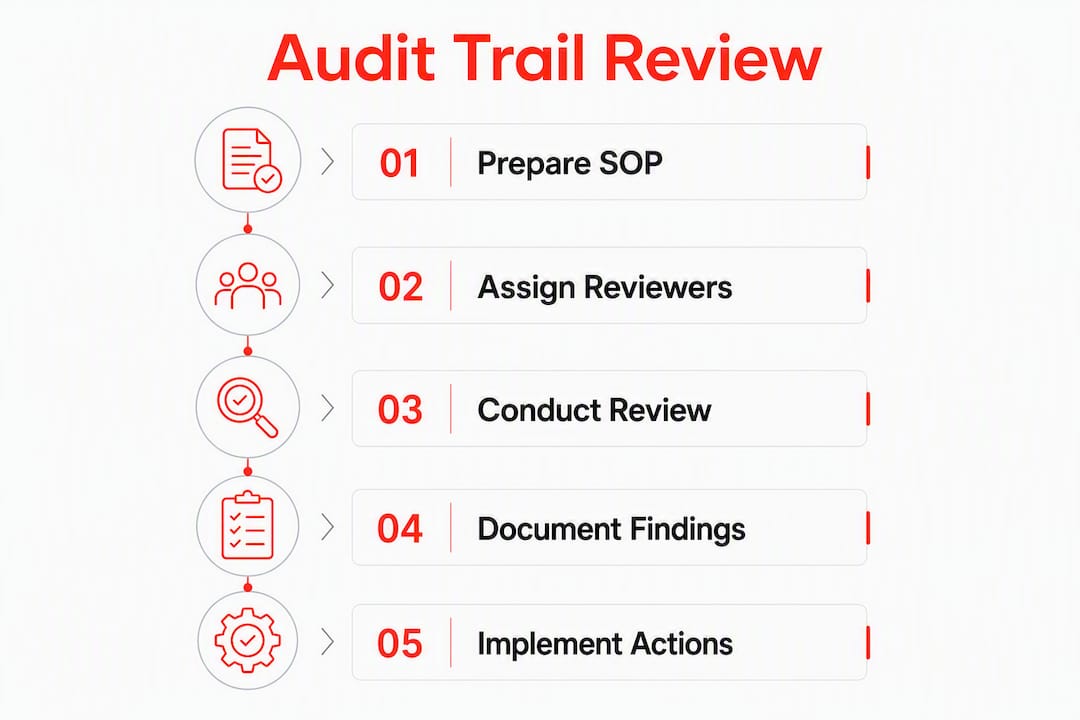
Generating a compliant audit trail is necessary but not sufficient. Audit-trail review is itself a regulated activity that must be scheduled, documented, and traceable within your quality management system.
- Define scope by risk tier. Identify which systems and workflows require periodic review. High-risk workflows (critical assays, calibration records, reagent lot changes) warrant frequent review. Per-batch review before release applies to analytical records as part of routine quality assurance. Low-risk administrative records may be reviewed periodically.
- Assign qualified reviewers. Second-person review must be performed by QA personnel or experienced users who did not generate the original record. Reviewers need read-only access to prevent inadvertent modification.
- Document review criteria. Your SOP must specify what constitutes an anomaly, how reviewers document their findings, and what electronic sign-off looks like inside the system.
- Establish escalation and CAPA linkage. When anomalies appear, the SOP must define the investigation pathway, who is notified, and how findings connect to your corrective and preventive action process.
- Archive review evidence. Documented review outcomes must be retained alongside the audit trail itself, aligned to the record's retention schedule.
- Train and verify competency. Reviewer training must cover the specific system, the review criteria, and how to escalate. Competency verification should be documented before a reviewer performs independent reviews.
Pro Tip: Maintain a short, system-specific SOP for audit-trail review for each application rather than one generic SOP covering all systems. Because implementations vary by vendor, a single generic SOP rarely maps accurately to any individual platform's interface or export format.
How do you validate audit-trail functionality before go-live?
Validation evidence is what separates a system that works from one you can defend during an inspection. Use IQ/OQ/PQ-style acceptance criteria mapped directly to 21 CFR Part 11 and ALCOA+.
- Define acceptance criteria first. Each criterion must map to a specific regulatory requirement: unique user ID attribution, non-editable entries, time fidelity to the nearest second, reason-for-change capture, and retention aligned to record lifecycle.
- Execute core test cases. Create, modify, and delete a regulated record, then verify the audit trail captures who, what, when, and why, and that prior values are preserved. Attempt a clock change and confirm the system rejects or flags it. Export the audit trail and confirm readability.
- Test separation of trails. Verify that system-level events (account creation, configuration changes) and data-level events (record edits) appear in distinct, separately exportable logs.
- Validate backup and restore. Perform a restore from backup and confirm the audit trail is complete, readable, and matches the primary record.
- Document all evidence. Retain exportable audit-trail reports, SOPs for review, training records, and test scripts with pass/fail results. Inspectors expect a traceability matrix linking each regulatory requirement to the system function, test case ID, and validation evidence.
| Regulatory Requirement | System Function | Test Case | Acceptance Criterion |
|---|---|---|---|
| Unique user attribution (21 CFR Part 11) | User ID stamped on every entry | Create record as User A; verify ID in trail | User A's ID appears; no anonymous entries |
| Non-editable entries (ALCOA+ accurate) | Immutable log storage | Attempt to edit audit entry; verify rejection | Edit attempt blocked; original entry unchanged |
| Contemporaneous timestamp | Controlled clock source | Modify record; verify timestamp matches system clock | Timestamp within 1 second of controlled clock |
| Reason-for-change capture | Mandatory change-reason field | Modify a field; verify reason captured | Reason-for-change present in audit entry |
| Readable export | PDF/print export function | Export full audit trail; open on standalone viewer | All entries legible; no proprietary viewer required |
Revalidation is required after major upgrades, configuration changes, or integration additions. Build that trigger into your change-control SOP.
What does a realistic implementation timeline look like?
Before you evaluate vendors, inventory every system that holds dynamic electronic records, map data flows, and identify high-risk processes that need immediate attention. That gap analysis drives your functional requirements list.
| Phase | Activity | Typical Weeks | Expedited Weeks |
|---|---|---|---|
| Requirements | FR list, risk-tier mapping, regulatory gap analysis | Several weeks | A shorter timeframe |
| Procurement | Vendor evaluation, 21 CFR Part 11 mapping review | Several weeks | A shorter timeframe |
| Configuration | System setup, access controls, integration (HL7/FHIR) | Several weeks | A shorter timeframe |
| Validation | IQ/OQ/PQ execution, test scripts, traceability matrix | Several weeks | A shorter timeframe |
| Training & SOP rollout | Reviewer training, SOP publication, competency sign-off | About a week | Less than a week |
| Go-live | Validated export, backup test, reviewer accounts confirmed | About a week | Less than a week |
| Total | Several weeks to a few months | A compressed schedule in a few weeks |
Expedited timelines of 3–4 weeks are realistic for white-label integrations with pre-built validation artifacts. Labs launching a PGx reporting service with a platform that ships validation documentation can compress the procurement and configuration phases significantly.
Go-live readiness requires: validated export confirmed, backup and restore tested, reviewer accounts configured with read-only permissions, SOPs published and version-controlled, and training records complete.
How does Signalpgx support audit-trail compliance for labs?
Signalpgx maps its platform architecture directly to the compliance attributes auditors expect. For labs deploying pharmacogenomics reporting, the platform provides:
- Automatic audit generation: every report creation, modification, and delivery event is logged without manual intervention
- Immutable entries: audit records cannot be edited or deleted after capture; prior values are retained alongside current ones
- Reason-for-change capture: the platform records the rationale for any modification to a report or interpretation
- Medical-director review documentation: physician review and sign-off are recorded electronically within the system, satisfying second-person review requirements
- HL7/FHIR integration: EHR connectivity via FHIR and CDS Hooks maintains cross-system traceability without manual re-entry
- Encrypted backups and security controls: HIPAA-compliant storage with integrity-checked backups aligned to record retention requirements
| Compliance Dimension | Signalpgx Capability |
|---|---|
| 21 CFR Part 11 readiness | Automatic, non-disableable audit generation; unique user attribution |
| Auditability (who/what/when/why) | Full event capture with prior values and reason-for-change |
| Integration (LIMS/EHR) | HL7/FHIR APIs; CDS Hooks for EHR delivery |
| Operational workflows | In-system medical-director review and second-person sign-off |
| Security and retention | HIPAA-compliant encryption; integrity-checked backups |
| Deployment and validation support | 5–7 day deployment; validation artifacts available on request |
Key Takeaways
A compliant lab audit trail requires immutable, automatic, and attributable records tied to 21 CFR Part 11, with documented second-person review and validated export capability.
| Point | Details |
|---|---|
| Immutability is non-negotiable | Audit entries must be non-editable and preserve prior values; any system that allows edits fails Part 11. |
| Second-person review must be electronic | In-system reviewer sign-off is required; paper logs do not satisfy inspector expectations. |
| Separate system and data trails | Keeping configuration logs distinct from analytical record logs simplifies review, archiving, and restoration. |
| Validate before go-live | Execute IQ/OQ/PQ test cases, retain a traceability matrix, and confirm readable exports before accepting the system. |
| Signalpgx for PGx labs | Signalpgx delivers automatic audit generation, medical-director review documentation, and HL7/FHIR integration within a 5–7 day deployment window. |
What compliance officers consistently underestimate about audit trails
The most common inspection failure is not a missing feature. It is a system that technically generates an audit trail but cannot demonstrate that anyone reviewed it. Inspectors ask for review evidence, and labs hand over a printout with no electronic sign-off, no escalation record, and no SOP that maps to the actual software interface. That gap is more damaging than a configuration deficiency because it signals a quality culture problem, not just a technical one.
The second underestimated risk is the audit trail that can be turned off. Administrators sometimes disable logging during performance troubleshooting or upgrades, believing they will re-enable it before an inspection. That decision, even if temporary, is a direct Part 11 violation and a frequent source of warning letters.
My prioritized remediation order: secure your backups and confirm immutability first, because those are the hardest to retrofit. Then build your reviewer SOPs and train your team on the specific system, not a generic procedure. Integration validation and automated export testing come last, but they must be completed before go-live, not after. Legacy systems without native audit trails should be replaced, not patched with paper workarounds. The goal, as the data-integrity literature frames it, is to reduce the gap between observation and contemporaneous capture so records remain faithful to what actually happened.
Signalpgx gives your lab a compliance-ready audit foundation
Your acceptance checklist now has a concrete counterpart. Signalpgx delivers the technical controls your compliance officer needs: automatic, immutable audit generation, in-system medical-director review, reason-for-change capture, and HL7/FHIR integration, all within a deployment window of 5–7 days. Labs that need to move quickly from gap analysis to validated go-live can request pre-built validation artifacts rather than building test scripts from scratch.

Review the full platform capabilities on the PGx reporting infrastructure page, compare subscription options on the pricing page, and confirm the platform's encryption and retention controls on the security page. When you are ready to evaluate Signalpgx against your functional requirements list, book a demo and request the validation artifact package.
Useful sources
- Audit Trail Requirements for a Digitalized Regulated Lab | Technology Networks: covers second-person review requirements, non-disableable audit trails, and in-system reviewer sign-off expectations
- LIMS Audit Trails: Automating Compliance Documentation for Regulatory Inspections | Lab Manager: covers ALCOA+ mapping, separation of system and data trails, automated generation, and scheduled review as a regulated activity
- Audit Trails in Lab Environments: Overview and Best Practices | Westbourne IT: covers backup security, immutability requirements, and routine review as a quality activity
- Audit Trail Requirements: A Guide for Modern Labs | VerbalExperiment: covers reconstructable context, prior-value visibility, and the principle of contemporaneous capture
- A HIPAA Compliance Checklist for Long-Term Care Facilities | MyLTC Apps: cross-reference for SOP and privacy controls applicable to healthcare compliance programs