
An audit trail in healthcare is a computer-generated, time-stamped record of every action taken on a patient's electronic data, and yes, a properly built one satisfies both HIPAA and ONC expectations. Before you move another line of policy, confirm your logs meet these six essentials:
- Computer-generated and automatic — no manual, editable, or paper-based substitutes
- Time-stamped with synchronized clocks — NTP or an equivalent trusted time source
- User identity captured — every action tied to a specific, authenticated individual
- Tamper-evident or immutable — alterations must be detectable, not just discouraged
- Restricted disable privileges — only a limited set of administrators can turn logging off
- Retention aligned to risk — a common industry practice is to retain audit logs for multiple years, but no single HIPAA rule sets a fixed retention period
Does HIPAA specify one mandatory retention period for audit logs? No. The Security Rule at 45 CFR § 164.312 requires "audit controls" that record and examine system activity, but it stops short of naming a duration. Many organizations default to a six-year minimum drawn from related documentation rules, while ONC certification criteria and ASTM E2147-18 fill in the technical specifics HIPAA leaves open. If your policy cites "HIPAA's retention requirement" as though it were a fixed number, that's the first thing to fix.
Key Takeaways
A defensible healthcare audit trail combines ONC's default-on logging requirement, ASTM E2147-18's field specifications, and a documented, risk-based review process that produces evidence, not just data.
| Point | Details |
|---|---|
| Confirm the six essentials | Verify your logs are computer-generated, time-stamped, user-identified, tamper-evident, disable-restricted, and retained per policy. |
| Map every data field | Capture user identity, timestamp, action type, patient identifier, location, and a pointer to prior state on every entry. |
| Adopt risk-based review | Reserve manual review for high-risk events like deletions and bulk exports; automate the rest. |
| Test before and after upgrades | Run modification, disable-attempt, and export test cases at go-live and after every system change. |
| Choose PGx infrastructure built for it | SignalPGx embeds audit trail support and medical-director review across genotype ingestion, evidence mapping, and report generation. |
Table of Contents
- What Counts as an Audit Trail in Healthcare?
- Why Healthcare Organizations Actually Need Audit Trails
- The Three Levels of Audit Trails and What to Log at Each
- HIPAA, ONC, and the Standards Behind a Defensible Log
- The Data Fields Every Healthcare Audit Log Needs
- Making Audit Logs Tamper-Evident and Trustworthy
- Running a Review Program That Doesn't Drown Your Team
- Building and Validating a Compliant Audit Trail: A Working Checklist
- Why Pharmacogenomics Reporting Raises the Audit-Trail Bar
- Common Audit Trail Mistakes That Trigger Inspection Findings
- A Compliance and Engineering Lead's Take on Making Audit Trails Stick
- How SignalPGx Builds Audit-Ready PGx Reporting Into the Platform
- Sources
- FAQ
What Counts as an Audit Trail in Healthcare?
An audit trail is not one file sitting on a server. It's a composite record, assembled from every system that touches protected health information, that reconstructs who did what, when, and to which record.
Three related terms get used interchangeably, and the confusion causes real policy gaps. An audit log is the raw, granular record generated by a system, event by event. An audit trail is the chronological sequence of those log entries stitched together around a patient, a user, or an incident. An audit report is the human-readable output, usually a query result, that compliance staff or investigators actually review. Confusing the three leads teams to assume that having a report on file means they have a defensible trail; it doesn't, if the underlying logs weren't captured correctly in the first place.
Logs get generated across a wider footprint than most compliance teams initially map:
- Electronic health record (EHR) platforms, at both the application and database layer
- Laboratory information management systems (LIMS) processing specimen and result data
- Instrument interfaces and middleware translating device output into structured records
- Health information exchange (HIE) endpoints and interface engines
- Identity and access management systems controlling login and authentication events
Not every system event belongs in an audit trail. The events that matter for healthcare compliance are the ones that touch patient data or the controls protecting it: viewing a record, creating or modifying an entry, deleting data, exporting or printing a report, copying information between systems, and changing security or configuration settings. A server reboot log is telemetry. A clinician opening a chart they weren't assigned to is an auditable event.
Why Healthcare Organizations Actually Need Audit Trails
Compliance officers often frame audit trails as a check-box requirement. That undersells what they actually do operationally, legally, and scientifically.
Operational use cases show up first during a security incident. When a breach investigation starts, the audit trail is often the only source that can answer "how far did this go?" Patient access reports, required under HIPAA's accounting-of-disclosures provisions, depend entirely on complete logs. Internal investigations into inappropriate record access, a persistent problem in hospitals with large, curious staffs, are unresolvable without them.
Regulatory and legal use cases matter just as much, if not more, when things go to litigation. Audit trails are frequently the deciding evidence in malpractice cases where the sequence of chart updates determines whether a clinician saw a lab result before or after a treatment decision. Regulators requesting evidence during a HIPAA compliance review will ask for the audit trail before they ask for anything else.
Quality and scientific use cases get less attention but matter enormously in laboratory and precision-medicine settings. Data integrity for lab results, and reproducible interpretation for pharmacogenomics, depend on being able to show exactly which genotype call, evidence source, and clinical guideline version fed into a specific report. Audit logs underpin the trustworthiness of that clinical evidence chain, not just the forensic record of who clicked what.
The Three Levels of Audit Trails and What to Log at Each
Audit trails split into three functional categories, and most organizations under-invest in one of them without realizing it.
System-level logs track infrastructure events: server access, network authentication, operating system changes, and database administration actions. These logs answer "was the environment itself compromised?"
Application-level logs track behavior inside a specific piece of software: EHR module access, report generation, workflow state changes. These answer "did the application behave as designed, and who used it?"
User-level (or data-level) logs track actions tied to a specific patient record: who viewed chart 4471, who modified the medication list, who exported the discharge summary. These answer the question regulators and plaintiffs' attorneys actually ask: "who touched this specific patient's data?"
| Audit Trail Category | Sample Events | Typical Source Systems |
|---|---|---|
| System-level | Server login, OS patch, network authentication failure | Operating systems, firewalls, identity providers |
| Application-level | Report generated, workflow status changed, module accessed | EHR, LIMS, middleware, interface engines |
| User/data-level | Record viewed, field modified, result exported, chart printed | EHR, LIMS, HIE gateways, patient portals |
Prioritizing what to retain and review comes down to blast radius. A failed login attempt on a workstation is low stakes. A bulk export of patient records at 2 a.m. is high stakes. Weight your review and retention effort toward events where unauthorized action causes the most damage, not toward whichever events happen to be easiest to query.
HIPAA, ONC, and the Standards Behind a Defensible Log
The regulatory picture for healthcare audit trails is layered, and each layer covers a gap the one below it leaves open.
At the foundation, the HIPAA Security Rule at 45 CFR § 164.312 requires "audit controls," meaning mechanisms that record and examine activity in systems containing protected health information. It's deliberately technology-neutral. It tells you that you need audit controls; it does not tell you what fields to capture or how long to keep them.
That's where ONC steps in. The ONC Cures Act Final Rule under §170.315(d)(10) requires certified health IT to record actions on electronic health information by default, restrict who can disable auditing where the technology allows it, detect whether logs have been altered, and support synchronized timestamps. This is the criterion that turns "have audit controls" into a testable engineering requirement.
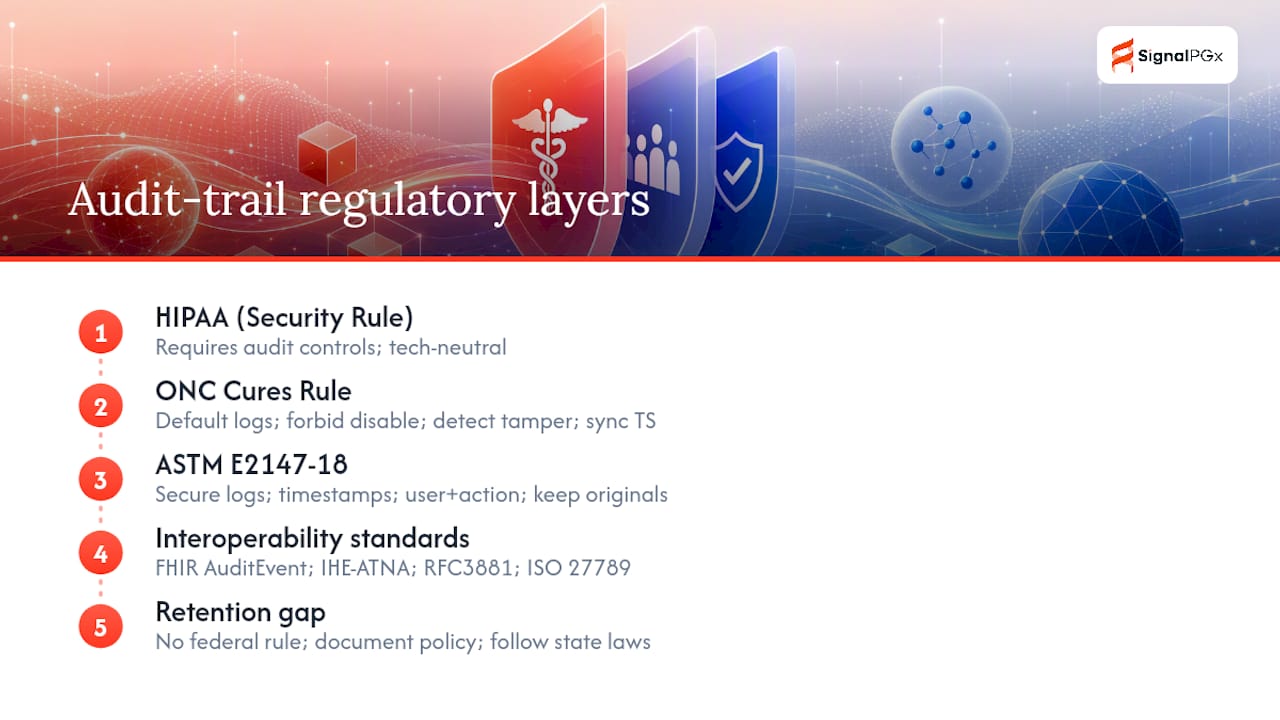
ASTM International's E2147-18 standard is the technical specification ONC references for what those logs must actually contain: secure, computer-generated, time-stamped records that capture user identity and action, and that never obscure the original data underneath a modification.
For interoperability, HL7's FHIR AuditEvent resource, along with the older IHE-ATNA profile and RFC 3881 definitions, gives implementers a practical data model for capturing who, what, where, when, and why consistently across systems that need to exchange audit data, not just generate it locally. Internationally, ISO 27789:2021 offers a comparable framework specifying minimum audit elements for electronic health records.
The gap most compliance programs miss: HIPAA tells you audit controls are required. ONC and ASTM tell you what those controls must technically do. Neither one tells you how long to keep the resulting logs. That decision is yours to make; it needs to be documented, defensible, and consistent with any state-level retention statutes that apply to your organization.
A multi-year retention period is a common practice by analogy to HIPAA's documentation retention rule, but this is not a fixed statutory requirement specifically for audit logs.
The Data Fields Every Healthcare Audit Log Needs
A log entry that skips any of these fields creates a gap an investigator, auditor, or malpractice attorney will find eventually.
| Field | Purpose | Example Format |
|---|---|---|
| User identity | Ties the action to a specific authenticated person | Employee ID, not shared login |
| Date and time | Establishes sequence, NTP synced | timestamp with time zone |
| Action type | Distinguishes view from edit from delete from export | CREATE / READ / UPDATE / DELETE / EXPORT |
| Patient identifier | Links the event to the record affected | Medical record number, not name alone |
| Device or location | Shows where the action originated | Workstation ID, IP address, facility code |
| Pointer to prior state | Allows reconstruction of what changed | Link or hash reference to the previous record version |
| Reason or justification | Required for certain override or emergency-access events | Free-text or coded reason field |
Here's a simplified, synthetic example of what a compliant entry looks like in practice:
2026-03-12T14:32:07Z | user: rjacobs_md | action: UPDATE | patient: MRN-004471 | field: medication_list | prior_value_ref: rec_88213_v4 | new_value_ref: rec_88213_v5 | location: WS-ONCO-07 | reason: dose_adjustment
Notice the entry doesn't overwrite rec_88213_v4. It points to it. That pointer, not the new value alone, is what lets you reconstruct the chart's full history months or years later, which is exactly what ASTM E2147-18 means when it says an audit log must never obscure the original data.
Making Audit Logs Tamper-Evident and Trustworthy
Capturing the right fields is only half the job. If a log can be quietly edited after the fact, it has no evidentiary value, and no inspector will treat it as one.
Hashing is the baseline control. ONC and NIST point to SHA-2 family algorithms for generating cryptographic checksums of log entries, so any post-hoc alteration produces a detectable hash mismatch. Digital signatures add a second layer, tying the hash to a specific system or key so tampering can be traced.
Write-once storage removes the temptation entirely. WORM (write-once, read-many) storage or an immutable object store means the underlying record physically cannot be overwritten, only appended to. This is the difference between "we trust our admins not to edit logs" and "our admins cannot edit logs even if they wanted to."
Time synchronization protects the sequence, not just the timestamp. A log with a plausible-looking time that drifted from the actual clock is functionally unreliable for reconstructing an incident timeline. NTP synchronization against a trusted time source, checked periodically, is a small technical lift with outsized forensic value.
Access control around the audit function itself needs to be tighter than access control around the data it's watching. Very few administrators should have the ability to disable auditing, and every one of those disable events needs to generate its own audit entry. If your system can turn off logging without logging that it happened, you have a blind spot regulators will find.
Pro Tip: Run a quarterly test where a designated engineer attempts to disable audit logging using a standard admin account. If it succeeds without triggering an alert and a corresponding log entry, you've found a real gap before an inspector does.
Retention and export planning round this out. Logs need to be retrievable in a legally usable format on short notice, whether for a litigation hold, a HIPAA compliance review, or an internal breach investigation. An audit trail that takes three weeks and a vendor support ticket to export isn't operationally different from one that doesn't exist.
Running a Review Program That Doesn't Drown Your Team
The mistake most compliance programs make is trying to review every log entry manually. That approach fails within a month at any organization above a certain size, and it produces reviewers who rubber-stamp entries out of fatigue rather than genuinely evaluating them.
A risk-based review model solves this by classifying data and events by potential impact, then applying technical controls to prevent low-value manual review of routine activity. Reserve human attention for the entries that actually carry risk.
Suggested review cadence by risk tier:
- High-risk events — deletions, bulk exports, permission escalations, after-hours access to VIP or sensitive records: review within 24 to 48 hours, ideally via automated alerting rather than a scheduled batch pull.
- Medium-risk events — routine record modifications, standard report generation, cross-department access: review weekly, sampled rather than exhaustive.
- Low-risk events — standard read access by assigned care team members, routine login activity: review monthly or on an exception basis only, relying on system-generated flags.
Documenting that a review happened matters as much as the review itself. Regulators increasingly expect systems to capture a second person's electronic sign-off on audit-trail review, stored inside the system itself rather than printed out and filed. A paper printout with a handwritten initial is treated, in most modern inspection frameworks, as weaker evidence than an in-system reviewer log with its own timestamp.
Building and Validating a Compliant Audit Trail: A Working Checklist
Turning policy language into an inspectable, working audit trail follows a fairly predictable sequence. Skipping steps here is the single most common reason organizations fail an audit-trail review during a HIPAA compliance assessment.
- Write the policy first. Define what counts as an auditable event, who reviews logs, at what cadence, and where retention decisions come from, before touching configuration.
- Map every system generating patient data events. EHR, LIMS, middleware, HIE gateways, and any instrument interface that writes to a patient record.
- Configure logging to default-on, per ONC §170.315(d)(10), with disable privileges restricted to a named, small administrator group.
- Enable hashing or a digital-signature mechanism on log storage, and confirm NTP synchronization across every system generating timestamps.
- Run validation test cases before go-live:
- Generate a modification and confirm the prior value is preserved via pointer, not overwritten
- Attempt to disable logging with a standard admin account and confirm it fails or triggers its own audit entry
- Export a log and confirm it's human-readable and machine-parseable without vendor assistance
- Attempt to backdate or edit an existing entry and confirm the hash check flags it
- Set retention rules explicitly, cross-checked against any state-specific medical record retention statutes that exceed the federal baseline.
- Establish the review cadence and sign-off workflow, with reviewer outcomes stored in-system.
- Repeat validation testing after every major upgrade, since a vendor patch that silently changes logging behavior is one of the more common causes of an inspection finding.
For go-live, a reasonable acceptance bar is: zero failed test cases across the four validation scenarios above, documented reviewer sign-off workflow live and tested, and retention policy signed off by both compliance and legal. Post-upgrade, re-run the same four test cases before considering the system production-ready again.
Why Pharmacogenomics Reporting Raises the Audit-Trail Bar
Pharmacogenomics (PGx) reporting adds a layer of complexity that a standard EHR audit trail wasn't necessarily designed for. A PGx report isn't a single data entry; it's the output of a pipeline that pulls genotype data, maps it against clinical evidence from multiple guideline sources, and applies interpretation logic that can change as those guidelines evolve.
That means your audit trail needs to reconstruct more than "who viewed this report." It needs to answer: which genotype call fed this interpretation, which version of the clinical evidence was active at the time, and did the recommendation change after a living reanalysis updated the underlying guidance? SignalPGx's living reanalysis model, which updates recommendations as CPIC and FDA guidance evolve, only works as a defensible clinical tool if every version change is logged with a clear pointer back to what the report said before and why it changed.
Labs building or evaluating a PGx reporting pipeline should think about audit trails at each pipeline stage separately: genotype ingestion, evidence mapping against the unified evidence source, interpretation logic, and final report generation. A gap at any one stage breaks the chain of custody a regulator or a plaintiff's attorney would need to trust the final output.
A few practical points specific to LIMS and clinical decision support (CDS) environments:
- Keep system-level audit trails (instrument, middleware, network) separate from data-level trails (genotype records, interpretation changes) so a review of one doesn't require wading through the other.
- Build in second-person review for high-stakes interpretation changes, with electronic sign-off captured inside the reporting system rather than in a separate spreadsheet.
- Treat every report regeneration triggered by a guideline update as its own auditable event, not a silent overwrite.
Automated, system-generated audit trails have become the expectation, not the exception, wherever dynamic electronic records exist. A manual logbook backing up a genomics pipeline is a red flag to any inspector who's seen a modern LIMS audit trail work correctly.
Common Audit Trail Mistakes That Trigger Inspection Findings
Most audit-trail failures aren't dramatic breaches. They're quiet gaps that surface only when an inspector, plaintiff's attorney, or internal investigator actually goes looking.
- Audit logging gets disabled and nobody notices. If disabling auditing doesn't itself generate a log entry, the gap can persist for months before anyone catches it.
- Logs are technically editable. A system that stores logs in a standard, writable database table without hashing or WORM protection has a trail that a sufficiently motivated insider can quietly alter.
- No documented reviewer sign-off exists. Logs get generated but nobody can prove they were reviewed, or the "review" was a single person eyeballing a report once a year.
- Patient linkage is missing or inconsistent. Some systems log the action but not the specific patient record affected, which makes an access report legally useless.
- Retention policy is vague or contradicts state law. "We keep logs as long as HIPAA requires" isn't a policy if HIPAA doesn't specify a number and the organization hasn't cross-checked applicable state statutes.
- Manual, paper-based logs sit alongside electronic ones as a backstop. Regulators increasingly view this as a sign that the electronic system's logging can't be fully trusted on its own.
Each of these should trigger immediate remediation, not a note for the next policy review cycle. A log that can be disabled silently or edited without detection isn't a minor gap; it's the difference between having an audit trail and having a document that only looks like one.
A Compliance and Engineering Lead's Take on Making Audit Trails Stick
The technical requirements around audit trails are, honestly, the easier part to get right. Hashing algorithms, NTP sync, and field-level minimums are well documented, and any competent engineering team can implement them against ASTM E2147-18 and ONC's certification criteria without much ambiguity.
What consistently breaks down is the organizational commitment to keep the review program running once the initial validation passes. A risk-based, review-by-exception model works, but only if leadership resists the temptation to declare victory after go-live and stops treating the review cadence as optional overhead. Audit-trail readiness has to become a standing line item in every system upgrade, every vendor selection process, and every validation cycle, not a project that gets revisited only when an inspection notice arrives.
The organizations that handle this well treat audit-trail evidence the same way they treat any other clinical or quality record: something that gets produced continuously and reviewed on a schedule, not assembled retroactively when someone asks for it. That single habit, more than any specific hashing algorithm or retention number, is what separates a defensible audit trail from a decorative one.
How SignalPGx Builds Audit-Ready PGx Reporting Into the Platform
Labs launching a pharmacogenomics reporting service usually discover the audit-trail problem the hard way: building compliant, tamper-evident logging across genotype ingestion, evidence mapping, and report generation from scratch takes months most teams don't have.

SignalPGx is built with that gap closed from day one. The platform maintains medical-director review and audit trail support across the full reporting pipeline, so every report version, evidence update, and interpretation change is logged and reconstructable, not just the final output a physician signs off on. Living reanalysis, HL7/FHIR integration with existing EHR systems, and white-label deployment come with that same logging layer underneath, which matters most when a regulator or hospital compliance officer asks to see the trail behind a specific report. Details on how the platform handles logging, encryption, and HIPAA/GDPR compliance are on the security and compliance page. Labs typically go from contract to a branded, white-label PGx reporting service in five to seven days, audit trail included rather than bolted on later. If your team is evaluating what a compliant PGx reporting build actually requires, book a demo and walk through the logging architecture with SignalPGx directly.
Sources
Pull these documents directly when drafting policy language, validation packages, or SOPs, rather than relying on secondhand summaries.
- Healthit
- ASTM E2147-18 Standard Specification for Audit and Disclosure Logs for Use in Health Information Systems
- 45 CFR § 164.312 – Technical safeguards (audit controls) — eCFR
Labs working with outside laboratory partners on documentation and traceability should also look at how Certificates of Analysis get maintained for lab outputs, and how regulated environments handle ongoing compliance obligations beyond the initial validation phase.
This article is general information, not a substitute for advice from a qualified lawyer. Consult a qualified legal professional about your own circumstances before acting on anything here.
FAQ
What Does an Audit Trail Check For?
An audit trail checks who accessed, created, modified, deleted, or exported a patient record, and when. It doesn't police clinical judgment; it verifies the sequence and authorship of every action on the data itself.
What Is an Example of an Audit Trail in Healthcare?
A typical example is an EHR log entry showing a nurse viewed a patient's chart at a specific timestamp, followed by a physician's medication update logged with a pointer back to the prior medication list value. Chained together, those entries form the patient's full access and edit history.
Does HIPAA Require Audit Logs?
Yes. The HIPAA Security Rule at 45 CFR § 164.312 requires audit controls that record and examine system activity, though it does not name a specific retention period or exact field list, which ONC and ASTM E2147-18 fill in.
How Does an Audit Trail Work in Practice?
Systems generate a log entry automatically each time a defined event occurs, capturing user identity, timestamp, action type, and a pointer to the prior data state. Those entries accumulate into a chronological trail that reviewers, investigators, or auditors query later to reconstruct exactly what happened to a record.
How Long Should Healthcare Organizations Keep Audit Logs?
HIPAA doesn't set one universal number, but six years is common industry practice, often extended further to match state-specific medical record retention statutes.