
The quickest reliable path to pharmacogenomics in Allscripts/Veradigm is to ingest discrete, lab-interpreted PGx results via FHIR R4 or HL7 v2 interfaces into an EHR-integrated clinical decision support system, then surface those results at the point of prescribing through CDS Hooks or native medication CDS. The Murfreesboro Medical Clinic pilot, run on the 2bPrecise platform within an Allscripts workflow, showed what that looks like in practice: a high proportion of patients in a psychiatric cohort required a medication change once PGx insights appeared in the clinical workflow, and every one of those patients reported marked improvement.
Before you go further, confirm three things:
- Confirm lab output format and discrete mappings — know whether your lab returns VCF, star-allele XML, or structured JSON, and whether phenotype and metabolizer status are already discrete or still embedded in a PDF.
- Pick your delivery method — direct discrete result import, FHIR DiagnosticReport + Observation resources, or a CDS Hooks responder at order entry.
- Schedule a 4–8 week integration spike — a time-boxed discovery and prototyping sprint with your EHR analyst, interface developer, and a PGx clinical lead (ideally a clinical pharmacist).
Those three steps determine everything else in the project.
Key Takeaways
Integrating PGx into Allscripts/Veradigm requires discrete lab outputs, FHIR or HL7 transport, a CDS delivery layer, and a clinical validation process before any alert reaches a prescriber.
| Point | Details |
|---|---|
| Start with discrete results | Lab must return phenotype and metabolizer status as computable observations, not free-text PDF. |
| Use FHIR R4 or HL7 v2 transport | FHIR DiagnosticReport + Observation is the preferred path; HL7 ORU^R01 works for legacy feeds. |
| Deliver CDS at the prescribing screen | CDS Hooks at medication-prescribe produces the highest clinician uptake and medication-change rates. |
| Pilot in psychiatry or cardiology first | High density of CPIC level A gene-drug pairs yields measurable outcomes within a single sprint. |
| SignalPGx integration path | SignalPGx provides FHIR, CDS Hooks, living reanalysis, and a 4–8 week integration spike to production. |
Table of Contents
- How Allscripts PGx integration typically works: 2bPrecise and partner models
- Technical interfaces and data flow: how PGx results move into Allscripts
- Where PGx guidance appears in clinician workflows inside Allscripts
- Implementation checklist for IT and clinical teams
- Timeline, resourcing, and cost factors
- Privacy, consent, and governance for genomic data in EHRs
- What the Murfreesboro Medical Clinic pilot actually showed
- How SignalPGx supports Allscripts/Veradigm integration
- The case for starting narrow and validating fast
- SignalPGx: a purpose-built path to PGx in your EHR
- Sources
- FAQ
How Allscripts PGx integration typically works: 2bPrecise and partner models
Allscripts, now operating under the Veradigm brand for its EHR business, has pursued PGx delivery primarily through two channels: its subsidiary platform 2bPrecise and structured partner programs with specialized PGx vendors.

The 2bPrecise model is the most documented path. 2bPrecise is a cloud-based, EHR-agnostic platform that consumes genomic data from molecular labs, synthesizes it with clinical EHR information through a clinical-genomic ontology, and returns discrete, actionable observations back into the provider workflow. Its Genomic EHR Mentor (GEM™) surfaces those observations at the point of care. The platform was designed to be lab-agnostic and EHR-agnostic, which means it can normalize inputs from different genotyping sources and plug results directly into the native EHR workflow without requiring clinicians to leave their prescribing screen.
The partner model is illustrated by the Allscripts and Translational Software collaboration. That partnership automated an end-to-end PGx testing program covering ordering portal access, kit distribution through PWN Health, lab network routing for sample processing, and result access, all within a single integrated workflow. The program was initially deployed for Allscripts associates, but the architecture illustrates a replicable model for health systems: a knowledge vendor handles interpretation and CDS logic, while the EHR handles ordering and result display.
Key capabilities common to both models:
- Discrete test result consolidation from multiple lab sources
- Phenotype and metabolizer status mapped to computable EHR observations
- Population analytics for identifying patients with actionable PGx profiles
- Workflow delivery at prescribing screens, medication lists, and pharmacist queues
Technical interfaces and data flow: how PGx results move into Allscripts
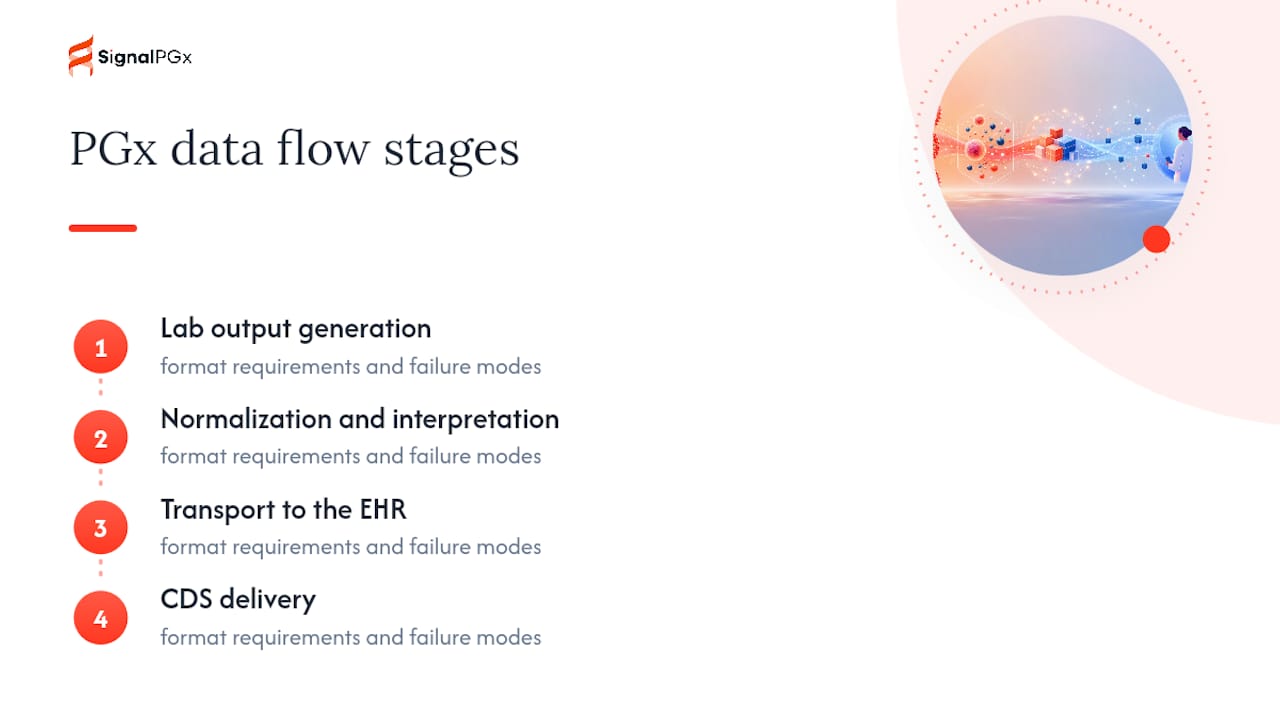
The data path from a genotyping lab to a clinician alert has four logical stages: lab output generation, normalization and interpretation, transport to the EHR, and CDS delivery. Each stage has its own format requirements and failure modes.
Lab output formats
Genotyping platforms, including high-throughput microarrays capable of analyzing hundreds to thousands of samples per week, typically produce one of three output types: raw VCF files with variant calls, star-allele reports with diplotype assignments, or structured XML/JSON messages with phenotype and metabolizer status already resolved. The further downstream the lab processes the result before sending it, the simpler the EHR-side mapping. Labs that return only VCF require a normalization layer to call star alleles, assign phenotype, and apply evidence grading before the data is usable by EHR CDS.
Interface patterns
Three transport patterns cover the majority of Allscripts PGx integrations:
- HL7 v2 discrete result messages (ORU^R01): the most common path for labs already sending results to Allscripts. PGx observations are encoded as discrete OBX segments with LOINC codes for gene, diplotype, phenotype, and evidence grade. Reliable, widely supported, but requires careful OBX segment design to make results computable rather than free-text.
- FHIR R4 DiagnosticReport + Observation resources: the preferred path for new integrations. A DiagnosticReport groups the panel; individual Observation resources carry gene-phenotype pairs with coded values. RESTful FHIR APIs support both push (lab posts to EHR FHIR endpoint) and pull (EHR polls lab FHIR server) patterns. The genotype-to-guidance pipeline maps cleanly onto this resource structure.
- CDS Hooks responder: a real-time pattern where the EHR calls an external CDS service at a defined hook point (typically
medication-prescribeororder-select). The responder queries the patient's stored PGx observations and returns cards with dosing guidance, interaction warnings, or alternative medication suggestions. This is the pattern that produces inline alerts at the prescribing screen.
Mapping checklist
| Stage | Input | Output | Key validation rule |
|---|---|---|---|
| Variant calling | VCF / raw genotype | Star allele diplotype | Confirm reference genome build |
| Phenotype assignment | Diplotype | Metabolizer status (e.g., Poor, Intermediate) | Validate against CPIC gene-phenotype tables |
| Evidence grading | Phenotype + drug | Evidence level (A–D or CPIC tier) | Cross-reference CPIC, FDA biomarker table, DPWG |
| EHR observation | Evidence-graded result | Discrete FHIR Observation or HL7 OBX | Confirm LOINC codes and value sets are computable |
| CDS delivery | Stored observation + active med list | Alert card or inline suggestion | Test against synthetic patients with known genotypes |
Pro Tip: When your lab or knowledge service updates phenotype assignments as guidelines evolve, every stored FHIR Observation should carry a meta.lastUpdated timestamp and a derivedFrom provenance reference. Without versioning, a clinician has no way to know whether the phenotype on file reflects last year's CPIC guidance or this year's. Living reanalysis only works if the EHR can distinguish a fresh result from a stale one. See living PGx reports for a detailed treatment of this pattern.
Where PGx guidance appears in clinician workflows inside Allscripts
The delivery point matters as much as the data. A PGx result buried in a discrete result tab is clinically inert. The same result surfaced as an inline suggestion at the prescribing screen changes prescribing behavior.
Common CDS delivery patterns
- Inline dosing suggestion at e-prescribe: when a clinician selects a drug, a CDS Hooks card appears with the patient's metabolizer status and a guideline-concordant dose recommendation. No navigation required.
- Pre-prescription interaction alert: a modal or banner fires when a clinician attempts to prescribe a drug with a known gene-drug interaction, flagging the interaction and suggesting an alternative.
- Longitudinal flag in the medication list: a persistent indicator on the medication list marks drugs where the patient's PGx profile warrants ongoing monitoring, even outside an active prescribing event.
- Pharmacist inbox item: a routed notification to the clinical pharmacist when a new PGx result arrives or when a medication change triggers a review need.
In ambulatory psychiatry, where antidepressant and antipsychotic selection is heavily influenced by CYP2D6 and CYP2C19 status, an inline CDS card at the prescribing screen is the highest-value delivery point. A clinician selecting sertraline for a CYP2C19 poor metabolizer can see the interaction and switch to an alternative in the same workflow step. In primary care, the longitudinal flag pattern is often more practical: patients carry multiple medications, and a persistent marker on the medication list lets the pharmacist review the full picture during a medication reconciliation visit.
Programs that embed PGx-certified ambulatory pharmacists alongside an EMR-integrated CDST consistently report higher uptake and more actionable recommendations than those relying on static reports alone.
Pro Tip: Alert fatigue is the single biggest adoption killer in PGx CDS. Tier your alerts by evidence level: CPIC level A recommendations fire as hard stops or prominent banners; level C or D interactions appear as passive flags or pharmacist-only notifications. Every alert should offer a concrete next step, either a suggested alternative medication or a dose adjustment, not just a warning. An alert that says "interaction detected" with no suggested action trains clinicians to dismiss it.
Implementation checklist for IT and clinical teams
A structured, phased approach prevents the most common failure modes: scope creep, undefined data ownership, and clinical validation gaps.
Discovery phase
- Assemble a RACI: identify the EHR analyst, interface developer, PGx clinical lead (pharmacist or physician), lab liaison, privacy officer, and project sponsor.
- Assess the lab interface: confirm output format (VCF, star-allele XML, structured JSON), transport method (SFTP, HL7 feed, FHIR endpoint), and whether phenotype is pre-resolved or requires a normalization layer.
- Define data ownership and consent model: determine who owns the genomic record, how consent is captured and stored, and whether the CDS responder must check consent status before firing.
- Select evidence sources: choose your guideline stack, typically CPIC, FDA biomarker labeling, and DPWG, and confirm the knowledge service or reporting platform that will apply them. See PGx guideline selection for a comparison of the three sources.
Integration phase
- Map lab outputs to FHIR Observation profiles or HL7 OBX segments, assigning LOINC codes for gene, diplotype, phenotype, and evidence grade.
- Configure message transport: SFTP batch for high-volume lab feeds, RESTful FHIR for real-time or near-real-time delivery.
- Build and configure the CDS Hooks responder or native medication CDS rules, including the hook points, prefetch templates, and card templates.
- Test responder logic against a synthetic patient library covering common genotypes (CYP2D6 poor metabolizer, CYP2C19 ultrarapid metabolizer, SLCO1B1 decreased function).
Clinical validation phase
- Run test patients through the full pipeline: lab result ingestion → discrete observation storage → CDS trigger → alert display.
- Conduct pharmacist review of alert content, evidence grading, and suggested alternatives.
- Define acceptance criteria: alert accuracy rate, false-positive threshold, and latency from result receipt to alert availability.
- Document a rollback plan: if CDS logic produces unexpected alerts in production, define the process to disable rules without disrupting the broader EHR.
Operational readiness
- Train prescribers and pharmacists on interpreting PGx alerts and acting on suggestions.
- Establish a monitoring dashboard: track alert fire rate, dismissal rate, and medication change rate post-alert.
- Schedule a reanalysis cadence: when CPIC or FDA updates a gene-drug guideline, define the process for updating stored phenotype observations and re-evaluating active medication lists.
Timeline, resourcing, and cost factors
Realistic timelines vary by scope, not by ambition.
- Small pilot (single department, one lab feed, 1–2 CDS rules): 4–8 weeks from discovery to go-live. Requires one EHR analyst, one interface developer, and a part-time PGx pharmacist.
- Departmental roll-out (psychiatry or cardiology, multiple CDS rules, pharmacist workflow): 3–6 months. Adds a clinical informaticist, QA resources, and a formal validation sprint.
- Enterprise staging (multi-department, multiple lab feeds, population analytics): 6–12 months. Requires a dedicated project manager, a PGx clinical lead, and a formal governance structure.
Cost drivers to budget for:
- Lab output normalization (if the lab returns VCF rather than pre-resolved phenotype, a normalization layer adds engineering time and potentially a knowledge service license)
- Interface engineering (HL7 or FHIR build, testing, and certification)
- CDS configuration and clinical validation (pharmacist time is often the most underestimated line item)
- Ongoing knowledge service or reporting platform license fees
- Maintenance: guideline updates, interface monitoring, and periodic reanalysis runs
For pharmacogenetic testing cost considerations on the patient and lab side, the cost structure differs from the IT integration budget but affects total program economics.
Pro Tip: Start with psychiatry or cardiology, not a broad multi-specialty launch. These specialties have the highest density of actionable CPIC level A gene-drug pairs, the clearest clinical champions, and the fastest path to a measurable outcome. A successful 8-week psychiatric pilot with documented medication-change rates gives you the evidence to fund the enterprise roll-out.
Privacy, consent, and governance for genomic data in EHRs
Genomic data carries a different risk profile than most clinical data. A medication allergy can be corrected; a genotype cannot be changed. Governance must reflect that permanence.
Governance checklist for your planning phase:
- Data classification: classify genomic data at the highest sensitivity tier your organization uses. Many institutions treat it as equivalent to or more sensitive than HIV status or behavioral health records.
- Consent capture and storage: define whether PGx consent is embedded in the general research or clinical consent, or whether it requires a separate, discrete consent record. Store consent status as a computable EHR element so CDS rules can check it before firing an alert.
- Access controls: restrict raw genomic data (VCF, diplotype) to authorized clinical and laboratory roles. Clinician-facing views should expose only phenotype, evidence grade, and recommendation, not raw variant data.
- Audit logging: log every access to genomic records, every CDS alert fired, and every alert dismissal. This supports both HIPAA compliance and clinical quality review.
- Retention policies: genomic data is longitudinal by nature. Define retention periods explicitly, and confirm whether your state or jurisdiction imposes specific genomic data retention rules beyond HIPAA minimums.
- Encryption: encrypt genomic data at rest (AES-256 or equivalent) and in transit (TLS 1.2+). Apply the same standard to any FHIR endpoints or SFTP channels used for lab result transport.
Patient consent status should map to a discrete FHIR Consent resource or an equivalent EHR flag, so the CDS Hooks responder can query it as part of the prefetch and suppress alerts for patients who have not consented to PGx-guided care.
What the Murfreesboro Medical Clinic pilot actually showed
The Murfreesboro Medical Clinic and SurgiCenter pilot is the most cited real-world precedent for Allscripts PGx integration, and the numbers are worth examining carefully.
In a psychiatric cohort where 2bPrecise integrated PGx results into the Allscripts clinical workflow, clinicians changed medication for 87% of patients after reviewing PGx insights. Every patient who received a medication change reported marked improvement in outcomes.
That result, documented in the Veradigm investor release, reflects a specific clinical context: a psychiatric population where CYP2D6 and CYP2C19 variants have well-established, CPIC level A gene-drug pairs. The medication-change rate is high because psychiatry has a high density of actionable interactions and because the pilot selected patients with confirmed PGx findings, not a general population.
What is replicable from that pilot: the lab-to-platform pipeline (lab sends discrete results to 2bPrecise, which normalizes and surfaces them in Allscripts), the workflow delivery model (clinician reviews PGx results within the native EHR screen), and the pharmacist-supported review process. What typically differs by site: the patient population, the mix of gene-drug pairs in scope, the consent model, and the CDS alert configuration.
A separate implementation report from a community hospital-associated primary care setting found that a large proportion of patients with detected pharmacogenomic interactions had alternate therapy recommendations available per guidelines, with a substantial share of assessed patients carrying at least one actionable medication interaction. That figure comes from a broader, multi-drug primary care context and is a more conservative benchmark for enterprise planning.
How SignalPGx supports Allscripts/Veradigm integration
SignalPGx is built for exactly the integration architecture this article describes: discrete lab results in, evidence-graded CDS out, delivered through the interfaces Allscripts already supports.
Integration capabilities:
- FHIR R4 DiagnosticReport and Observation resource generation, ready for push or pull transport to Allscripts FHIR endpoints
- CDS Hooks responder support, configured for
medication-prescribeandorder-selecthook points - HL7 v2 ORU^R01 output for labs and EHR environments that have not yet migrated to FHIR
- Medication intelligence graph that evaluates drug-gene and drug-drug-gene interactions across the patient's full medication list, not just single-drug lookups
Living reanalysis and evidence currency:
SignalPGx's living reanalysis engine monitors CPIC, FDA biomarker labeling, and DPWG for guideline updates and re-evaluates stored patient genotypes against updated evidence automatically. Every updated observation carries a new timestamp and provenance reference, so the EHR CDS always reflects current guidance.
Implementation services:
- Integration spike: a 4–8 week scoped engagement to prototype the lab feed, FHIR mapping, and CDS Hooks responder in your Allscripts environment.
- Data mapping support: field-level mapping documentation from your lab's output format to FHIR Observation profiles and HL7 OBX segments.
- Validation scripts: synthetic patient test cases covering common genotypes, used to verify alert accuracy before go-live.
- Clinical review workflows: white-label reporting with medical director review and audit trail, supporting pharmacist and physician sign-off on PGx reports.
- Production monitoring: alert fire rate, dismissal rate, and reanalysis event logging, available through the SignalPGx dashboard.
Compliance and security: SignalPGx is designed for HIPAA and GDPR compliance, with encryption at rest and in transit, role-based access controls, and a full audit trail. Details are available on the security and compliance page.
The white-label platform supports branded deployment for labs that want to offer PGx reporting under their own name, typically live within 5–7 days of configuration.
The case for starting narrow and validating fast
The most common mistake in PGx integration projects is designing for the enterprise before validating the workflow.
The Murfreesboro pilot worked partly because it started with psychiatry, a specialty with a small number of high-confidence gene-drug pairs and a clinical team already motivated to use PGx results. The primary care implementation cited above succeeded because it embedded a PGx-certified pharmacist in the workflow rather than expecting prescribers to interpret raw metabolizer status on their own.
My recommendation: define your first pilot around a single clinical use case, a single lab feed, and no more than five CDS rules covering CPIC level A gene-drug pairs. Validate clinician UX, measure alert acceptance rates, and document at least one medication change before you expand scope. A narrow pilot that produces a documented outcome is worth more than a broad integration that produces alert fatigue.
In the next 30–90 days, the most valuable steps are: schedule a discovery session with your lab to confirm output format and discrete mapping capability; identify your PGx clinical champion (a pharmacist or physician who will own clinical validation); and run a 4–8 week integration spike to prototype the FHIR feed and one CDS Hooks rule. Those three actions will tell you more about your real integration complexity than any vendor demo.
SignalPGx: a purpose-built path to PGx in your EHR
Labs and health systems that have worked through the technical checklist in this article often reach the same decision point: the interpretation layer, the living reanalysis engine, and the CDS Hooks responder are the hardest parts to build and maintain in-house. SignalPGx delivers all three as a subscription platform, with white-label PGx reporting that connects your lab's genotype output to Allscripts clinician workflows through FHIR and CDS Hooks, without requiring you to build and maintain a knowledge curation team.
The integration spike engagement gets your lab feed, FHIR mapping, and first CDS rule into a test environment within 4–8 weeks. From there, the living reanalysis engine keeps every stored patient observation current as CPIC and FDA guidelines evolve, and the medical director audit trail supports your clinical governance requirements. HIPAA and GDPR compliance controls are built in from day one. Review pricing and plans to scope the subscription for your lab's volume, or book a demo to walk through a sample FHIR mapping and a live CDS Hooks demonstration in a sandbox Allscripts environment.
Sources
- Murfreesboro Medical Clinic and SurgiCenter Partners with 2bPrecise for Precision Medicine (Veradigm investor release)
- Translational Software partners with Allscripts to provide pharmacogenomic testing service for U.S.-based associates (PR Newswire)
- Implementing comprehensive pharmacogenomics in a community hospital-associated primary care setting (implementation report)
This article is general information, not a substitute for advice from a qualified doctor. Consult a qualified healthcare professional about your own circumstances before acting on anything here.
FAQ
What is Allscripts called now?
Allscripts rebranded its EHR and health IT business as Veradigm. The Veradigm name covers the EHR platform, data, and analytics products previously sold under the Allscripts brand.
Are Allscripts and Veradigm the same company?
Yes. Veradigm is the rebranded identity for the Allscripts healthcare IT business. The underlying EHR platform and integration infrastructure are the same; the corporate and product branding changed.
Is PGx testing worth it for clinical integration?
Evidence from multiple implementation programs supports clinical value. The Murfreesboro pilot found that a high proportion of patients in a psychiatric cohort required a medication change after PGx results were integrated into the Allscripts workflow, with all of those patients reporting marked improvement. A separate primary care implementation found more than 80% of patients with detected interactions had guideline-concordant alternate therapies available.
What does a PGx test typically cost, and how does that affect the integration budget?
The lab test cost and the IT integration budget are separate line items. Pharmacogenetic testing costs vary by panel size, lab, and payer coverage. The integration budget covers interface engineering, CDS configuration, clinical validation, and ongoing knowledge service or platform license fees, none of which are included in the per-test price.
What technical standards does Allscripts PGx integration require?
The core standards are HL7 v2 (ORU^R01 discrete result messages), FHIR R4 (DiagnosticReport and Observation resources), and CDS Hooks for real-time decision support at order entry. LOINC codes are used to identify gene, diplotype, phenotype, and evidence grade as computable observations. CPIC, FDA biomarker labeling, and DPWG provide the evidence framework for CDS rule content.